1.1 Scarcity
Scarcity forces every person and society to choose. Learn the four economic resources, what each one earns, and how scarcity differs from a shortage.
Part 1 of 3 Why Every Choice Costs Something
Scarcity is the gap between unlimited wants and the limited resources available to satisfy them. Because resources are limited, every person, business and government has to choose what to do with the resources it has.
Most resources are scarce, even ones that seem plentiful. Clean water, a worker's hour and a hospital bed can each go to only one use at a time. A city council with $2 million can repave roads or build a library branch. Choosing one leaves the other unbuilt.
Scarcity leads every economy to answer three questions. What goods and services will it produce? How will it produce them? Who will receive them?
Every choice has a cost because a resource used for one purpose cannot serve another at the same time. Economists call that cost opportunity cost, and Topic 1.2 measures it. Scarcity applies to time as well as to things. A student with four free hours after school can work, study, practice an instrument or rest. Every hour spent on one activity is an hour taken from the others.
Part 2 of 3 The Four Economic Resources
Economic resources are the inputs that make every good and service. Economists sort them into four groups, often called the factors of production.
| Resource | What it includes | Example | Payment it earns |
|---|---|---|---|
| Land | Natural resources | Farmland, rivers, iron ore | Rent |
| Labor | Human effort, physical and mental | A welder, a teacher, a coder | Wages |
| Capital | Tools, machines and buildings made by people | A forklift, a laptop, a warehouse | Interest |
| Entrepreneurship | Organizing the other three and taking the risk | A founder who opens a repair shop | Profit |
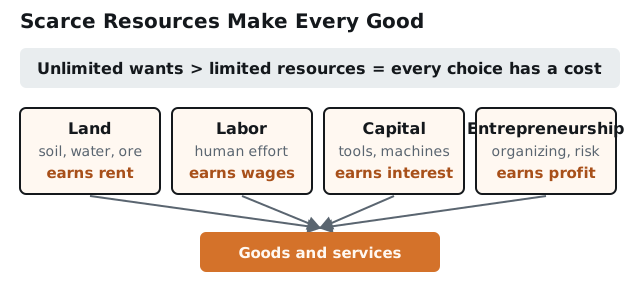
Goods are physical products, such as shoes and laptops. Services are tasks done for someone, such as a haircut or a bus ride. Both use up resources. A haircut uses the barber's labor, the chair and scissors as capital, and the shop's lot as land. The owner's entrepreneurship brings those inputs together.
Part 3 of 3 Scarcity and Shortage
Students often swap these two words. The table separates them.
Scarcity is permanent. A shortage ends when the price adjusts.
A shortage in one market can end when the price rises. Scarcity cannot end. A wealthy country with every market in equilibrium still has to decide how to use its land, labor, capital and entrepreneurship.
Key Terms
Practice Questions
6 questions. Nothing here is recorded or scored.
- Question 1MOD-1.A.1
Which of the following best describes scarcity?
- A.The condition in which a market price is set below equilibrium
- B.The condition in which wants exceed the resources available to satisfy them
- C.The condition in which a country has used up a natural resource
- D.The condition in which only poor households must make choices
Check answerHide answer
Answer: B
- A.
- That describes a shortage in one market. Scarcity exists at every price and in every market.
- B.
- Correct. Scarcity is the permanent gap between unlimited wants and limited resources, which is why every economy must choose.
- C.
- Running out of a resource is one extreme case. Scarcity applies to resources that still exist in large amounts, such as labor hours.
- D.
- Scarcity affects every person, business and government, whatever their income.
- Question 2MOD-1.A.1
A furniture maker in the example town of Lindcrest buys a new computer-controlled saw to cut table legs. In economics, the saw is an example of which resource?
- A.Land
- B.Labor
- C.Capital
- D.Entrepreneurship
Check answerHide answer
Answer: C
- A.
- Land covers natural resources such as timber and soil. The saw was made by people.
- B.
- Labor is human effort. The saw is a tool that workers use.
- C.
- Correct. Capital is a tool, machine or building made by people and used to produce other goods. The saw fits that definition.
- D.
- Entrepreneurship is the organizing and risk taking of the owner. The saw is one of the inputs the owner organizes.
- Question 3MOD-1.A.1
Which of the following is an example of the payment earned by entrepreneurship?
- A.The profit a founder keeps after paying all costs of a new bike shop
- B.The wages a mechanic earns for repairing bikes
- C.The rent a landowner receives for the shop's lot
- D.The interest a lender earns on the shop's equipment loan
Check answerHide answer
Answer: A
- A.
- Correct. Entrepreneurship earns profit, the reward for organizing resources and bearing the risk of a venture.
- B.
- Wages are the payment to labor.
- C.
- Rent is the payment to land.
- D.
- Interest is the payment connected to capital.
- Question 4MOD-1.A.1
Which of the following statements about money is correct in economics?
- A.Money is a form of capital because it buys machines.
- B.Money is land because it is a store of natural wealth.
- C.Money is not one of the four economic resources, though it can buy them.
- D.Money is entrepreneurship because owners supply it.
Check answerHide answer
Answer: C
- A.
- Capital means the physical tools and machines themselves. Money pays for capital, so it is not capital.
- B.
- Land is natural resources. Money is not a natural resource.
- C.
- Correct. The four economic resources are land, labor, capital and entrepreneurship. Money is used to purchase them and is not itself an input to production.
- D.
- Entrepreneurship is the organizing and risk-taking effort. Supplying funds is a financial act, separate from that effort.
- Question 5MOD-1.A.1
The example country of Ferrowan has enough doctors to staff either 40 new rural clinics or 25 new city hospital wards this year, but not both. Which concept best explains why Ferrowan must choose?
- A.Shortage
- B.Inflation
- C.Absolute advantage
- D.Scarcity
Check answerHide answer
Answer: D
- A.
- A shortage happens in a market when price sits below equilibrium. Ferrowan's problem is a limit on doctors, whatever the price.
- B.
- Inflation is a rise in the general price level. Nothing in the scenario involves prices.
- C.
- Absolute advantage compares two producers' output. Ferrowan is choosing between two uses of its own resources.
- D.
- Correct. Doctors' time is a limited resource with competing uses. That limit is scarcity, and it forces the choice between clinics and wards.
- Question 6MOD-1.A.1
Which of the following correctly distinguishes scarcity from a shortage?
- A.Scarcity ends when prices rise, while a shortage lasts forever.
- B.Scarcity affects only goods, while a shortage affects only services.
- C.Scarcity is permanent and applies to all resources, while a shortage is temporary and ends when price rises to equilibrium.
- D.Scarcity and a shortage both describe a market price set too low.
Check answerHide answer
Answer: C
- A.
- The timing runs the other way. A shortage ends when price adjusts; scarcity never ends.
- B.
- Both concepts apply to goods and services alike.
- C.
- Correct. Scarcity is the lasting gap between wants and resources. A shortage is a market condition at a price below equilibrium, and it disappears as the price rises.
- D.
- Only a shortage is tied to a price below equilibrium. Scarcity exists at every price.
Practice every topic in Unit 1
CED Codes
MOD-1.A.1