1.2 Opportunity Cost and the Production Possibilities Curve (PPC)
Use the production possibilities curve to show trade-offs, efficiency and growth, and calculate opportunity cost from a PPC graph or a table.
Part 1 of 4 What the PPC Shows
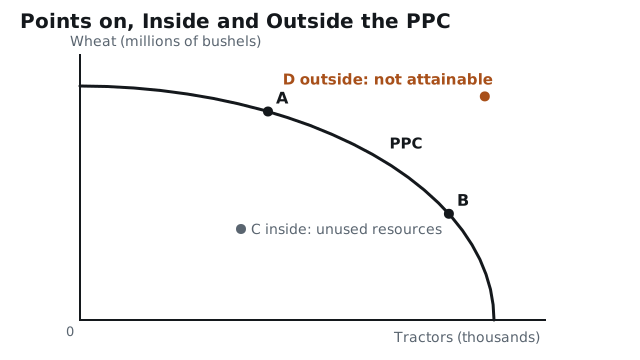
The production possibilities curve (PPC) shows every combination of two goods an economy can make when it uses all its resources and current technology. The curve is the edge of what the economy can produce.
Every PPC rests on three assumptions. The economy makes only two goods. Its resources and technology are fixed for the moment. It uses those resources fully. Under those assumptions, making more of one good means making less of the other. That is a trade-off.
| Point | Position | Meaning |
|---|---|---|
| A or B | On the curve | Efficiency: all resources are in use |
| C | Inside the curve | Inefficiency: some resources are unemployed or underused |
| D | Outside the curve | Not attainable with current resources and technology |
Part 2 of 4 Calculating Opportunity Cost
Opportunity cost is the value of the next best alternative given up. On a PPC, the opportunity cost of more of one good is the amount of the other good the economy gives up.
| Combination | Tractors (thousands) | Wheat (millions of bushels) | Wheat given up for the next 1,000 tractors |
|---|---|---|---|
| A | 0 | 20 | 1 |
| B | 1 | 19 | 2 |
| C | 2 | 17 | 3 |
| D | 3 | 14 | 4 |
| E | 4 | 10 | 5 |
| F | 5 | 5 |
Moving from C to D adds 1,000 tractors and costs 3 million bushels of wheat. Each tractor costs 3,000 bushels. Moving from D to E costs 4 million bushels for the same 1,000 tractors, so the cost per tractor keeps rising.
Part 3 of 4 The Shape of the Curve
| Shape | Opportunity cost | Why |
|---|---|---|
| Bowed out from the origin | Increasing opportunity cost | Resources are specialized. Farmland and farmers moved into tractor plants produce fewer tractors than factory workers do. |
| Straight line | Constant opportunity cost | Resources are equally good at making both goods. |
| Bowed in toward the origin | Decreasing opportunity cost | Each extra unit costs less of the other good, which is rare. |
Increasing opportunity cost is the most common case. The first tractors use the workers and land least suited to wheat, so wheat output barely drops. The last tractors pull in the best wheat farms and the most skilled farmers, so each of those tractors costs far more wheat.
Tarrow's curve bows outward because its costs rise from 1 to 5 million bushels per 1,000 tractors.
Part 4 of 4 Growth and Contraction
The PPC shifts when the economy's capacity changes. More land, labor, capital or entrepreneurship shifts the curve outward. So does better technology or higher productivity. That outward shift is economic growth. A war, a disaster or a shrinking workforce shifts the curve inward, which is contraction.
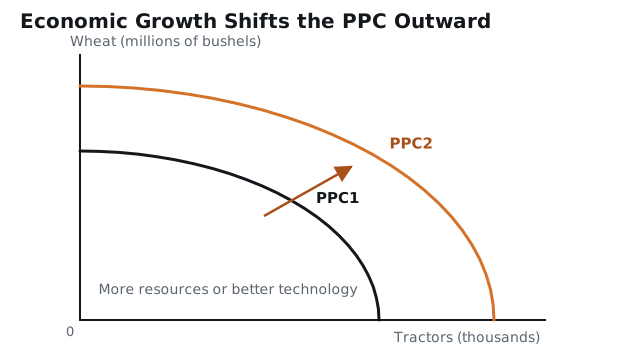
A new technology for only one good, such as a faster tractor assembly line, moves only that good's end of the curve outward. The curve pivots outward along the tractor axis.
Key Terms
Practice Questions
6 questions. Nothing here is recorded or scored.
- Question 1MOD-1.B.2
Brennick's Production Possibilities
The example country of Brennick produces only bicycles and scooters. The table shows five combinations Brennick can make with full use of its resources and technology.
Combination | Bicycles | Scooters A | 0 | 60 B | 10 | 55 C | 20 | 45 D | 30 | 30 E | 40 | 0 Based on the table, what is the opportunity cost of increasing bicycle production from 20 to 30?
- A.10 scooters
- B.15 scooters
- C.30 scooters
- D.45 scooters
Check answerHide answer
Answer: B
- A.
- Ten is the number of bicycles gained. The cost is measured in scooters given up.
- B.
- Correct. Moving from C to D, scooter output falls from 45 to 30. The 10 extra bicycles cost 15 scooters.
- C.
- Thirty is the number of scooters still produced at D. The cost is the amount given up, 45 minus 30.
- D.
- Forty-five is the scooter output at C. The cost is the change in scooters, which is 15.
- Question 2MOD-1.B.3
Brennick's Production Possibilities
The example country of Brennick produces only bicycles and scooters. The table shows five combinations Brennick can make with full use of its resources and technology.
Combination | Bicycles | Scooters A | 0 | 60 B | 10 | 55 C | 20 | 45 D | 30 | 30 E | 40 | 0 Based on the table, which statement about Brennick's PPC is correct?
- A.The PPC is a straight line because each 10 bicycles costs the same number of scooters.
- B.The PPC is bowed inward because the opportunity cost of bicycles falls.
- C.The PPC shows constant opportunity cost between combinations A and E.
- D.The PPC is bowed outward because the opportunity cost of bicycles rises as more are made.
Check answerHide answer
Answer: D
- A.
- The cost is not constant. Each 10 bicycles costs 5, then 10, then 15, then 30 scooters.
- B.
- A bowed-in curve needs falling costs. Brennick's costs rise.
- C.
- Constant cost would mean equal scooter losses for each 10 bicycles. The losses grow from 5 to 30.
- D.
- Correct. Each additional 10 bicycles costs more scooters (5, 10, 15, 30). Rising opportunity cost bows the PPC outward from the origin.
- Question 3MOD-1.B.2
Brennick's Production Possibilities
The example country of Brennick produces only bicycles and scooters. The table shows five combinations Brennick can make with full use of its resources and technology.
Combination | Bicycles | Scooters A | 0 | 60 B | 10 | 55 C | 20 | 45 D | 30 | 30 E | 40 | 0 Brennick produces 20 bicycles and 30 scooters. Which of the following best describes this combination?
- A.It is inefficient, because Brennick could make 20 bicycles and 45 scooters.
- B.It is efficient, because it is on the PPC.
- C.It is unattainable with Brennick's current resources.
- D.It shows economic growth.
Check answerHide answer
Answer: A
- A.
- Correct. At 20 bicycles the PPC allows 45 scooters. Making only 30 leaves resources unused or misused, so the point lies inside the curve.
- B.
- Combination C on the curve pairs 20 bicycles with 45 scooters. A point with fewer scooters sits inside the curve.
- C.
- Brennick can make 20 bicycles and 45 scooters, so 20 and 30 is well within reach.
- D.
- Growth shifts the whole PPC outward. A point inside the existing curve shows no growth.
- Question 4MOD-1.B.4, MOD-1.B.5
Which of the following would shift a country's production possibilities curve outward?
- A.A rise in the unemployment rate
- B.A move from a point inside the curve to a point on the curve
- C.An increase in the size of the labor force
- D.A shift of workers from one good to the other
Check answerHide answer
Answer: C
- A.
- Higher unemployment moves production to a point inside the curve. The curve itself stays put.
- B.
- That move uses idle resources. It does not change what the economy could produce at full use.
- C.
- Correct. More labor raises the economy's capacity to produce both goods, which shifts the PPC outward.
- D.
- Reallocating workers moves the economy along the existing curve.
- Question 5MOD-1.B.4
A new process doubles the number of solar panels each factory can produce but has no effect on the production of corn. On a PPC with solar panels on the horizontal axis and corn on the vertical axis, what happens?
- A.The whole curve shifts outward by the same amount along both axes.
- B.The curve pivots outward along the solar panel axis, and the corn intercept stays the same.
- C.The curve pivots outward along the corn axis, and the solar panel intercept stays the same.
- D.The curve does not move, and the economy moves to a point outside it.
Check answerHide answer
Answer: B
- A.
- An equal outward shift needs gains for both goods. Corn production did not change.
- B.
- Correct. If every resource went to corn, output would be unchanged, so the corn intercept stays put. Maximum solar output rises, so the curve swings outward along the solar axis.
- C.
- This gets the axes backward. The gain is in solar panels, on the horizontal axis.
- D.
- A technology gain changes what the economy can produce, so the curve itself moves.
- Question 6MOD-1.B.2
A student can spend Saturday working a shift that pays $90, studying for a test or attending a free concert. She values the concert most and the shift second. What is the opportunity cost of going to the concert?
- A.The $90 shift plus the time she could have spent studying
- B.Studying for the test
- C.Nothing, because she chose what she values most
- D.The $90 shift she gives up
Check answerHide answer
Answer: D
- A.
- Opportunity cost counts only the next best alternative, so studying, her third choice, is left out.
- B.
- Studying ranks third. Opportunity cost is the next best alternative, which is the shift.
- C.
- Every choice has an opportunity cost, including the best choice.
- D.
- Correct. Opportunity cost is the next best alternative given up, which is the $90 shift.
Practice every topic in Unit 1
CED Codes
MOD-1.B.1 · MOD-1.B.2 · MOD-1.B.3 · MOD-1.B.4 · MOD-1.B.5