1.3 Comparative Advantage and Gains from Trade
Find absolute and comparative advantage from output tables, see how specialization creates gains from trade, and find terms of trade that help both.
Part 1 of 3 Two Kinds of Advantage
A producer has an absolute advantage when it makes more of a good with the same resources. A producer has a comparative advantage when it makes a good at a lower opportunity cost. Trade decisions follow comparative advantage.
Two example countries show the difference. Corvania and Delmora each have 100 workers. Each worker can make blankets or lamps in a day.
| Country | Blankets | Lamps | Cost of 1 blanket | Cost of 1 lamp |
|---|---|---|---|---|
| Corvania | 8 | 4 | 0.5 lamp | 2 blankets |
| Delmora | 3 | 3 | 1 lamp | 1 blanket |
Corvania has the absolute advantage in both goods, because each Corvanian worker makes more of each. Comparative advantage splits. Corvania gives up only half a lamp per blanket, so Corvania has the comparative advantage in blankets. Delmora gives up only 1 blanket per lamp, against Corvania's 2, so Delmora has the comparative advantage in lamps.
Part 2 of 3 Specialization Raises Total Output
Before trade, Corvania splits its workers evenly and makes 400 blankets and 200 lamps. Delmora also splits evenly and makes 150 of each. Together they make 550 blankets and 350 lamps.
With specialization, Delmora puts every worker on lamps and makes 300. Corvania puts 75 workers on blankets and 25 on lamps, making 600 blankets and 100 lamps. Together they now make 600 blankets and 400 lamps: 50 more of each good from the same 200 workers.
Part 3 of 3 Terms of Trade Both Sides Accept
The terms of trade must fall between the two countries' opportunity costs. A lamp costs Corvania 2 blankets to make and costs Delmora 1 blanket. Any price between 1 and 2 blankets per lamp helps both countries.
At 1.5 blankets per lamp, Delmora sends Corvania 120 lamps for 180 blankets. Delmora ends with 180 lamps and 180 blankets. Corvania ends with 220 lamps and 420 blankets. Each country now has more of both goods than before trade.
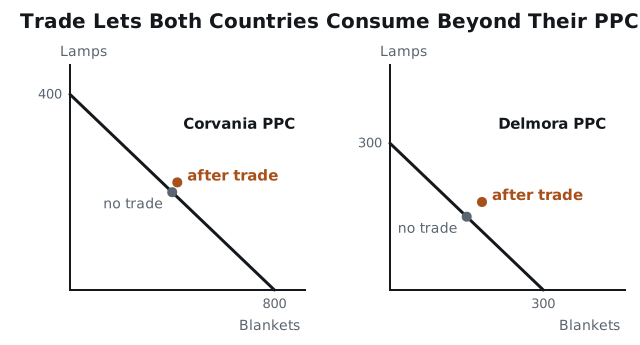
Trade lets each country consume a combination it could never produce alone.
| Country | Before trade | After trade | Gains from trade |
|---|---|---|---|
| Corvania | 400 blankets, 200 lamps | 420 blankets, 220 lamps | +20 blankets, +20 lamps |
| Delmora | 150 blankets, 150 lamps | 180 blankets, 180 lamps | +30 blankets, +30 lamps |
Key Terms
Practice Questions
6 questions. Nothing here is recorded or scored.
- Question 1MKT-1.A.1
Quillon and Rennet
The example countries of Quillon and Rennet each produce rice and cloth. The table shows how much one worker can produce in a month. Each country has the same number of workers.
Country | Tons of rice per worker | Bolts of cloth per worker Quillon | 6 | 2 Rennet | 4 | 4 Based on the table, which country has the absolute advantage in rice?
- A.Quillon
- B.Rennet
- C.Neither country
- D.Both countries
Check answerHide answer
Answer: A
- A.
- Correct. One Quillon worker produces 6 tons of rice, more than the 4 tons a Rennet worker produces.
- B.
- Rennet's workers produce 4 tons, fewer than Quillon's 6.
- C.
- The two countries' rice output differs, so one has the absolute advantage.
- D.
- Absolute advantage goes to the producer with more output. Only one country can have it in rice.
- Question 2MKT-1.A.2
Quillon and Rennet
The example countries of Quillon and Rennet each produce rice and cloth. The table shows how much one worker can produce in a month. Each country has the same number of workers.
Country | Tons of rice per worker | Bolts of cloth per worker Quillon | 6 | 2 Rennet | 4 | 4 Based on the table, what is Quillon's opportunity cost of producing 1 bolt of cloth?
- A.1/3 ton of rice
- B.2 tons of rice
- C.3 tons of rice
- D.6 tons of rice
Check answerHide answer
Answer: C
- A.
- One third of a ton is the cost of a ton of rice, measured in cloth. The question asks for the cost of cloth.
- B.
- Two is the number of bolts one worker makes, not the cost.
- C.
- Correct. A Quillon worker trades 6 tons of rice for 2 bolts of cloth. One bolt costs 6 / 2 = 3 tons of rice.
- D.
- Six tons is the rice given up for 2 bolts. One bolt costs half of that.
- Question 3MKT-1.A.2, MKT-1.B.1
Quillon and Rennet
The example countries of Quillon and Rennet each produce rice and cloth. The table shows how much one worker can produce in a month. Each country has the same number of workers.
Country | Tons of rice per worker | Bolts of cloth per worker Quillon | 6 | 2 Rennet | 4 | 4 Based on the table, how should the countries specialize?
- A.Quillon should produce cloth, and Rennet should produce rice.
- B.Quillon should produce both goods because it has an absolute advantage in rice.
- C.Rennet should produce both goods because it has an absolute advantage in cloth.
- D.Quillon should produce rice, and Rennet should produce cloth.
Check answerHide answer
Answer: D
- A.
- This reverses comparative advantage. Cloth costs Quillon 3 tons of rice and costs Rennet only 1.
- B.
- Absolute advantage does not decide specialization. Quillon gives up more rice for cloth than Rennet does.
- C.
- Rennet gives up rice to make cloth at a lower cost, but its rice costs more cloth than Quillon's. Each country should make the good with the lower opportunity cost.
- D.
- Correct. Rice costs Quillon 1/3 bolt of cloth and costs Rennet 1 bolt, so Quillon has the comparative advantage in rice. Cloth costs Rennet 1 ton of rice and Quillon 3, so Rennet has it in cloth.
- Question 4MKT-1.B.2
Quillon and Rennet
The example countries of Quillon and Rennet each produce rice and cloth. The table shows how much one worker can produce in a month. Each country has the same number of workers.
Country | Tons of rice per worker | Bolts of cloth per worker Quillon | 6 | 2 Rennet | 4 | 4 Based on the table, which of the following terms of trade would benefit both countries?
- A.1 bolt of cloth for 2 tons of rice
- B.1 bolt of cloth for 4 tons of rice
- C.1 bolt of cloth for 1/2 ton of rice
- D.1 bolt of cloth for 3.5 tons of rice
Check answerHide answer
Answer: A
- A.
- Correct. Cloth costs Rennet 1 ton of rice and costs Quillon 3. A price of 2 tons per bolt falls between those costs, so Rennet earns more than its cost and Quillon pays less than its cost.
- B.
- At 4 tons per bolt, Quillon pays more than its own 3-ton cost and would rather make its own cloth.
- C.
- At half a ton per bolt, Rennet receives less than the 1 ton it gives up to make each bolt.
- D.
- At 3.5 tons per bolt, Quillon pays more than its own cost of 3 tons.
- Question 5MKT-1.A.2
Which of the following is true of comparative advantage?
- A.A country with an absolute advantage in every good has a comparative advantage in every good.
- B.When two producers' opportunity costs differ, each has a comparative advantage in one good, even a producer with no absolute advantage.
- C.Comparative advantage goes to the producer that uses the most resources.
- D.Comparative advantage is found by comparing total output.
Check answerHide answer
Answer: B
- A.
- Lower opportunity cost in one good means higher opportunity cost in the other, so one producer cannot have comparative advantage in both goods.
- B.
- Correct. Comparative advantage compares opportunity costs. When costs differ, each producer has the lower cost in one of the two goods.
- C.
- Resource use is not the test. The test is which producer gives up less of the other good.
- D.
- Comparing total output finds absolute advantage. Comparative advantage compares opportunity cost.
- Question 6MKT-1.B.1
After two countries specialize according to comparative advantage and trade at mutually beneficial terms, which of the following is true?
- A.Each country can consume a combination of goods outside its own PPC.
- B.Each country's PPC shifts outward.
- C.Only the country with the absolute advantage gains.
- D.Total world output of both goods falls.
Check answerHide answer
Answer: A
- A.
- Correct. Specialization raises total output, and trade lets each country consume a bundle it could not make alone, a point beyond its PPC.
- B.
- Trade does not change a country's resources or technology, so its PPC stays put. Its consumption point moves beyond the curve.
- C.
- With terms between the two opportunity costs, both countries gain.
- D.
- Specialization by comparative advantage raises total output.
Practice every topic in Unit 1
CED Codes
MKT-1.A.1 · MKT-1.A.2 · MKT-1.B.1 · MKT-1.B.2