1.4 Demand
Learn the law of demand, read a demand schedule and curve, and separate a change in quantity demanded from a shift in demand caused by its determinants.
Part 1 of 3 The Law of Demand
Demand lists how much of a good buyers are willing and able to buy at each price. The law of demand says that price and quantity demanded move in opposite directions, so the demand curve slopes downward.
Two forces drive that inverse relationship. When a price rises, buyers switch to substitutes. A higher price also leaves buyers able to afford less with the same income.
| Price | Quantity demanded |
|---|---|
| $8 | 40 |
| $7 | 60 |
| $6 | 80 |
| $5 | 100 |
| $4 | 120 |
A demand schedule and a demand curve hold the same information. The schedule lists prices and quantities in a table. The curve plots those pairs with price on the vertical axis and quantity on the horizontal axis. Market demand adds up every buyer's quantity at each price.
At $7 the juice bar sells 60 smoothies a day. When the price falls to $5, sales rise to 100. That change is a movement along one demand curve, because only the smoothie's own price changed.
Part 2 of 3 Moving Along the Curve or Shifting It
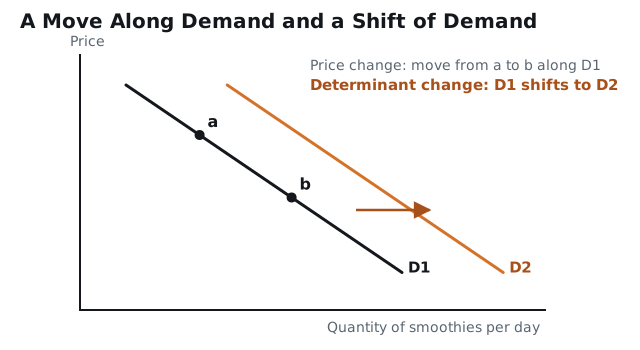
| Change in quantity demanded | Change in demand | |
|---|---|---|
| Cause | The good's own price changes | A determinant changes |
| On the graph | A move along the same curve | The whole curve shifts right or left |
| Smoothie example | Price drops from $7 to $5; sales go from 60 to 100 | A heat wave raises sales at every price |
Read the cause before you draw anything. If the smoothie's own price changed, stay on the same curve and move along it. If anything else changed, shift the whole curve.
Part 3 of 3 What Shifts Demand
The determinants of demand are the factors other than the good's own price. Any one of them shifts the whole curve.
| Determinant | Example | Effect on demand |
|---|---|---|
| Income | Incomes rise | Increase for a normal good; decrease for an inferior good |
| Tastes and preferences | A study praises smoothies | Increase |
| Price of a related good | Bottled iced tea, a substitute, costs more | Increase |
| Price of a related good | Paper straws, a complement, cost more | Decrease |
| Expectations | Buyers expect a price rise next week | Increase now |
| Number of buyers | A new office tower opens next door | Increase |
Each determinant changes how much buyers want at every price, so the whole curve moves. An increase in demand shifts the curve to the right, because buyers want more at each price. A decrease shifts the curve to the left. A rise in income raises demand for normal goods, such as restaurant meals. The same rise lowers demand for inferior goods, such as store-brand noodles, as buyers switch to options they prefer.
A change in the good's own price moves along the demand curve. A change in any determinant shifts the curve.
Key Terms
Practice Questions
6 questions. Nothing here is recorded or scored.
- Question 1MKT-2.A.1
The law of demand states that, other things held constant,
- A.as income rises, demand rises
- B.as the price of a good rises, the quantity demanded falls
- C.as the price of a good rises, demand rises
- D.as the price of a good falls, the quantity supplied falls
Check answerHide answer
Answer: B
- A.
- Income is a determinant that shifts demand. The law of demand concerns the good's own price.
- B.
- Correct. The law of demand describes an inverse relationship between a good's price and the quantity demanded, which gives the demand curve its downward slope.
- C.
- A price change moves along the curve and changes quantity demanded. It does not shift demand, and quantity falls as price rises.
- D.
- That describes the law of supply.
- Question 2MKT-2.A.1
The price of concert tickets at the example Harbor Hall falls from $60 to $45. Which of the following will happen in the market for Harbor Hall tickets?
- A.Demand will increase.
- B.Demand will decrease.
- C.Quantity demanded will increase.
- D.The demand curve will shift to the right.
Check answerHide answer
Answer: C
- A.
- A change in the good's own price does not change demand. Only a determinant shifts the curve.
- B.
- The price fell, and demand itself does not respond to the good's own price.
- C.
- Correct. A lower price moves buyers down along the existing demand curve to a larger quantity demanded.
- D.
- A rightward shift needs a change in a determinant, such as income or tastes.
- Question 3MKT-2.B.1
Incomes in a city rise. Demand for intercity bus tickets in the city falls. Which of the following best explains this result?
- A.Bus tickets are a normal good.
- B.Bus tickets are an inferior good.
- C.The price of bus tickets rose.
- D.Bus tickets and train tickets are complements.
Check answerHide answer
Answer: B
- A.
- Demand for a normal good rises with income. Here demand fell.
- B.
- Correct. An inferior good is one people buy less of as income rises, often because they switch to options such as flying or driving.
- C.
- A price rise would reduce quantity demanded. The question says demand fell after incomes changed.
- D.
- The scenario gives no information about train tickets, and complements are used together.
- Question 4MKT-2.B.1
Peanut butter and jelly are complements. If the price of peanut butter rises, what happens in the market for jelly?
- A.Demand for jelly decreases.
- B.Demand for jelly increases.
- C.Quantity demanded of jelly increases.
- D.Supply of jelly increases.
Check answerHide answer
Answer: A
- A.
- Correct. A higher peanut butter price means buyers purchase less peanut butter. Because the two goods are used together, buyers also want less jelly at every price.
- B.
- An increase in demand for the other good comes from substitutes. Complements move the opposite way.
- C.
- Jelly's own price did not change, so there is no movement along jelly's demand curve.
- D.
- Peanut butter prices affect buyers of jelly. Nothing here changes jelly producers' costs.
- Question 5MKT-2.B.1
A medical report says that eating oats lowers cholesterol. On a graph of the oat market, which of the following shows the effect on demand?
- A.A movement down along the demand curve
- B.A leftward shift of the demand curve
- C.A movement up along the demand curve
- D.A rightward shift of the demand curve
Check answerHide answer
Answer: D
- A.
- A movement along the curve needs a change in the price of oats.
- B.
- A leftward shift would mean buyers want less at every price. The report makes oats more attractive.
- C.
- A movement up the curve comes from a higher oat price.
- D.
- Correct. Tastes and preferences are a determinant of demand. A favorable report raises the quantity wanted at every price, shifting demand right.
- Question 6MKT-2.B.1
Which combination of events would most clearly increase the demand for electric scooters, a normal good?
- A.Consumer incomes fall and the price of bus fares falls.
- B.Consumer incomes rise and the price of bus fares, a substitute, rises.
- C.The price of electric scooters falls and the price of helmets, a complement, rises.
- D.Consumer incomes rise and the price of scooter batteries, a complement, rises.
Check answerHide answer
Answer: B
- A.
- Both changes reduce demand: lower income cuts demand for a normal good, and cheaper bus fares pull buyers toward the substitute.
- B.
- Correct. Higher income raises demand for a normal good, and higher bus fares push buyers toward scooters. Both shifts point the same way.
- C.
- A lower scooter price changes quantity demanded, and pricier helmets reduce demand for scooters.
- D.
- Higher income raises demand, but pricier batteries lower it, so the overall effect is unclear.
Practice every topic in Unit 1
CED Codes
MKT-2.A.1 · MKT-2.B.1