1.5 Supply
Learn the law of supply, read a supply schedule and curve, and separate a change in quantity supplied from a shift in supply caused by its determinants.
Part 1 of 3 The Law of Supply
Supply lists how much of a good sellers are willing and able to offer at each price. The law of supply says that price and quantity supplied move in the same direction, so the supply curve slopes upward.
A higher price makes each sale more profitable, so firms produce more and new sellers join the market. Producing more often costs more per unit, too, as a bakery adds overtime shifts or older ovens. Sellers need a higher price to cover those costs.
| Price per loaf | Quantity supplied |
|---|---|
| $2 | 300 |
| $3 | 450 |
| $4 | 600 |
| $5 | 750 |
| $6 | 900 |
The schedule shows the bakery district offering 450 loaves a day at $3 and 750 at $5. Plotting those pairs, with price on the vertical axis, gives an upward-sloping supply curve. Market supply adds up the quantity every seller offers at each price.
Part 2 of 3 Moving Along the Curve or Shifting It
| Change in quantity supplied | Change in supply | |
|---|---|---|
| Cause | The good's own price changes | A determinant changes |
| On the graph | A move along the same curve | The whole curve shifts right or left |
| Bread example | Price rises from $3 to $5; output goes from 450 to 750 | Flour costs jump; output falls at every price |
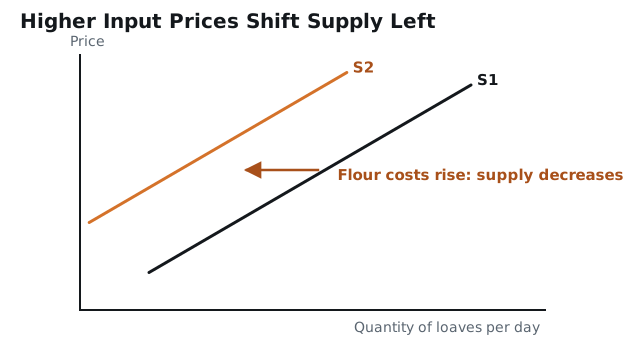
A leftward shift means sellers offer less at every price. A rightward shift means they offer more at every price. When flour costs jump, the bakery district might offer only 300 loaves at $3, where it offered 450 before. The cost of making each loaf rose before any change in the price of bread.
Part 3 of 3 What Shifts Supply
The determinants of supply are the factors other than the good's own price. A change in one shifts the whole curve. A rightward shift is an increase in supply, and a leftward shift is a decrease.
| Determinant | Example | Effect on supply |
|---|---|---|
| Input prices | Flour and electricity cost more | Decrease |
| Technology and productivity | A faster oven bakes twice as many loaves an hour | Increase |
| Taxes and subsidies | The city pays bakeries a subsidy per loaf | Increase |
| Number of sellers | Three new bakeries open | Increase |
| Expectations of future prices | Bakers expect higher bread prices next month | Decrease now, as sellers hold back |
| Prices of other goods sellers can make | Pastries become more profitable | Decrease in bread supply |
Anything that raises the cost of producing a good shifts its supply curve left.
Gains in technology and productivity are the main reason supply grows over time. A machine that bakes twice as many loaves an hour lowers the cost of each loaf. The bakery district can then offer more bread at every price, and the supply curve shifts right.
Key Terms
Practice Questions
6 questions. Nothing here is recorded or scored.
- Question 1MKT-2.C.1
Which of the following describes the law of supply?
- A.As the price of a good rises, the quantity supplied rises.
- B.As the price of a good rises, supply shifts to the right.
- C.As input prices rise, the quantity supplied rises.
- D.As the price of a good rises, the quantity demanded rises.
Check answerHide answer
Answer: A
- A.
- Correct. The law of supply describes a positive relationship between a good's price and the quantity sellers offer, so the supply curve slopes upward.
- B.
- A change in the good's own price moves along the supply curve. It does not shift supply.
- C.
- Higher input prices raise costs and decrease supply.
- D.
- Quantity demanded falls when price rises. This choice mixes in the demand side.
- Question 2MKT-2.D.1
The price of steel, an input used to make bicycles, rises sharply. What happens in the bicycle market?
- A.The supply of bicycles increases.
- B.The supply of bicycles decreases.
- C.The quantity of bicycles supplied increases at every price.
- D.The demand for bicycles decreases.
Check answerHide answer
Answer: B
- A.
- Higher input costs make each bicycle more expensive to build, which lowers supply.
- B.
- Correct. A higher input price raises production costs, so firms offer fewer bicycles at every price. The supply curve shifts left.
- C.
- More at every price is an increase in supply, the opposite of what a cost increase does.
- D.
- Steel is an input for sellers. Buyers' willingness to pay at each price is unchanged by the steel price.
- Question 3MKT-2.D.1
A dairy installs robotic milking machines that let each worker handle twice as many cows. Which determinant of supply has changed?
- A.Number of buyers
- B.Expectations of buyers
- C.Technology
- D.Prices of related goods in consumption
Check answerHide answer
Answer: C
- A.
- The number of buyers is a determinant of demand.
- B.
- Buyer expectations affect demand.
- C.
- Correct. Better technology raises productivity, so the dairy can supply more milk at every price.
- D.
- Related goods in consumption, substitutes and complements, affect demand.
- Question 4MKT-2.D.1
The government gives each wheat farmer a subsidy of $1 per bushel. On a graph of the wheat market, what happens?
- A.The demand curve shifts right.
- B.The supply curve shifts left.
- C.The market moves down along the supply curve.
- D.The supply curve shifts right.
Check answerHide answer
Answer: D
- A.
- The subsidy is paid to sellers, so it affects supply.
- B.
- A leftward shift is a decrease in supply. A subsidy lowers farmers' costs.
- C.
- A movement along the curve needs a change in the price of wheat.
- D.
- Correct. A per-unit subsidy lowers the cost of producing each bushel, so farmers offer more at every price. Supply shifts right.
- Question 5MKT-2.D.1
Orange growers in the example region of Calvesse expect the price of oranges to rise sharply next month. What happens to the supply of oranges this month?
- A.Supply increases, because growers rush to sell now.
- B.Supply decreases, because growers hold oranges back to sell later at the higher price.
- C.Quantity supplied increases, because the price is higher.
- D.Supply is unchanged, because only the current price affects sellers.
Check answerHide answer
Answer: B
- A.
- Growers who expect a higher price later gain by waiting, so they offer fewer oranges now.
- B.
- Correct. Expected future prices are a determinant of supply. Sellers who expect higher prices later hold back current sales, shifting this month's supply left.
- C.
- The current price has not changed. Only expectations have, which shifts the curve.
- D.
- Expectations are a determinant of supply, so the curve shifts.
- Question 6MKT-2.C.1, MKT-2.D.1
Which of the following correctly distinguishes a change in quantity supplied from a change in supply?
- A.A change in quantity supplied comes from a change in input prices; a change in supply comes from a change in the good's price.
- B.A change in quantity supplied shifts the curve; a change in supply moves along it.
- C.A change in quantity supplied is caused by a change in the good's own price; a change in supply is caused by a change in a determinant such as technology.
- D.They are the same thing measured on different axes.
Check answerHide answer
Answer: C
- A.
- This swaps the causes. Input prices shift supply; the good's price moves along the curve.
- B.
- This swaps the graph effects. A change in supply shifts the curve.
- C.
- Correct. A price change moves sellers along one supply curve. A change in a determinant, such as technology or input prices, shifts the whole curve.
- D.
- The two terms describe different causes and different movements on one graph.
Practice every topic in Unit 1
CED Codes
MKT-2.C.1 · MKT-2.D.1