1.6 Market Equilibrium, Disequilibrium, and Changes in Equilibrium
Find market equilibrium, calculate a surplus or shortage, explain how prices move back to equilibrium, and predict what shifts in supply and demand do.
Part 1 of 3 Where Buyers and Sellers Agree
Market equilibrium is the price where the quantity buyers want equals the quantity sellers offer. At that price the market clears: every unit offered for sale finds a buyer.
| Price | Quantity demanded | Quantity supplied | Result |
|---|---|---|---|
| $50 | 200 | 800 | Surplus of 600 |
| $40 | 400 | 600 | Surplus of 200 |
| $30 | 500 | 500 | Equilibrium |
| $20 | 700 | 300 | Shortage of 400 |
| $10 | 900 | 100 | Shortage of 800 |
Surplus equals quantity supplied minus quantity demanded. Shortage equals quantity demanded minus quantity supplied.
At the equilibrium price of $30, the town sells 500 tickets a week. Every buyer who values a ticket at $30 or more gets one. Every seller willing to sell a ticket for $30 or less sells one. Nobody on either side is left wanting to trade at that price.
Part 2 of 3 How Prices Restore Equilibrium
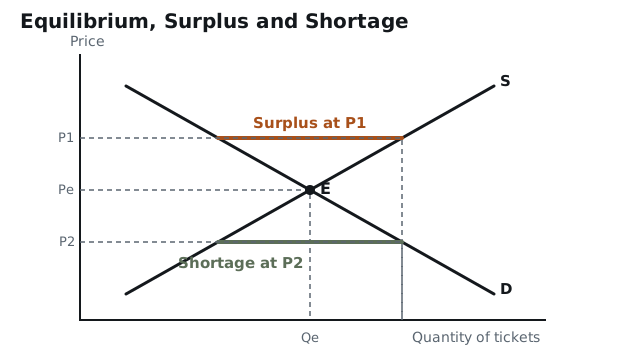
Any other price is disequilibrium. At $40 the town has a surplus of 200 tickets. Sellers left holding unsold tickets cut their price. As the price falls, quantity demanded rises and quantity supplied falls until the surplus is gone.
At $20 the town has a shortage of 400 tickets. Buyers who miss out offer more, and sellers raise the price. Quantity demanded falls and quantity supplied rises until the shortage is gone. Both pressures push the price to $30.
Part 3 of 3 When Supply or Demand Shifts
A change in any determinant shifts a curve and creates a new equilibrium price and quantity.
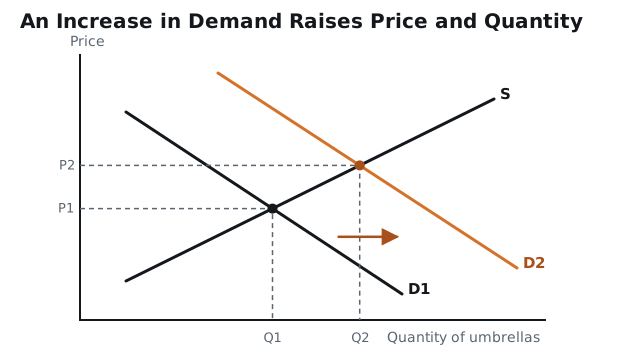
A rainy season raises demand for umbrellas. At the old price, buyers now want more umbrellas than stores have, which is a shortage. Stores raise their prices, and the market moves up the supply curve. The new equilibrium has a higher price and a larger quantity.
| Shift | Equilibrium price | Equilibrium quantity |
|---|---|---|
| Demand increases | Rises | Rises |
| Demand decreases | Falls | Falls |
| Supply increases | Falls | Rises |
| Supply decreases | Rises | Falls |
When both curves shift at once, one result is certain and the other depends on which shift is larger. If demand and supply both increase, quantity rises for sure. Demand pushes the price up and supply pushes it down, so the price change is indeterminate.
The same logic covers every pair of shifts. When demand rises and supply falls, the price rises for sure and the quantity change is indeterminate.
Key Terms
Practice Questions
6 questions. Nothing here is recorded or scored.
- Question 1MKT-2.E.1
Ferry Passes in Saltmere
The table shows the weekly demand for and supply of ferry passes in the example town of Saltmere.
Price | Quantity demanded | Quantity supplied $12 | 100 | 400 $10 | 150 | 350 $8 | 250 | 250 $6 | 350 | 150 $4 | 450 | 50 Based on the table, what are the equilibrium price and quantity of ferry passes?
- A.$10 and 150 passes
- B.$8 and 250 passes
- C.$6 and 350 passes
- D.$10 and 350 passes
Check answerHide answer
Answer: B
- A.
- At $10, 150 passes are demanded and 350 supplied. The quantities are not equal.
- B.
- Correct. At $8, quantity demanded and quantity supplied both equal 250, so the market clears.
- C.
- At $6, 350 passes are demanded but only 150 supplied.
- D.
- This pairs the $10 price with the quantity supplied. At $10 buyers want only 150.
- Question 2MKT-2.F.1
Ferry Passes in Saltmere
The table shows the weekly demand for and supply of ferry passes in the example town of Saltmere.
Price | Quantity demanded | Quantity supplied $12 | 100 | 400 $10 | 150 | 350 $8 | 250 | 250 $6 | 350 | 150 $4 | 450 | 50 Based on the table, if the town sets the price of a pass at $6, the market will have
- A.a surplus of 200 passes
- B.a shortage of 100 passes
- C.a shortage of 350 passes
- D.a shortage of 200 passes
Check answerHide answer
Answer: D
- A.
- At $6 quantity demanded exceeds quantity supplied, which is a shortage.
- B.
- One hundred is the gap at no price in the table. At $6 the gap is 350 minus 150.
- C.
- Three hundred fifty is the quantity demanded. The shortage is the gap between demand and supply.
- D.
- Correct. At $6, buyers want 350 passes and sellers offer 150. The shortage is 350 minus 150, or 200.
- Question 3MKT-2.F.1
Ferry Passes in Saltmere
The table shows the weekly demand for and supply of ferry passes in the example town of Saltmere.
Price | Quantity demanded | Quantity supplied $12 | 100 | 400 $10 | 150 | 350 $8 | 250 | 250 $6 | 350 | 150 $4 | 450 | 50 Based on the table, the price is $12. Which of the following will happen as the market moves toward equilibrium?
- A.The price falls, quantity demanded rises and quantity supplied falls.
- B.The price rises, quantity demanded falls and quantity supplied rises.
- C.The price falls, demand shifts right and supply shifts left.
- D.The price stays at $12 because sellers want the higher price.
Check answerHide answer
Answer: A
- A.
- Correct. At $12 there is a surplus of 300. Sellers cut the price, which moves buyers down the demand curve and sellers down the supply curve until the quantities meet at $8.
- B.
- The price rises only from below equilibrium, when there is a shortage.
- C.
- Price adjustment moves the market along the curves. Neither curve shifts.
- D.
- Unsold passes push sellers to lower the price, so a surplus does not last.
- Question 4MKT-2.G.1
A new highway makes it cheaper to drive around the bay, and fewer people want to ride the ferry. What happens to the equilibrium price and quantity of ferry passes?
- A.Price rises and quantity rises.
- B.Price rises and quantity falls.
- C.Price falls and quantity falls.
- D.Price falls and quantity rises.
Check answerHide answer
Answer: C
- A.
- Rising price and quantity come from an increase in demand.
- B.
- Rising price with falling quantity comes from a decrease in supply.
- C.
- Correct. Driving is a substitute that got cheaper, so demand for passes decreases. The new equilibrium has a lower price and a lower quantity.
- D.
- Falling price with rising quantity comes from an increase in supply.
- Question 5MKT-2.G.1
A frost destroys much of the coffee crop. On a correctly labeled graph of the coffee market, which of the following shows the effect?
- A.Demand shifts left; price falls and quantity falls.
- B.Supply shifts right; price falls and quantity rises.
- C.Demand shifts right; price rises and quantity rises.
- D.Supply shifts left; price rises and quantity falls.
Check answerHide answer
Answer: D
- A.
- The frost affects growers, so it shifts supply.
- B.
- A frost reduces the crop, so supply decreases.
- C.
- The frost does not change buyers' tastes, incomes or the prices of related goods.
- D.
- Correct. Less coffee is available at every price, so supply shifts left. The equilibrium price rises and the equilibrium quantity falls.
- Question 6MKT-2.G.1
In the market for electric cars, consumer incomes rise and the cost of batteries falls at the same time. Electric cars are a normal good. Which of the following is certain?
- A.Equilibrium price rises.
- B.Equilibrium price falls.
- C.Equilibrium quantity rises.
- D.Equilibrium quantity falls.
Check answerHide answer
Answer: C
- A.
- Higher demand pushes price up, but higher supply pushes it down, so the price change depends on which shift is larger.
- B.
- The same opposing pushes make a price fall uncertain.
- C.
- Correct. Higher income increases demand and cheaper batteries increase supply. Both shifts raise the equilibrium quantity, so the rise in quantity is certain.
- D.
- Both shifts push quantity up, so quantity cannot fall.
Practice every topic in Unit 1
CED Codes
MKT-2.E.1 · MKT-2.F.1 · MKT-2.G.1