2.1 The Circular Flow and GDP
See how money and goods move through the circular flow, then measure GDP three ways and calculate nominal GDP from spending, income or value added.
Part 1 of 3 The Circular Flow
The circular flow diagram shows an economy as two groups trading in two markets. Every dollar one group spends becomes income for the other, so total spending and total income are the same flow seen from two sides.
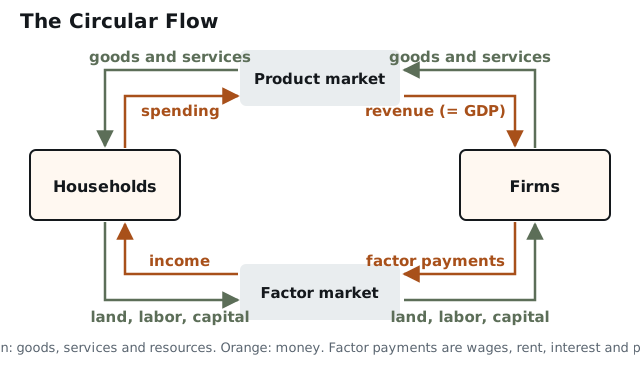
In the product market, households buy goods and services, and their spending becomes firms' revenue. In the factor market, firms hire land, labor, capital and entrepreneurship from households. Firms pay for those resources with rent, wages, interest and profit, which become household income. Households spend that income in the product market, and the loop repeats.
The diagram makes one fact clear. Measuring total spending in the product market and measuring total income in the factor market give the same number, because they are the same dollars.
Part 2 of 3 What GDP Measures
Gross domestic product (GDP) is the market value of all final goods and services produced within a country in a year. GDP measures the economy's final output, so it leaves out anything that would count the same production twice or that is not new production.
| Transaction | In GDP? | Why |
|---|---|---|
| A new bike sold to a rider | Yes | A final good produced this year |
| Tires bought by the bike maker | No | Intermediate goods are already inside the bike's price |
| A used car sold this year | No | It was counted the year it was made |
| Shares of stock bought | No | A financial transaction produces nothing |
| An unemployment benefit check | No | A transfer payment buys no output |
| A car built in the country by a foreign-owned firm | Yes | GDP counts production inside the borders |
Part 3 of 3 Three Ways to Measure GDP
Because spending and income are one flow, GDP can be measured three ways, and each gives the same total.
| Approach | What it adds | Example economy, billions |
|---|---|---|
| Expenditures approach | Consumption + investment + government spending + net exports | 600 + 150 + 200 + (90 - 120) = 920 |
| Income approach | Wages + rent + interest + profit | 560 + 60 + 80 + 220 = 920 |
| Value-added approach | The value added at every stage of production | Sum of every firm's sales minus its purchased inputs |
The value-added approach follows one product. A farmer sells wheat to a miller for $0.40. The miller sells flour to a baker for $1.00. The baker sells bread to a shop for $2.20, and the shop sells it to a shopper for $3.00. The value added at each stage is $0.40, $0.60, $1.20 and $0.80. Those amounts sum to $3.00, the price of the final loaf.
To calculate nominal GDP from output data, multiply the quantity of each final good by its current price and add the results. An economy that makes 100 loaves at $3 and 20 haircuts at $15 has a nominal GDP of $300 plus $300, or $600.
Key Terms
Practice Questions
6 questions. Nothing here is recorded or scored.
- Question 1MEA-1.A.3
National Accounts of Morvale
The table shows data for the example country of Morvale in one year.
Item | Billions of dollars Consumption | 700 Gross investment | 180 Government purchases | 250 Transfer payments | 120 Exports | 90 Imports | 110 Based on the table, what is Morvale's GDP?
- A.$1,110 billion
- B.$1,220 billion
- C.$1,230 billion
- D.$1,340 billion
Check answerHide answer
Answer: A
- A.
- Correct. GDP = C + I + G + (X - M) = 700 + 180 + 250 + (90 - 110) = 1,110. Transfer payments are left out because they buy no output.
- B.
- This adds exports and ignores imports. Net exports are 90 minus 110, which is negative 20.
- C.
- This adds the transfer payments. Transfers are not purchases of output, so GDP excludes them.
- D.
- This adds both the transfers and exports while ignoring imports.
- Question 2MEA-1.A.1
Which of the following would be included in this year's GDP of the example country of Calbrook?
- A.A used pickup truck sold by one Calbrook resident to another
- B.Shares of stock bought by a Calbrook retiree
- C.A new dishwasher made in Calbrook and bought by a household
- D.Flour bought by a Calbrook bakery to bake bread for sale
Check answerHide answer
Answer: C
- A.
- Used goods were counted in the year they were produced.
- B.
- Buying stock transfers ownership of an existing asset. No new output is produced.
- C.
- Correct. A new final good made within Calbrook this year and sold to its final user counts in GDP.
- D.
- The flour is an intermediate good. Its value is included in the price of the bread.
- Question 3MEA-1.A.2
In the circular flow diagram, households receive wages, rent, interest and profit from firms through which market?
- A.The product market
- B.The factor market
- C.The stock market
- D.The foreign exchange market
Check answerHide answer
Answer: B
- A.
- Households spend money in the product market. They receive income in the factor market.
- B.
- Correct. Firms buy land, labor, capital and entrepreneurship in the factor market and pay households income for them.
- C.
- The simple circular flow has two markets, products and factors.
- D.
- The simple circular flow does not include a foreign exchange market.
- Question 4MEA-1.A.3
A mine sells iron ore to a steel mill for $300. The mill sells steel to a car maker for $800. The car maker sells a car to a buyer for $2,000. How much does this chain add to GDP?
- A.$3,100
- B.$1,100
- C.$800
- D.$2,000
Check answerHide answer
Answer: D
- A.
- Adding every sale counts the ore and steel more than once.
- B.
- This adds only the ore and steel, which are intermediate goods.
- C.
- This is the steel mill's sale, an intermediate stage.
- D.
- Correct. GDP counts the final good once. The value added sums to the same total: $300 + $500 + $1,200 = $2,000.
- Question 5MEA-1.A.3
Which of the following correctly describes the income approach to measuring GDP?
- A.It adds wages, rent, interest and profit earned in producing output.
- B.It adds consumption, investment, government spending and net exports.
- C.It adds the sales revenue of every firm, including sales of intermediate goods.
- D.It adds the market value of every good in the economy, new or used.
Check answerHide answer
Answer: A
- A.
- Correct. The income approach sums the payments earned by the four economic resources, which equals total spending in the circular flow.
- B.
- That is the expenditures approach.
- C.
- Adding every firm's full revenue double counts intermediate goods.
- D.
- Used goods are left out of GDP.
- Question 6MEA-1.A.1, MEA-1.A.3
An American-owned company builds a factory in the example country of Tessaly and produces furniture there that it sells to Tessaly households. The furniture adds to which of the following?
- A.U.S. GDP only, because the company is American-owned
- B.Neither country's GDP, because the company is foreign
- C.Tessaly's exports
- D.Tessaly's GDP, because the production happens within Tessaly's borders
Check answerHide answer
Answer: D
- A.
- GDP measures production within a country's borders, whoever owns the firm.
- B.
- The furniture is produced inside Tessaly, so it counts in Tessaly's GDP.
- C.
- The furniture is sold to Tessaly households, so it is not an export from Tessaly.
- D.
- Correct. GDP counts output produced inside the country, so furniture made in Tessaly counts in Tessaly's GDP.
Practice every topic in Unit 2
CED Codes
MEA-1.A.1 · MEA-1.A.2 · MEA-1.A.3