2.2 Limitations of GDP
GDP is a strong gauge of output with clear blind spots. Learn what it leaves out, from home production and hidden work to leisure and pollution.
Part 1 of 3 A Useful Measure with Gaps
GDP tells you how much an economy produced and sold in markets. It is a useful indicator of economic performance, and it leaves out several things that matter to people's lives.
Economists compare GDP across years to see whether output grew. They compare GDP per person across countries to judge average production. Those comparisons work best when you remember what the number cannot see.
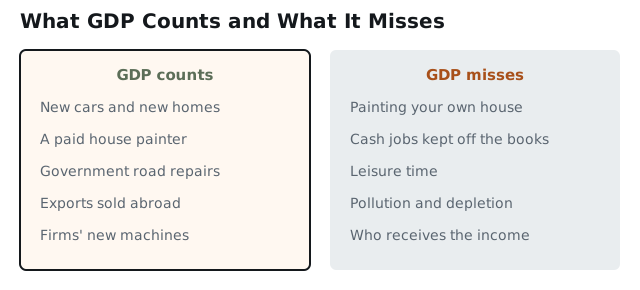
GDP counts only goods and services sold in markets at a recorded price. Anything produced without a sale, or sold without a record, falls outside the number. A few other gaps come from what a price tag cannot show, such as free time or clean air.
Part 2 of 3 What GDP Leaves Out
| Limitation | Example | Effect on GDP as a measure |
|---|---|---|
| Nonmarket transactions | A parent cooks dinner at home | Real production goes uncounted |
| Underground economy | A tutor paid in cash who reports nothing | Real production goes uncounted |
| Leisure | Workers gain a shorter workweek | Well-being rises while GDP may fall |
| Environmental costs | A factory pollutes a river | Output counts; the damage does not |
| Product quality | A phone gets better at the same price | Gains in quality are hard to measure |
| Income distribution | Gains go to a small group | GDP shows the total and hides who receives it |
The first limitation in the table is the one AP economics names first. When a homeowner hires a painter, the $2,000 job adds to GDP. When the homeowner paints the house without pay, the same work adds nothing. The work is the same in both cases. Only the paid job shows up in GDP.
Part 3 of 3 Reading GDP with Care
Some events raise GDP while making people worse off. Rebuilding after a flood adds construction spending to GDP. The flood still destroyed homes and roads, and the rebuilding only replaces them.
Population size also matters. A country's GDP can grow 2% while its population grows 3%. Output per person then falls. GDP per capita, which divides GDP by population, gives a better view of the average person's share.
A larger GDP means more measured production. A larger GDP does not prove that people live better.
None of these gaps makes GDP useless. Economists pair GDP with other measures, such as life expectancy, hours worked or pollution levels, when they want a fuller picture of how people live.
Key Terms
Practice Questions
6 questions. Nothing here is recorded or scored.
- Question 1MEA-1.B.1
Which of the following is a nonmarket transaction that GDP fails to count?
- A.A homeowner repairs her own leaking roof.
- B.A homeowner pays a roofer $900 to repair her roof.
- C.A city government pays a firm to repair a library roof.
- D.A roofing company buys a new truck.
Check answerHide answer
Answer: A
- A.
- Correct. Work done for oneself without a market sale is a nonmarket transaction, so it does not enter GDP.
- B.
- A paid repair is a market transaction and counts as consumption.
- C.
- Government purchases of services count in GDP.
- D.
- A new truck bought by a firm counts as investment.
- Question 2MEA-1.B.1
GDP may overstate improvements in well-being when
- A.people take more leisure time
- B.household production replaces market purchases
- C.output rises while pollution damages public health
- D.the quality of goods improves at constant prices
Check answerHide answer
Answer: C
- A.
- More leisure raises well-being without raising GDP, so GDP would understate the improvement.
- B.
- Moving production into the home lowers measured GDP while total output stays the same, which understates well-being.
- C.
- Correct. GDP counts the output and ignores the damage, so it makes the gain in well-being look larger than it is.
- D.
- Quality gains at constant prices raise well-being without raising measured GDP, which understates the improvement.
- Question 3MEA-1.B.1
The example country of Varrow's GDP grew 2% last year while its population grew 4%. Which of the following is most likely true?
- A.Output per person rose.
- B.Output per person fell.
- C.Nominal GDP fell.
- D.The economy entered a recession by definition.
Check answerHide answer
Answer: B
- A.
- Population grew faster than output, so each person's share shrank.
- B.
- Correct. GDP per capita equals GDP divided by population. Output growing 2% while population grows 4% lowers output per person.
- C.
- GDP grew, and nothing in the question says prices fell.
- D.
- Total output grew, so the economy did not have falling real output.
- Question 4MEA-1.B.1
A tutor teaches students for cash and never reports the income. How does this affect measured GDP?
- A.GDP counts it as consumption.
- B.GDP counts it as a transfer payment.
- C.GDP counts it twice.
- D.GDP misses it because it is part of the underground economy.
Check answerHide answer
Answer: D
- A.
- Consumption is counted only when the transaction is recorded.
- B.
- The tutoring is a service sold in a market, not a transfer, and it goes unrecorded.
- C.
- Unreported work is not counted at all.
- D.
- Correct. Unreported market activity belongs to the underground economy, which official GDP misses.
- Question 5MEA-1.B.1
A hurricane destroys thousands of homes, and the rebuilding raises construction spending for the next two years. Which statement is most accurate?
- A.Measured GDP may rise even though the country's stock of homes and well-being fell.
- B.Measured GDP must fall, because the hurricane destroyed output.
- C.Measured GDP is unaffected, because rebuilding replaces old homes.
- D.Measured GDP falls, because rebuilding is a nonmarket transaction.
Check answerHide answer
Answer: A
- A.
- Correct. Rebuilding is new production and adds to GDP. GDP does not subtract the homes that were destroyed, so the measure can rise while people are worse off.
- B.
- GDP measures new production each year. It does not subtract the value of homes destroyed.
- C.
- New construction is new output, so GDP counts it.
- D.
- Rebuilding by paid contractors is a market transaction and counts in GDP.
- Question 6MEA-1.B.1
Which of the following is a limitation of GDP as a measure of a nation's standard of living?
- A.GDP counts final goods only.
- B.GDP is reported in dollars.
- C.GDP shows total output and says nothing about how income is distributed.
- D.GDP includes government purchases.
Check answerHide answer
Answer: C
- A.
- Counting final goods only is a design choice that prevents double counting. It is a strength of the measure.
- B.
- A money measure is how GDP adds unlike goods together.
- C.
- Correct. Two countries with the same GDP can have very different shares going to typical households. GDP cannot show that.
- D.
- Government purchases are part of the economy's output.
Practice every topic in Unit 2
CED Codes
MEA-1.B.1