2.3 Unemployment
Calculate the unemployment and participation rates, see what the rate misses, and sort unemployment into frictional, structural and cyclical types.
Part 1 of 3 Who Is in the Labor Force
The labor force is every adult who has a job or is actively looking for one. A person without a job counts as unemployed only if that person is looking for work. Retirees, full-time students and others not looking are outside the labor force.
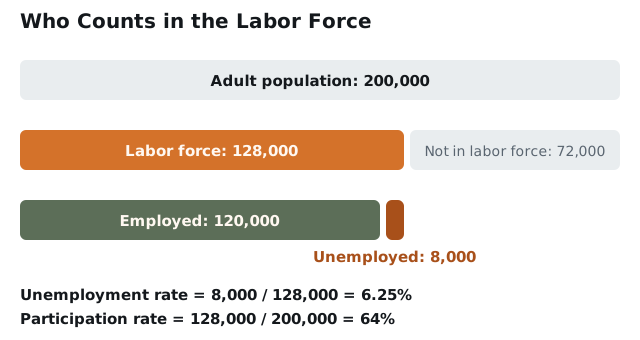
In the example, 8,000 of the 128,000 people in the labor force are unemployed, so the unemployment rate is 6.25%. The labor force is 128,000 of 200,000 adults, so the labor force participation rate is 64%.
Part 2 of 3 What the Rate Misses
The measured unemployment rate can understate joblessness. Discouraged workers want a job but have stopped looking, so they drop out of the labor force and out of the rate. When 2,000 unemployed people in the example give up, the unemployed count falls to 6,000 and the labor force falls to 126,000. The rate drops to about 4.8% although nobody found a job.
The reverse also happens. When the job market improves, discouraged workers start looking again and rejoin the labor force as unemployed. The unemployment rate can rise for a short time even as hiring picks up.
Part-time workers who want full-time hours count as employed, so the rate also misses the hours they cannot get.
Part 3 of 3 Three Types of Unemployment
| Type | Cause | Example |
|---|---|---|
| Frictional | Time spent searching for a suitable job | A graduate applying for first jobs |
| Structural | Skills or locations no longer match the jobs | Mill workers after the mill automates |
| Cyclical | Falling total spending in a recession | Retail staff laid off when sales drop |
The natural rate of unemployment is frictional plus structural unemployment. It is the rate when the economy produces its full-employment output. Cyclical unemployment is the actual rate minus the natural rate. With an actual rate of 7% and a natural rate of 4.5%, cyclical unemployment is 2.5 percentage points.
The natural rate can change slowly over time. A labor force with more young workers, who change jobs often, tends to raise it. Faster job-matching tools can lower it by shortening searches.
Read each example for its cause. A person searching with skills employers want is frictional. A person whose skills no longer fit any opening is structural. A person laid off because sales fell across the economy is cyclical.
Full employment means zero cyclical unemployment. Frictional and structural unemployment remain.
Key Terms
Practice Questions
6 questions. Nothing here is recorded or scored.
- Question 1MEA-1.C.1
Labor Data for Pinehollow
The table shows labor market data for the example town of Pinehollow.
Category | Number of people Adult population | 50,000 Employed | 28,500 Unemployed | 1,500 Not in the labor force | 20,000 Based on the table, what is Pinehollow's unemployment rate?
- A.3%
- B.5%
- C.5.3%
- D.7.5%
Check answerHide answer
Answer: B
- A.
- Three percent divides the unemployed by the adult population. The rate uses the labor force.
- B.
- Correct. The labor force is 28,500 + 1,500 = 30,000. The unemployment rate is 1,500 / 30,000 = 5%.
- C.
- Dividing by the employed only gives about 5.3%. The denominator is the whole labor force.
- D.
- Dividing 1,500 by 20,000 uses the people outside the labor force.
- Question 2MEA-1.C.2
Labor Data for Pinehollow
The table shows labor market data for the example town of Pinehollow.
Category | Number of people Adult population | 50,000 Employed | 28,500 Unemployed | 1,500 Not in the labor force | 20,000 Based on the table, what is Pinehollow's labor force participation rate?
- A.40%
- B.57%
- C.95%
- D.60%
Check answerHide answer
Answer: D
- A.
- Forty percent is the share not in the labor force.
- B.
- Fifty-seven percent counts only the employed.
- C.
- Ninety-five percent is the share of the labor force that is employed.
- D.
- Correct. The labor force of 30,000 divided by the adult population of 50,000 is 60%.
- Question 3MEA-1.D.1
Labor Data for Pinehollow
The table shows labor market data for the example town of Pinehollow.
Category | Number of people Adult population | 50,000 Employed | 28,500 Unemployed | 1,500 Not in the labor force | 20,000 Based on the table, suppose 500 of Pinehollow's unemployed workers give up looking for work. What happens to the unemployment rate?
- A.It falls from 5% to about 3.4%.
- B.It rises from 5% to about 6.7%.
- C.It stays at 5%.
- D.It falls from 5% to 2%.
Check answerHide answer
Answer: A
- A.
- Correct. Unemployed falls to 1,000 and the labor force to 29,500. The rate is 1,000 / 29,500, about 3.4%, although nobody found a job.
- B.
- Discouraged workers leave the count of unemployed, which lowers the rate.
- C.
- Both the number unemployed and the labor force fall, and the rate falls.
- D.
- Two percent would need the unemployed to drop to about 600.
- Question 4MEA-1.E.1
A factory replaces its welders with robots, and the welders lack the training for the jobs that are open in their region. This is an example of
- A.frictional unemployment
- B.cyclical unemployment
- C.structural unemployment
- D.discouraged workers
Check answerHide answer
Answer: C
- A.
- Frictional unemployment involves usable skills during a job search. These workers' skills no longer fit the jobs.
- B.
- Cyclical unemployment comes from a fall in total spending during a recession.
- C.
- Correct. A mismatch between workers' skills and the jobs available, caused by new technology, is structural unemployment.
- D.
- Discouraged workers have stopped looking for work. The question asks what caused these welders to lose their jobs, which is a skills mismatch.
- Question 5MEA-1.E.2, MEA-1.E.3
The example country of Ostley has frictional unemployment of 2.5%, structural unemployment of 2%, and an actual unemployment rate of 7%. What is cyclical unemployment?
- A.4.5%
- B.7%
- C.2.5%
- D.9.5%
Check answerHide answer
Answer: C
- A.
- Four and a half percent is the natural rate, frictional plus structural.
- B.
- Seven percent is the total rate.
- C.
- Correct. The natural rate is 2.5% + 2% = 4.5%. Cyclical unemployment is the actual rate minus the natural rate: 7% - 4.5% = 2.5%.
- D.
- This adds the actual rate to the natural rate.
- Question 6MEA-1.E.4
Which of the following would most likely lower a country's natural rate of unemployment over time?
- A.An online system that matches job seekers with openings faster
- B.A recession that cuts consumer spending
- C.A rise in the share of very young workers in the labor force
- D.A fall in the labor force participation rate
Check answerHide answer
Answer: A
- A.
- Correct. Faster matching shortens job searches, which reduces frictional unemployment and lowers the natural rate.
- B.
- A recession raises cyclical unemployment, which is outside the natural rate.
- C.
- Young workers change jobs often, which tends to raise frictional unemployment.
- D.
- The participation rate measures who is in the labor force. A change in it does not by itself shorten job searches or fix skill mismatches.
Practice every topic in Unit 2
CED Codes
MEA-1.C.1 · MEA-1.C.2 · MEA-1.D.1 · MEA-1.E.1 · MEA-1.E.2 · MEA-1.E.3 · MEA-1.E.4