2.4 Price Indices and Inflation
Build a consumer price index from a market basket, calculate inflation and real wages, and see why the CPI tends to overstate the true rise in prices.
Part 1 of 4 Pricing a Fixed Basket
The consumer price index (CPI) tracks what a fixed market basket of goods and services costs each year compared with a base year. The CPI shows how much more income a household needs to keep the same standard of living.
| Item | Quantity | Base-year price | Year 2 price |
|---|---|---|---|
| Bread | 10 loaves | $2.00 | $2.20 |
| Bus rides | 6 rides | $2.50 | $2.50 |
| Movie tickets | 1 ticket | $15.00 | $16.80 |
The basket costs $20 + $15 + $15 = $50 in the base year and $22 + $15 + $16.80 = $53.80 in year 2. The year 2 CPI is 53.80 divided by 50, times 100, or 107.6. The base year's CPI is always 100.
Part 2 of 4 Measuring Inflation
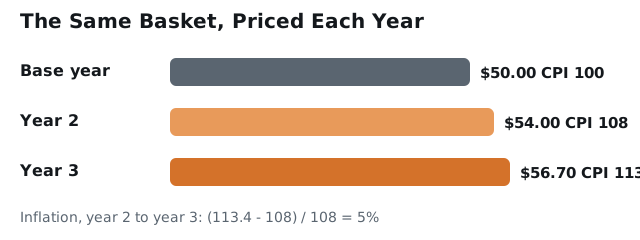
The inflation rate measures how fast a price index rises from one period to the next. Economists calculate it with the CPI or with the GDP deflator. In the figure, the index rises from 108 to 113.4, an inflation rate of 5%.
| Term | What happens to prices | Example inflation rates |
|---|---|---|
| Inflation | The price level rises | 3% then 4% |
| Deflation | The price level falls | -1% then -2% |
| Disinflation | Prices still rise, more slowly | 6% then 3% |
Part 3 of 4 Real and Nominal Values
Nominal variables are in current dollars. Real variables remove the effect of price changes. To find a real wage, divide the nominal wage by the price index and multiply by 100.
A worker's wage rises from $20 an hour in the base year to $22 when the CPI reaches 110. The real wage is 22 divided by 110, times 100, or $20. The raise only kept pace with prices.
Part 4 of 4 Why the CPI Overstates Inflation
Substitution bias is the main shortcoming. The basket is fixed, but shoppers switch to cheaper goods when one price jumps. The CPI keeps pricing the old mix, so it overstates the rise in living costs. New products and quality improvements add to the overstatement, because a better phone at the same price looks like no change.
An overstated CPI matters because many payments rise with it, such as some pensions and wage contracts. If the CPI runs high, those payments rise faster than the true cost of living.
Key Terms
Practice Questions
6 questions. Nothing here is recorded or scored.
- Question 1MEA-1.F.3
Consumer Prices in Lantry
The table shows the consumer price index for the example country of Lantry. The base year is 2030.
Year | CPI 2030 | 100 2031 | 104 2032 | 109.2 2033 | 111.4 Based on the table, what was Lantry's inflation rate from 2031 to 2032?
- A.5%
- B.9.2%
- C.5.2%
- D.4%
Check answerHide answer
Answer: A
- A.
- Correct. The CPI rose from 104 to 109.2. The change of 5.2 divided by 104 is 5%.
- B.
- A 9.2% rise compares 2032 with the base year, 2030.
- C.
- The index rose 5.2 points. Divide that change by the starting index of 104 to get the percentage.
- D.
- Four percent is the inflation from 2030 to 2031.
- Question 2MEA-1.F.3
Consumer Prices in Lantry
The table shows the consumer price index for the example country of Lantry. The base year is 2030.
Year | CPI 2030 | 100 2031 | 104 2032 | 109.2 2033 | 111.4 Based on the table, which term best describes what happened to prices from 2032 to 2033 compared with 2031 to 2032?
- A.Deflation
- B.Rising inflation
- C.Stable prices
- D.Disinflation
Check answerHide answer
Answer: D
- A.
- Deflation means falling prices. The CPI still rose, from 109.2 to 111.4.
- B.
- The inflation rate fell from 5% to about 2%, so inflation slowed.
- C.
- The CPI changed, so prices were not stable.
- D.
- Correct. Inflation fell from 5% to about 2%. Prices still rose, more slowly, which is disinflation.
- Question 3MEA-1.F.4
Consumer Prices in Lantry
The table shows the consumer price index for the example country of Lantry. The base year is 2030.
Year | CPI 2030 | 100 2031 | 104 2032 | 109.2 2033 | 111.4 Based on the table, a worker in Lantry earned $40,000 in 2030 and $43,680 in 2032. What happened to her real income?
- A.It rose by $3,680.
- B.It fell.
- C.It stayed the same.
- D.It rose by 9.2%.
Check answerHide answer
Answer: C
- A.
- The $3,680 is the nominal raise. Prices rose too.
- B.
- The raise matched the rise in prices.
- C.
- Correct. Real income in 2032 is 43,680 / 109.2 x 100 = $40,000 in 2030 dollars, the same as in 2030.
- D.
- The nominal wage rose 9.2%, exactly as much as prices, so real income did not rise.
- Question 4MEA-1.F.1, MEA-1.F.2
The consumer price index measures
- A.the prices producers pay for raw materials
- B.the cost of a fixed basket of consumer goods and services compared with its cost in a base year
- C.the total value of all final goods produced in a country
- D.the number of goods consumers buy each year
Check answerHide answer
Answer: B
- A.
- Producer input prices are the subject of a different index.
- B.
- Correct. The CPI prices the same basket each year and compares the cost with the base year.
- C.
- That describes GDP.
- D.
- The CPI holds quantities fixed and measures prices.
- Question 5MEA-1.G.1
When the price of beef jumps, shoppers buy more chicken instead, but the CPI basket keeps the same amount of beef. As a result, the CPI
- A.understates the rise in the cost of living
- B.measures the cost of living exactly
- C.stops being useful for calculating inflation
- D.overstates the rise in the cost of living
Check answerHide answer
Answer: D
- A.
- The fixed basket makes the CPI too high, not too low.
- B.
- Holding the basket fixed ignores the switch to chicken, so the CPI misses how shoppers protect themselves.
- C.
- The CPI remains a useful measure even with this flaw.
- D.
- Correct. This is substitution bias. Pricing the old basket ignores the cheaper choices shoppers made, so the CPI overstates the rise in living costs.
- Question 6MEA-1.F.2
A basket cost $250 in the base year and costs $275 this year. What is this year's CPI?
- A.25
- B.90.9
- C.110
- D.275
Check answerHide answer
Answer: C
- A.
- Twenty-five is the dollar change in cost.
- B.
- This divides the base-year cost by the current cost.
- C.
- Correct. CPI = 275 / 250 x 100 = 110.
- D.
- The CPI is an index, not the dollar cost of the basket.
Practice every topic in Unit 2
CED Codes
MEA-1.F.1 · MEA-1.F.2 · MEA-1.F.3 · MEA-1.F.4 · MEA-1.G.1