2.5 Costs of Inflation
Unexpected inflation moves purchasing power between groups. See why lenders, savers and fixed incomes lose, why borrowers gain, and how deflation flips it.
Part 1 of 3 Expected and Unexpected Inflation
When people expect inflation, they build it into wages, prices and loan terms. Unexpected inflation catches them with the wrong numbers locked in, and purchasing power moves from one group to another without anyone choosing it.
Suppose a lender and a borrower expect 2% inflation and agree on a 5% interest rate. The lender expects a real gain of about 3% in purchasing power. If inflation turns out to be 6%, the dollars repaid buy less than the dollars lent. The lender loses purchasing power, and the borrower gains it.
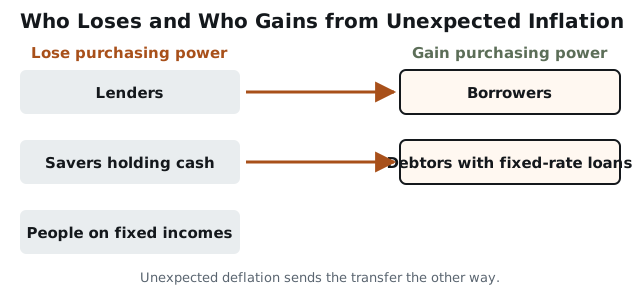
Part 2 of 3 Who Loses and Who Gains
| Group | Effect | Reason |
|---|---|---|
| Lenders on fixed-rate loans | Lose | They are repaid in dollars that buy less |
| Borrowers on fixed-rate loans | Gain | They repay with dollars that buy less |
| Savers holding cash or low fixed-rate accounts | Lose | The real value of their savings shrinks |
| People on fixed incomes | Lose | The same dollar income buys fewer goods |
| Workers whose contracts fix wages | Lose until wages catch up | Prices rise faster than their pay |
A retiree with a pension of $2,000 a month and no cost-of-living adjustment shows the fixed-income effect. If prices rise 8% in a year, that $2,000 buys what about $1,850 bought the year before.
Part 3 of 3 Deflation Reverses the Transfer
Unexpected deflation sends purchasing power the other way. Lenders gain, because each repaid dollar buys more. Borrowers lose, because their debts are fixed in dollars while their incomes and the prices they receive fall.
Lenders try to protect themselves. When they expect higher inflation, they ask for higher interest rates on new loans. The redistribution comes from the part of inflation nobody planned for.
Unexpected inflation helps whoever owes fixed dollars and hurts whoever is owed them.
People with incomes or debts that adjust with prices face less risk. A wage contract with a cost-of-living clause, or a loan whose rate moves with inflation, keeps the real terms close to what both sides expected.
Key Terms
Practice Questions
6 questions. Nothing here is recorded or scored.
- Question 1MEA-1.H.1
Which group is most likely to be hurt by unexpectedly high inflation?
- A.Borrowers with fixed-rate mortgages
- B.Lenders who made fixed-rate loans
- C.Workers whose wages rise automatically with the CPI
- D.Firms that raise their prices as fast as costs
Check answerHide answer
Answer: B
- A.
- Borrowers repay in dollars worth less than the dollars they borrowed, so they gain.
- B.
- Correct. Lenders are repaid fixed dollars that buy less than they expected, so unexpected inflation hurts them.
- C.
- Wages tied to the CPI keep pace with prices.
- D.
- Firms that raise prices with costs protect their real income.
- Question 2MEA-1.H.1
A bank and a borrower agree on a five-year loan at a fixed 6% interest rate, expecting 2% inflation. Inflation turns out to be 7% a year. Which of the following is true?
- A.The bank gains and the borrower loses.
- B.Both gain, because nominal incomes rise.
- C.Neither is affected, because the interest rate is fixed.
- D.The borrower gains and the bank loses.
Check answerHide answer
Answer: D
- A.
- The transfer runs the other way. The bank is repaid in cheaper dollars.
- B.
- Unexpected inflation moves purchasing power from one side to the other.
- C.
- A fixed interest rate is what exposes both sides to the surprise.
- D.
- Correct. With 7% inflation, the 6% interest the bank receives does not even keep pace with prices. Purchasing power shifts from the bank to the borrower.
- Question 3MEA-1.H.1
A retiree receives a pension of $1,800 a month that never changes. Prices rise 10% in a year. What happens to the retiree?
- A.Her real income falls.
- B.Her real income rises.
- C.Her nominal income falls.
- D.Her real income is unchanged.
Check answerHide answer
Answer: A
- A.
- Correct. The same $1,800 buys about 10% fewer goods, so her real income falls.
- B.
- Real income rises only if income grows faster than prices.
- C.
- Her nominal income stays at $1,800.
- D.
- A fixed dollar income loses purchasing power when prices rise.
- Question 4MEA-1.H.1
Which group would benefit from unexpected deflation?
- A.Borrowers with fixed-rate loans
- B.Firms whose output prices fall
- C.Lenders holding fixed-rate loans
- D.Workers whose wages are cut with prices
Check answerHide answer
Answer: C
- A.
- Borrowers repay fixed dollars that now buy more, so deflation hurts them.
- B.
- Falling output prices shrink firms' revenue while some costs stay fixed.
- C.
- Correct. Each repaid dollar buys more goods than expected, so lenders gain purchasing power.
- D.
- Wages cut in step with prices leave real income unchanged.
- Question 5MEA-1.H.1
A worker signs a two-year contract with a fixed wage of $25 an hour. Prices then rise faster than anyone expected. This is an example of
- A.unexpected inflation reducing the worker's real wage
- B.deflation raising the worker's real wage
- C.structural unemployment
- D.a rise in the worker's nominal wage
Check answerHide answer
Answer: A
- A.
- Correct. The nominal wage is locked at $25, so rising prices cut what each hour of work buys.
- B.
- Prices rose, which is inflation.
- C.
- The worker keeps the job, so this is not unemployment.
- D.
- The nominal wage stays at $25 under the contract.
- Question 6MEA-1.H.1
A saver keeps $10,000 in an account paying a fixed 1% a year, and a business owner owes $10,000 on a fixed 4% loan. Inflation unexpectedly rises to 6%. Which outcome is most likely?
- A.Both the saver and the business owner lose purchasing power.
- B.The saver gains and the business owner loses.
- C.Both gain because their dollar balances grow.
- D.The saver loses purchasing power and the business owner gains.
Check answerHide answer
Answer: D
- A.
- The business owner owes fixed dollars, and inflation shrinks what those dollars are worth.
- B.
- The saver's 1% falls far behind 6% inflation, so the saver loses.
- C.
- Dollar balances can grow while their purchasing power shrinks.
- D.
- Correct. The saver's balance grows 1% while prices rise 6%. The business owner repays a fixed 4% with dollars that lost 6% of their value.
Practice every topic in Unit 2
CED Codes
MEA-1.H.1