2.6 Real v. Nominal GDP
Separate output growth from price growth: calculate real GDP with base-year prices, find the GDP deflator, and convert nominal GDP to real GDP.
Part 1 of 3 Spending Versus Production
Nominal GDP values output at the prices of the year it was produced. Real GDP values output at constant base-year prices. Nominal GDP measures spending; real GDP measures production.
Nominal GDP can rise because the economy made more goods or because prices went up. Real GDP holds prices fixed, so it rises only when the quantity of output rises. Economists use real GDP to judge growth.
Part 2 of 3 Calculating Real GDP
| Year | Pizzas | Price | Books | Price | Nominal GDP | Real GDP |
|---|---|---|---|---|---|---|
| 1 | 100 | $10 | 50 | $20 | $2,000 | $2,000 |
| 2 | 110 | $12 | 50 | $22 | $2,420 | $2,100 |
Year 2 nominal GDP uses year 2 prices: 110 times $12 plus 50 times $22 is $2,420. Year 2 real GDP uses base-year prices: 110 times $10 plus 50 times $20 is $2,100. Nominal GDP grew 21%, while real output grew only 5%. Higher prices explain the rest.
The same steps work for any economy. Multiply each year's quantities by the base-year prices and add the results. Because the prices never change in that calculation, any change in the total comes from changes in quantities.
Valuing every year at one fixed set of base-year prices can overstate real growth over long periods. Statistical agencies use other methods to reduce that problem.
Part 3 of 3 The GDP Deflator
In year 2 the GDP deflator is 2,420 divided by 2,100, times 100, or about 115.2. Prices rose about 15.2% since the base year. A country reporting nominal GDP of $660 billion with a deflator of 110 has real GDP of $600 billion.
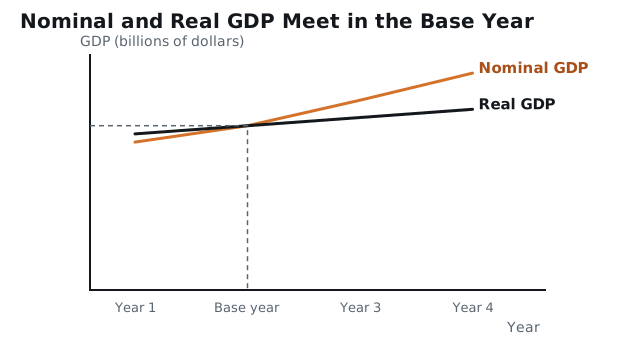
In the base year, nominal and real GDP are equal and the deflator is 100. After the base year, rising prices push nominal GDP above real GDP. Before the base year, nominal GDP sits below real GDP.
The deflator and the CPI both measure the price level, with different coverage. The CPI prices a fixed basket of consumer goods. The deflator covers every final good and service produced in the country, including capital goods and government purchases.
Key Terms
Practice Questions
6 questions. Nothing here is recorded or scored.
- Question 1MEA-1.J.2
Output in Harrowby
The table shows nominal GDP and the GDP deflator for the example country of Harrowby. Year 1 is the base year.
Year | Nominal GDP (billions) | GDP deflator 1 | $800 | 100 2 | $880 | 105 3 | $990 | 110 Based on the table, what was Harrowby's real GDP in year 3?
- A.$1,089 billion
- B.$990 billion
- C.$880 billion
- D.$900 billion
Check answerHide answer
Answer: D
- A.
- This multiplies by the deflator instead of dividing.
- B.
- Nine hundred ninety billion is nominal GDP, in year 3 prices.
- C.
- This is year 2 nominal GDP.
- D.
- Correct. Real GDP = 990 / 110 x 100 = $900 billion in base-year prices.
- Question 2MEA-1.I.1, MEA-1.J.2
Output in Harrowby
The table shows nominal GDP and the GDP deflator for the example country of Harrowby. Year 1 is the base year.
Year | Nominal GDP (billions) | GDP deflator 1 | $800 | 100 2 | $880 | 105 3 | $990 | 110 Based on the table, by about what percentage did Harrowby's real GDP grow from year 2 to year 3?
- A.7.4%
- B.12.5%
- C.4.8%
- D.10%
Check answerHide answer
Answer: A
- A.
- Correct. Year 2 real GDP is 880 / 105 x 100, about $838 billion. Year 3 real GDP is $900 billion. The growth is about 62 / 838, or 7.4%.
- B.
- Twelve and a half percent is the growth in nominal GDP.
- C.
- About 4.8% is the change in the deflator.
- D.
- Ten percent compares year 3 with the base year using the deflator alone.
- Question 3MEA-1.I.2
Real GDP differs from nominal GDP because real GDP
- A.includes intermediate goods
- B.is measured at constant base-year prices
- C.excludes government purchases
- D.is measured at current prices
Check answerHide answer
Answer: B
- A.
- Neither measure includes intermediate goods.
- B.
- Correct. Real GDP values output at base-year prices, which removes the effect of changes in the price level.
- C.
- Both measures include government purchases.
- D.
- Current prices define nominal GDP.
- Question 4MEA-1.I.1
From one year to the next, nominal GDP rises 6% and the price level rises 6%. Which of the following is true?
- A.Real GDP rose 12%.
- B.Real GDP rose 6%.
- C.Real GDP was about unchanged.
- D.Real GDP fell 6%.
Check answerHide answer
Answer: C
- A.
- Price growth does not add to real output.
- B.
- All of the nominal growth came from higher prices.
- C.
- Correct. Nominal growth minus price growth is about zero, so the quantity of output barely changed.
- D.
- Real GDP falls only if prices rise faster than nominal GDP.
- Question 5MEA-1.J.1
Why do statistical agencies use methods other than a single fixed base year to compute real GDP growth?
- A.A fixed base year can overstate real growth as relative prices change over time.
- B.A fixed base year makes nominal GDP impossible to measure.
- C.A fixed base year counts intermediate goods.
- D.A fixed base year leaves out government spending.
Check answerHide answer
Answer: A
- A.
- Correct. Valuing output at old base-year prices can overstate real GDP growth, so statistical agencies use other methods.
- B.
- Nominal GDP uses current prices and does not depend on a base year.
- C.
- The choice of base year does not change which goods are counted.
- D.
- Government purchases are counted under any base year.
- Question 6MEA-1.J.2
In one year the example country of Brisa had nominal GDP of $1,200 billion and real GDP of $1,000 billion. What was its GDP deflator?
- A.83.3
- B.100
- C.200
- D.120
Check answerHide answer
Answer: D
- A.
- This divides real GDP by nominal GDP.
- B.
- A deflator of 100 means the current year is the base year, with nominal equal to real.
- C.
- Two hundred is the dollar gap between the two measures.
- D.
- Correct. GDP deflator = 1,200 / 1,000 x 100 = 120.
Practice every topic in Unit 2
CED Codes
MEA-1.I.1 · MEA-1.I.2 · MEA-1.J.1 · MEA-1.J.2