2.7 Business Cycles
Trace the business cycle through peaks, troughs, recessions and expansions, and measure the output gap between actual real GDP and potential output.
Part 1 of 3 Ups and Downs Around a Trend
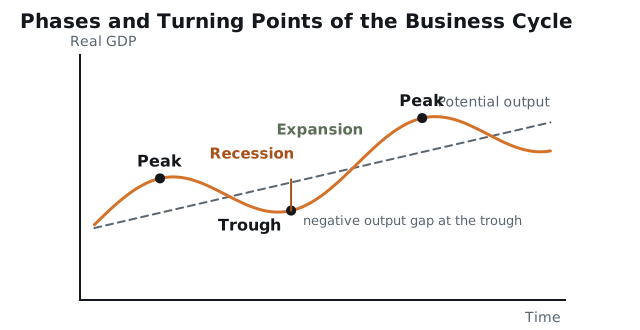
A business cycle is the rise and fall of real output and employment over time. Changes in aggregate demand or aggregate supply push the economy above or below its long-run path.
Part 2 of 3 Potential Output and the Output Gap
Potential output, also called full-employment output, is the real GDP the economy produces when unemployment equals the natural rate. The dashed line in the figure shows potential output growing over time as resources and technology improve.
The output gap is negative when the economy produces below potential. An economy producing $940 billion with a potential of $1,000 billion has a negative gap of $60 billion. Unemployment is above the natural rate, because cyclical unemployment has appeared.
The gap is positive when the economy runs above potential. Firms add shifts and overtime, unemployment falls below the natural rate, and prices tend to rise faster.
Over a full cycle, real GDP usually ends higher than it began, because potential output keeps growing beneath the ups and downs.
Part 3 of 3 Reading Cycle Data
A table of quarterly real GDP shows the cycle in numbers. Suppose real GDP reads $1,010, $1,020, $1,005, $990 and $1,000 billion over five quarters. The peak is the second quarter at $1,020. The recession runs through the third and fourth quarters. The trough is the fourth quarter at $990, and the expansion begins in the fifth.
A recession runs from a peak down to a trough. An expansion runs from a trough up to a peak.
Unemployment moves opposite to real GDP over the cycle. During the recession in the example, firms cut hours and lay off workers, so cyclical unemployment rises. During the expansion that follows, hiring returns and unemployment falls back toward the natural rate.
Key Terms
Practice Questions
6 questions. Nothing here is recorded or scored.
- Question 1MEA-2.A.3
Quarterly Output in Dunmere
The table shows real GDP for the example country of Dunmere over five quarters. Potential output is $510 billion in every quarter.
Quarter | Real GDP (billions) Q1 | $505 Q2 | $512 Q3 | $503 Q4 | $496 Q5 | $501 Based on the table, in which quarter did Dunmere reach a peak?
- A.Q1
- B.Q2
- C.Q4
- D.Q5
Check answerHide answer
Answer: B
- A.
- Real GDP rose after Q1, so Q1 is not a turning point.
- B.
- Correct. Real GDP rose to $512 billion in Q2 and then fell, so Q2 is the peak.
- C.
- Q4 is the lowest point, the trough.
- D.
- Q5 starts the expansion after the trough.
- Question 2MEA-2.A.2, MEA-2.A.3
Quarterly Output in Dunmere
The table shows real GDP for the example country of Dunmere over five quarters. Potential output is $510 billion in every quarter.
Quarter | Real GDP (billions) Q1 | $505 Q2 | $512 Q3 | $503 Q4 | $496 Q5 | $501 Based on the table, which statement describes Dunmere from Q2 to Q4?
- A.An expansion that ends at a trough
- B.A recession that ends at a peak
- C.An expansion that ends at a peak
- D.A recession that ends at a trough
Check answerHide answer
Answer: D
- A.
- Real GDP fell from Q2 to Q4, which is a recession.
- B.
- A recession ends at a trough.
- C.
- Falling output is a recession, and it ends at the low point.
- D.
- Correct. Real GDP fell from $512 to $496 billion, a recession, and the low point at Q4 is the trough.
- Question 3MEA-2.A.4
Quarterly Output in Dunmere
The table shows real GDP for the example country of Dunmere over five quarters. Potential output is $510 billion in every quarter.
Quarter | Real GDP (billions) Q1 | $505 Q2 | $512 Q3 | $503 Q4 | $496 Q5 | $501 Based on the table, what was Dunmere's output gap in Q4?
- A.A positive gap of $16 billion
- B.A negative gap of $14 billion
- C.A positive gap of $14 billion
- D.A negative gap of $16 billion
Check answerHide answer
Answer: B
- A.
- Sixteen billion compares Q4 with the Q2 peak instead of with potential output.
- B.
- Correct. Actual real GDP of $496 billion minus potential of $510 billion is negative $14 billion.
- C.
- Output is below potential, so the gap is negative.
- D.
- The gap compares actual output with potential output, $510 billion.
- Question 4MEA-2.A.5
Potential output is the level of real GDP at which
- A.unemployment is zero
- B.the economy is at the peak of a business cycle
- C.inflation is zero
- D.unemployment equals the natural rate
Check answerHide answer
Answer: D
- A.
- Full employment still includes frictional and structural unemployment, so unemployment is above zero.
- B.
- At a peak, output can sit above potential.
- C.
- Potential output is defined by employment, not by the inflation rate.
- D.
- Correct. Potential, or full-employment, output occurs when the unemployment rate equals the natural rate.
- Question 5MEA-2.A.1, MEA-2.A.2
During the recession phase of a business cycle, which of the following is most likely?
- A.Real GDP falls and cyclical unemployment rises.
- B.Real GDP rises and unemployment falls.
- C.Potential output falls to match actual output.
- D.The natural rate of unemployment falls to zero.
Check answerHide answer
Answer: A
- A.
- Correct. In a recession real output falls, and the drop in spending causes cyclical unemployment.
- B.
- That describes an expansion.
- C.
- Potential output depends on resources and technology, which do not shrink with each recession.
- D.
- The natural rate never falls to zero, and recessions raise cyclical unemployment.
- Question 6MEA-2.A.4, MEA-2.A.5
An economy is producing real GDP above its potential output. Which of the following is most likely true?
- A.Unemployment is above the natural rate.
- B.The output gap is negative.
- C.Unemployment is below the natural rate.
- D.The economy is at a trough.
Check answerHide answer
Answer: C
- A.
- Output above potential means firms are using more labor than at full employment.
- B.
- Actual output above potential gives a positive output gap.
- C.
- Correct. Producing beyond potential needs extra workers and hours, which pushes unemployment below the natural rate.
- D.
- A trough is a low point, usually below potential.
Practice every topic in Unit 2
CED Codes
MEA-2.A.1 · MEA-2.A.2 · MEA-2.A.3 · MEA-2.A.4 · MEA-2.A.5