3.1 Aggregate Demand (AD)
See why the aggregate demand curve slopes downward through three effects, and which changes in C, I, G and net exports shift the whole curve.
Part 1 of 3 What the AD Curve Shows
Aggregate demand (AD) is the total real output that households, firms, government and foreign buyers want at each price level. AD adds up all four spending components: C + I + G + Xn.
The AD curve plots the price level on the vertical axis and real GDP on the horizontal axis. AD is about the whole economy, so the price on the axis is an average of all prices. AD differs from the demand curve for one good, where buyers can switch to other goods when one price rises.
Each component has its own buyers. Households make consumption, firms make investment, the government makes its purchases, and foreign buyers make exports.
Part 2 of 3 Why AD Slopes Downward
Three effects explain why a higher price level lowers the quantity of real output demanded.
| Effect | When the price level rises | Spending that falls |
|---|---|---|
| Real wealth effect | Savings and other assets buy less | Consumption |
| Interest rate effect | People need more money for purchases, which pushes interest rates up | Investment and consumption on credit |
| Exchange rate effect | Domestic goods become more expensive than foreign goods | Net exports |
Each effect works in reverse when the price level falls. Wealth buys more, interest rates drop and exports become cheaper abroad, so the quantity of real output demanded rises.
None of these three effects shifts the curve. Each one explains a movement along AD as the price level changes, with every spending plan held constant.
Part 3 of 3 What Shifts AD
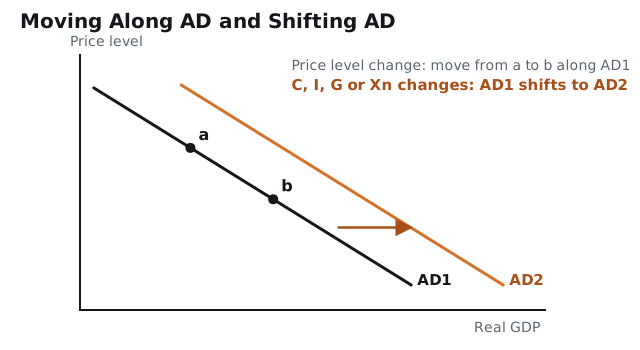
Any change in consumption, investment, government spending or net exports that does not come from a change in the price level shifts the whole AD curve. An increase shifts AD to the right. A decrease shifts AD to the left.
| Component | Example change | AD |
|---|---|---|
| Consumption | Household wealth rises as home values climb | Increases |
| Consumption | Personal income taxes rise | Decreases |
| Investment | Firms expect strong future sales | Increases |
| Investment | Interest rates rise for a reason other than the price level | Decreases |
| Government spending | The government buys more roads and bridges | Increases |
| Net exports | Incomes rise in the country's trading partners | Increases |
| Net exports | The country's currency gains value | Decreases |
Expectations matter on both the household and the business side. Households that expect a recession save more and spend less today. Firms that expect weak sales postpone new factories. Both changes shift AD to the left before any recession arrives.
Household debt matters too. Households that owe a great deal spend more of each paycheck on loan payments, which lowers consumption at every price level.
Key Terms
Practice Questions
6 questions. Nothing here is recorded or scored.
- Question 1MOD-2.A.2
Which of the following is one reason the aggregate demand curve slopes downward?
- A.A higher price level raises firms' production costs.
- B.A higher price level reduces the purchasing power of household wealth.
- C.A higher price level increases government spending.
- D.A higher price level makes domestic goods cheaper for foreign buyers.
Check answerHide answer
Answer: B
- A.
- Production costs relate to aggregate supply.
- B.
- Correct. This is the real wealth effect. When the price level rises, savings buy less, so households demand less real output.
- C.
- Government spending is a shifter of AD and does not explain its slope.
- D.
- A higher price level makes domestic goods more expensive abroad, which lowers net exports.
- Question 2MOD-2.A.3
Businesses in the example country of Kelvaro become more optimistic about future sales and order new equipment. What happens to aggregate demand?
- A.AD decreases because firms spend less on consumption.
- B.AD increases because investment rises.
- C.The economy moves down along the AD curve.
- D.AD is unchanged because investment is not part of AD.
Check answerHide answer
Answer: B
- A.
- Firms buying equipment raises investment, not consumption.
- B.
- Correct. More investment spending at every price level shifts AD to the right.
- C.
- A movement along AD needs a change in the price level.
- D.
- Investment is one of the four components of AD.
- Question 3MOD-2.A.3
Which of the following would shift a country's aggregate demand curve to the left?
- A.An increase in household wealth
- B.An increase in government purchases
- C.An increase in personal income taxes
- D.An increase in incomes abroad
Check answerHide answer
Answer: C
- A.
- Higher wealth raises consumption and increases AD.
- B.
- More government purchases increase AD directly.
- C.
- Correct. Higher income taxes lower disposable income, so consumption falls and AD shifts left.
- D.
- Higher foreign incomes raise exports and increase AD.
- Question 4MOD-2.A.2
When a country's price level rises, its exports become more expensive for foreign buyers and its imports seem cheaper to residents. This describes the
- A.interest rate effect
- B.real wealth effect
- C.multiplier effect
- D.exchange rate effect
Check answerHide answer
Answer: D
- A.
- The interest rate effect works through borrowing costs.
- B.
- The real wealth effect works through the purchasing power of assets.
- C.
- The multiplier describes rounds of spending after a shift in AD.
- D.
- Correct. A higher price level makes domestic goods more expensive relative to foreign goods, so net exports fall. That is the exchange rate effect.
- Question 5MOD-2.A.1, MOD-2.A.3
A country's currency loses value against the currencies of its trading partners. On a correctly labeled AD-AS graph, what happens to AD?
- A.AD shifts right because net exports rise.
- B.AD shifts left because net exports fall.
- C.The economy moves up along AD.
- D.AD shifts left because imports become cheaper.
Check answerHide answer
Answer: A
- A.
- Correct. A weaker currency makes the country's exports cheaper abroad and imports more expensive at home, so net exports rise and AD shifts right.
- B.
- Net exports rise with a weaker currency.
- C.
- The price level did not change, so the curve shifts.
- D.
- Imports become more expensive when the currency weakens.
- Question 6MOD-2.A.2, MOD-2.A.3
Which of the following correctly distinguishes a movement along AD from a shift of AD?
- A.A rise in interest rates caused by a higher price level shifts AD; a rise in interest rates for any other reason moves along AD.
- B.A change in the price level moves along AD; a change in a spending component not caused by the price level shifts AD.
- C.A change in government spending moves along AD; a change in the price level shifts AD.
- D.Any change in consumption moves along AD.
Check answerHide answer
Answer: B
- A.
- This swaps the two cases. An interest rate change caused by the price level is the interest rate effect, a movement along AD.
- B.
- Correct. The price level is on the vertical axis, so its change moves the economy along AD. Changes in C, I, G or Xn from other causes shift AD.
- C.
- Government spending is a shifter, and the price level moves along the curve.
- D.
- A change in consumption from wealth, taxes or expectations shifts AD.
Practice every topic in Unit 3
CED Codes
MOD-2.A.1 · MOD-2.A.2 · MOD-2.A.3