3.2 Multipliers
Calculate the MPC, MPS and the spending and tax multipliers, and see how one change in spending or taxes changes real GDP by a larger amount.
Part 1 of 3 Spending Becomes Someone Else's Income
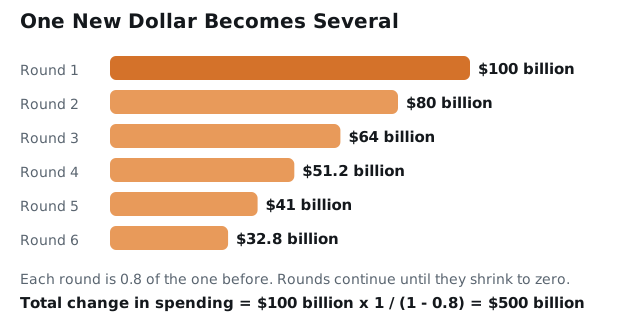
A new dollar of spending becomes income for whoever receives it, and that person spends part of it. A change in autonomous expenditure sets off further rounds of spending, so total output changes by more than the first change.
Suppose a city spends $100 billion more on schools. Builders and suppliers receive $100 billion in new income. They spend part of that income at stores and restaurants, whose owners and workers then spend part of what they receive. Each round is smaller than the one before.
Part 2 of 3 MPC and MPS
The marginal propensity to consume (MPC) is the share of an extra dollar of disposable income that households spend. The marginal propensity to save (MPS) is the share they save. Every extra dollar is either spent or saved, so MPC + MPS = 1.
MPC equals the change in consumption divided by the change in disposable income. MPS equals the change in saving divided by the change in disposable income. MPC plus MPS equals 1.
If disposable income rises by $2,000 and spending rises by $1,500, the MPC is 0.75 and the MPS is 0.25.
Part 3 of 3 The Two Multipliers
| MPC | MPS | Spending multiplier | Tax multiplier |
|---|---|---|---|
| 0.5 | 0.5 | 2 | -1 |
| 0.75 | 0.25 | 4 | -3 |
| 0.8 | 0.2 | 5 | -4 |
| 0.9 | 0.1 | 10 | -9 |
With an MPC of 0.8, a $20 billion rise in government spending can raise real GDP by $20 billion times 5, or $100 billion. A $20 billion tax cut can raise real GDP by $20 billion times 4, or $80 billion. The tax cut has a smaller effect because households save part of it before any spending begins.
The minus sign on the tax multiplier shows direction. A tax increase lowers real GDP, and a tax cut raises it. A higher MPC makes both multipliers larger, because more of each round is spent.
The multiplier also works in reverse. If firms cut investment by $10 billion and the MPC is 0.8, real GDP can fall by $50 billion as each round of lost income cuts the next round of spending.
The tax multiplier is always smaller in size than the spending multiplier.
Key Terms
Practice Questions
5 questions. Nothing here is recorded or scored.
- Question 1MOD-2.B.5
Disposable income in the example country of Pellanor rises by $400 billion, and consumer spending rises by $300 billion. What is the marginal propensity to save?
- A.0.75
- B.0.25
- C.1.33
- D.0.3
Check answerHide answer
Answer: B
- A.
- Seventy-five hundredths is the MPC, spending divided by income.
- B.
- Correct. Households saved $100 billion of the $400 billion, so the MPS is 0.25.
- C.
- This divides income by spending.
- D.
- This confuses the dollar amount with the ratio.
- Question 2MOD-2.B.2, MOD-2.B.4
The MPC is 0.8. Government spending rises by $15 billion. By how much can real GDP rise?
- A.$12 billion
- B.$15 billion
- C.$60 billion
- D.$75 billion
Check answerHide answer
Answer: D
- A.
- Twelve billion is the first round of consumer spending only.
- B.
- The first round is only the start. Each dollar is respent.
- C.
- Sixty billion uses the tax multiplier of 4.
- D.
- Correct. The spending multiplier is 1 / (1 - 0.8) = 5, so $15 billion x 5 = $75 billion.
- Question 3MOD-2.B.3, MOD-2.B.4
The MPC is 0.75. The government cuts taxes by $40 billion. By how much can real GDP change?
- A.It rises by $120 billion.
- B.It rises by $160 billion.
- C.It falls by $120 billion.
- D.It rises by $30 billion.
Check answerHide answer
Answer: A
- A.
- Correct. The tax multiplier is -0.75 / 0.25 = -3. A tax cut of $40 billion raises real GDP by $40 billion x 3 = $120 billion.
- B.
- One hundred sixty billion uses the spending multiplier of 4. Households save part of a tax cut.
- C.
- A tax cut raises real GDP.
- D.
- Thirty billion is the first round of spending only.
- Question 4MOD-2.B.4
Which of the following would increase the size of the spending multiplier?
- A.An increase in the MPS
- B.A decrease in the MPC
- C.An increase in the MPC
- D.An increase in government spending
Check answerHide answer
Answer: C
- A.
- A larger MPS means more of each round is saved, which shrinks the multiplier.
- B.
- A smaller MPC also shrinks the multiplier.
- C.
- Correct. A higher MPC means households spend more of each round, so the multiplier 1 / (1 - MPC) grows.
- D.
- More spending changes how much GDP changes, but the multiplier depends only on the MPC.
- Question 5MOD-2.B.1, MOD-2.B.2
The expenditure multiplier exists because
- A.one person's spending becomes another person's income, which is partly spent again
- B.taxes rise whenever government spending rises
- C.prices rise whenever spending rises
- D.households save all of any new income
Check answerHide answer
Answer: A
- A.
- Correct. A first change in spending becomes income, part of which is spent again in further rounds, so total spending rises by more than the first change.
- B.
- The multiplier does not depend on tax changes.
- C.
- The simple multiplier describes spending rounds, not the price level.
- D.
- If households saved everything, the multiplier would be 1.
Practice every topic in Unit 3
CED Codes
MOD-2.B.1 · MOD-2.B.2 · MOD-2.B.3 · MOD-2.B.4 · MOD-2.B.5