3.3 Short-Run Aggregate Supply (SRAS)
See why short-run aggregate supply slopes upward with sticky wages and prices, what shifts SRAS, and why a move along it trades inflation for jobs.
Part 1 of 3 Why SRAS Slopes Upward
Short-run aggregate supply (SRAS) is the total real output firms produce at each price level. SRAS slopes upward because some input prices, especially wages, are sticky in the short run.
Sticky wages and prices adjust slowly. Labor contracts fix wages for a year or more, and many suppliers set prices in advance. When the price level rises and wages stay put, each unit of output earns firms more than it costs. Firms respond by producing more. When the price level falls with wages fixed, profit per unit shrinks and firms cut output.
Part 2 of 3 Moving Along SRAS
A move up the SRAS curve means a higher price level and more real output. Producing more output takes more workers, so employment rises. With the labor force unchanged, unemployment falls.
Along SRAS, higher inflation comes with lower unemployment, and lower inflation comes with higher unemployment.
This short-run trade-off between inflation and unemployment returns in Unit 5 as the short-run Phillips curve. The trade-off holds only while wages and other input prices stay fixed.
A move along SRAS happens when AD shifts. When AD rises, the economy climbs SRAS to a higher price level and more output. When AD falls, it slides down SRAS.
Part 3 of 3 What Shifts SRAS
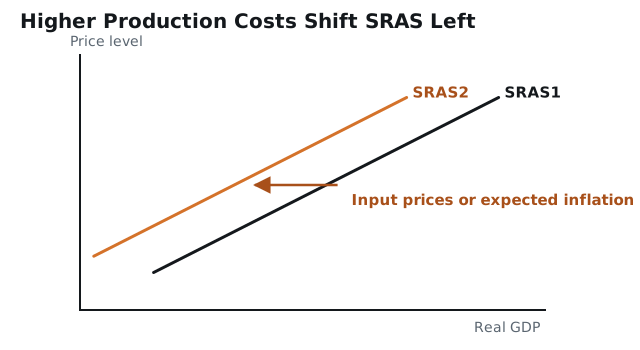
Any factor that changes the cost of producing output at every price level shifts SRAS. Higher costs shift SRAS left, and lower costs shift SRAS right.
| Shifter | Example | SRAS |
|---|---|---|
| Input prices | Nominal wages or energy prices rise | Decreases |
| Inflationary expectations | Workers expect 6% inflation and bargain for higher pay | Decreases |
| Productivity | New software lets each worker handle more orders | Increases |
| Business taxes, subsidies and regulation | The government raises a per-unit tax on producers | Decreases |
| Supply shocks | A drought ruins harvests | Decreases |
Inflationary expectations matter because people act on them. When workers expect prices to rise, they ask for higher wages to protect their real pay. Firms facing higher wage bills offer less output at every price level.
Productivity works in the other direction. When workers produce more per hour, the cost of each unit falls and SRAS shifts right.
Key Terms
Practice Questions
6 questions. Nothing here is recorded or scored.
- Question 1MOD-2.C.2
The short-run aggregate supply curve slopes upward because
- A.wages and some other input prices are slow to adjust
- B.consumers buy more when the price level falls
- C.government spending rises with the price level
- D.all prices and wages adjust immediately
Check answerHide answer
Answer: A
- A.
- Correct. With wages fixed for a time, a higher price level raises profit per unit, so firms produce more.
- B.
- That is a reason for the slope of AD.
- C.
- Government spending is not tied to the slope of SRAS.
- D.
- Fully flexible prices and wages describe the long run, where supply is vertical.
- Question 2MOD-2.C.3
The world price of oil, a key input for many firms, rises sharply. What happens to short-run aggregate supply?
- A.SRAS shifts right.
- B.SRAS shifts left.
- C.The economy moves up along SRAS.
- D.LRAS shifts right.
Check answerHide answer
Answer: B
- A.
- Higher costs reduce SRAS.
- B.
- Correct. Higher input costs reduce the output firms supply at every price level, so SRAS shifts left.
- C.
- A movement along SRAS needs a change in the price level.
- D.
- A cost increase does not raise long-run capacity.
- Question 3MOD-2.C.3
Workers in the example country of Thessaly come to expect higher inflation next year and negotiate larger raises. What happens in the AD-AS model?
- A.AD shifts right.
- B.SRAS shifts right.
- C.SRAS shifts left.
- D.LRAS shifts left.
Check answerHide answer
Answer: C
- A.
- The wage bargaining affects firms' costs, which is supply.
- B.
- Higher wages raise costs, which reduces SRAS.
- C.
- Correct. Higher expected inflation raises nominal wages and production costs, so SRAS shifts left.
- D.
- Wage bargains do not change the economy's long-run capacity.
- Question 4MOD-2.D.1
The economy moves up along a fixed SRAS curve. Holding the labor force constant, which of the following is most likely?
- A.The price level falls and unemployment rises.
- B.The price level rises and unemployment rises.
- C.The price level falls and unemployment falls.
- D.The price level rises and unemployment falls.
Check answerHide answer
Answer: D
- A.
- Moving up SRAS raises the price level.
- B.
- More output needs more workers, so unemployment falls.
- C.
- The price level rises along an upward move.
- D.
- Correct. A higher price level comes with more output and employment, so unemployment falls. This is the short-run trade-off.
- Question 5MOD-2.C.3
Which of the following would increase short-run aggregate supply?
- A.A rise in nominal wages
- B.A drop in the price of electricity
- C.A new per-unit tax on producers
- D.A rise in the price level
Check answerHide answer
Answer: B
- A.
- Higher wages raise costs and decrease SRAS.
- B.
- Correct. Cheaper electricity lowers production costs, so firms supply more at every price level.
- C.
- A new tax on producers raises costs and decreases SRAS.
- D.
- A change in the price level moves along SRAS.
- Question 6MOD-2.C.1, MOD-2.C.3
Which of the following correctly compares a change in the price level with a change in input prices?
- A.Both shift SRAS to the left.
- B.A change in the price level moves the economy along SRAS, while a change in input prices shifts SRAS.
- C.A change in the price level shifts SRAS, while a change in input prices moves the economy along SRAS.
- D.Neither affects short-run output.
Check answerHide answer
Answer: B
- A.
- Only cost changes shift SRAS.
- B.
- Correct. The price level is on the vertical axis, so its change is a movement along SRAS. Input prices change costs at every price level, which shifts the curve.
- C.
- This swaps the two effects.
- D.
- A movement along SRAS changes output, and so does a shift.
Practice every topic in Unit 3
CED Codes
MOD-2.C.1 · MOD-2.C.2 · MOD-2.C.3 · MOD-2.D.1