3.4 Long-Run Aggregate Supply (LRAS)
Separate the short run from the long run, and see why long-run aggregate supply is a vertical line at full-employment output that matches the PPC.
Part 1 of 3 The Short Run and the Long Run
In the short run, some input prices, especially nominal wages, are fixed. In the long run, every wage and price has time to adjust. That one difference explains why the short-run and long-run supply curves look different.
Because wages and prices fully adjust in the long run, a higher price level brings higher wages with it. Firms gain no lasting advantage from the higher price level, so they have no reason to produce more. The trade-off between inflation and unemployment disappears.
Part 2 of 3 A Vertical LRAS
The long-run aggregate supply (LRAS) curve is a vertical line at potential output, also called full-employment output (Yf). At Yf, unemployment equals the natural rate. In the long run the economy produces Yf at any price level.
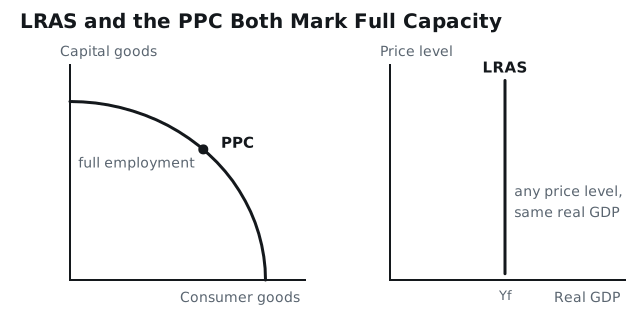
LRAS matches the production possibilities curve (PPC). Both show maximum sustainable capacity: the output an economy can keep producing over a period when all its resources are fully employed. A point on the PPC and a point on LRAS describe the same economy at full employment.
The word sustainable matters. An economy can produce beyond Yf for a while, with overtime shifts and unemployment below the natural rate. That output cannot last, because wages and prices rise until output returns to Yf.
Output can also sit below Yf for a time, as in a recession, when the economy is inside its PPC.
Part 3 of 3 What Moves LRAS
LRAS shifts when the economy's capacity changes, for the same reasons the PPC shifts. More labor, more capital, more natural resources or better technology shift LRAS to the right. A natural disaster that destroys factories shifts LRAS to the left. Topic 3.7 shows how these shifts mark economic growth.
The price level cannot move LRAS. Only resources, technology and productivity can.
Key Terms
Practice Questions
6 questions. Nothing here is recorded or scored.
- Question 1MOD-2.F.2
The long-run aggregate supply curve is vertical because in the long run
- A.wages and prices fully adjust
- B.firms cannot hire more workers
- C.the price level never changes
- D.aggregate demand is fixed
Check answerHide answer
Answer: A
- A.
- Correct. Once wages and prices fully adjust, a change in the price level gives firms no reason to change output, so LRAS is vertical at full-employment output.
- B.
- Firms can hire in the long run. Output settles at the full-employment level.
- C.
- The price level can change in the long run; output does not respond to it.
- D.
- AD can shift in the long run.
- Question 2MOD-2.F.1
Which of the following describes the link between LRAS and the production possibilities curve?
- A.Both show how output changes with the price level.
- B.Both slope downward.
- C.Both show only short-run output.
- D.Both represent the economy's maximum sustainable capacity with all resources fully employed.
Check answerHide answer
Answer: D
- A.
- The PPC has no price level on it, and LRAS output does not change with the price level.
- B.
- LRAS is vertical.
- C.
- Both describe the economy's long-run capacity.
- D.
- Correct. A point on the PPC and the LRAS line both describe full employment of resources.
- Question 3MOD-2.E.1
Which of the following is true in the long run but not in the short run?
- A.Some input prices are fixed.
- B.A higher price level comes with lower unemployment.
- C.All wages and prices are fully flexible.
- D.The SRAS curve slopes upward.
Check answerHide answer
Answer: C
- A.
- Fixed input prices describe the short run.
- B.
- That trade-off holds only in the short run.
- C.
- Correct. In the long run every wage and price adjusts. That flexibility removes the trade-off between inflation and unemployment.
- D.
- An upward SRAS reflects short-run sticky prices.
- Question 4MOD-2.F.2
In the long run, the price level in the example country of Brannock doubles. What happens to real GDP?
- A.It stays at full-employment output.
- B.It doubles.
- C.It falls by half.
- D.It rises above full-employment output permanently.
Check answerHide answer
Answer: A
- A.
- Correct. LRAS is vertical, so in the long run real GDP stays at full-employment output whatever the price level.
- B.
- Real output depends on resources and technology in the long run.
- C.
- A higher price level does not shrink long-run capacity.
- D.
- Output above full employment cannot last because wages adjust.
- Question 5MOD-2.F.1
On a correctly labeled long-run aggregate supply graph, the LRAS curve is
- A.upward sloping, with real GDP on the vertical axis
- B.vertical at full-employment output, with the price level on the vertical axis
- C.horizontal at the current price level
- D.downward sloping at full-employment output
Check answerHide answer
Answer: B
- A.
- Real GDP goes on the horizontal axis, and LRAS is vertical.
- B.
- Correct. The AD-AS graph puts the price level on the vertical axis and real GDP on the horizontal axis, with LRAS vertical at Yf.
- C.
- A horizontal line would mean output can change with no change in price level.
- D.
- A downward slope describes AD.
- Question 6MOD-2.E.1, MOD-2.F.2
Why is there no long-run trade-off between inflation and unemployment?
- A.Unemployment is always zero in the long run.
- B.Wages rise along with prices, so firms have no lasting reason to produce more at a higher price level.
- C.The government holds the price level fixed in the long run.
- D.Aggregate demand cannot shift in the long run.
Check answerHide answer
Answer: B
- A.
- Unemployment settles at the natural rate, which is above zero.
- B.
- Correct. When wages fully adjust to higher prices, real costs return to where they were. Output returns to Yf, and unemployment returns to the natural rate.
- C.
- The price level can change in the long run.
- D.
- AD can shift; the shift changes only the price level in the long run.
Practice every topic in Unit 3
CED Codes
MOD-2.E.1 · MOD-2.F.1 · MOD-2.F.2