3.5 Equilibrium in the Aggregate Demand–Aggregate Supply (AD–AS) Model
Find short-run and long-run equilibrium in the AD-AS model, and identify recessionary and inflationary output gaps from where AD and SRAS cross.
Part 1 of 3 Short-Run Equilibrium
Short-run equilibrium is where AD crosses SRAS. At that point the real output buyers want equals the real output firms supply, which sets the price level and real GDP for now.
At a price level above the crossing, firms supply more output than buyers want. Unsold inventories pile up, and firms cut prices and output. At a price level below the crossing, buyers want more than firms supply. Inventories run down, and prices and output rise.
An example economy shows the numbers. At a price level of 110, buyers want $760 billion of real output and firms supply $840 billion. At 100, both quantities equal $800 billion. The short-run equilibrium is a price level of 100 and real GDP of $800 billion.
Part 2 of 3 Long-Run Equilibrium
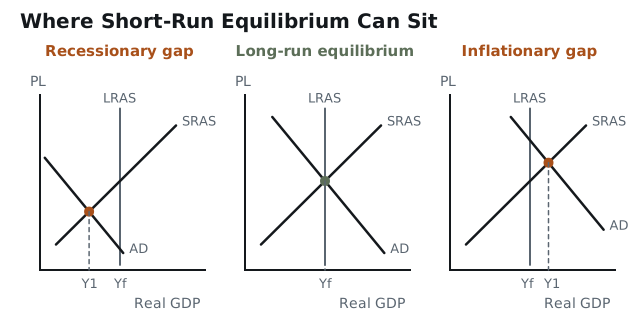
Long-run equilibrium occurs when AD and SRAS cross on the LRAS curve. Real GDP equals full-employment output, and unemployment equals the natural rate. Nothing in the economy pushes wages to change.
Long-run equilibrium is a resting point. If no new shock arrives, the economy stays at Yf with a steady price level.
Part 3 of 3 Output Gaps
Short-run equilibrium can sit at full employment, below it or above it.
| Position | Output gap | Unemployment | Price level pressure |
|---|---|---|---|
| Left of LRAS | Recessionary gap (negative) | Above the natural rate | Downward over time |
| On LRAS | None | At the natural rate | None |
| Right of LRAS | Inflationary gap (positive) | Below the natural rate | Upward over time |
In a recessionary gap, an example economy with Yf of $800 billion produces only $760 billion. The negative output gap of $40 billion leaves cyclical unemployment. In an inflationary gap, the same economy produces $830 billion. Firms run extra shifts, unemployment falls below the natural rate, and pressure builds for wages to rise.
Read gaps from the horizontal axis. The size of the gap is the distance between the equilibrium output and Yf. The price level on the vertical axis shows how prices compare between equilibria.
Left of LRAS is a recession. Right of LRAS is an overheating economy.
Key Terms
Practice Questions
6 questions. Nothing here is recorded or scored.
- Question 1MOD-2.G.1
Aggregate Data for Corrin
The table shows aggregate demand and short-run aggregate supply for the example country of Corrin. Corrin's full-employment output is $850 billion.
Price level | Real GDP demanded (billions) | Real GDP supplied, short run (billions) 120 | 700 | 900 110 | 760 | 840 100 | 800 | 800 90 | 860 | 740 Based on the table, what are Corrin's short-run equilibrium price level and real GDP?
- A.110 and $760 billion
- B.100 and $800 billion
- C.120 and $900 billion
- D.90 and $860 billion
Check answerHide answer
Answer: B
- A.
- At 110, buyers want $760 billion and firms supply $840 billion.
- B.
- Correct. At a price level of 100, real GDP demanded equals real GDP supplied at $800 billion.
- C.
- At 120, firms supply far more than buyers want.
- D.
- At 90, buyers want more than firms supply.
- Question 2MOD-2.G.3
Aggregate Data for Corrin
The table shows aggregate demand and short-run aggregate supply for the example country of Corrin. Corrin's full-employment output is $850 billion.
Price level | Real GDP demanded (billions) | Real GDP supplied, short run (billions) 120 | 700 | 900 110 | 760 | 840 100 | 800 | 800 90 | 860 | 740 Based on the table, which statement describes Corrin's economy?
- A.It has an inflationary gap of $50 billion.
- B.It is in long-run equilibrium.
- C.It has a recessionary gap of $50 billion.
- D.It has a recessionary gap of $800 billion.
Check answerHide answer
Answer: C
- A.
- Output is below full employment, so the gap is recessionary.
- B.
- Long-run equilibrium needs output at $850 billion.
- C.
- Correct. Equilibrium output of $800 billion is $50 billion below full-employment output of $850 billion: a negative, or recessionary, gap.
- D.
- Eight hundred billion is equilibrium output. The gap is the distance from $850 billion.
- Question 3MOD-2.G.3
Aggregate Data for Corrin
The table shows aggregate demand and short-run aggregate supply for the example country of Corrin. Corrin's full-employment output is $850 billion.
Price level | Real GDP demanded (billions) | Real GDP supplied, short run (billions) 120 | 700 | 900 110 | 760 | 840 100 | 800 | 800 90 | 860 | 740 Based on the table, how does Corrin's unemployment rate compare with its natural rate?
- A.Above the natural rate
- B.Equal to the natural rate
- C.Below the natural rate
- D.Equal to zero
Check answerHide answer
Answer: A
- A.
- Correct. Output below full employment leaves cyclical unemployment, so unemployment is above the natural rate.
- B.
- Unemployment equals the natural rate only at full-employment output.
- C.
- Unemployment falls below the natural rate only when output exceeds full employment.
- D.
- Unemployment never falls to zero.
- Question 4MOD-2.G.2
An economy is in long-run equilibrium when
- A.AD crosses SRAS anywhere
- B.AD and SRAS cross to the right of LRAS
- C.SRAS crosses LRAS above AD
- D.AD and SRAS cross on the LRAS curve
Check answerHide answer
Answer: D
- A.
- Any crossing gives short-run equilibrium. Long-run equilibrium needs the crossing on LRAS.
- B.
- A crossing right of LRAS is an inflationary gap.
- C.
- Equilibrium needs AD to cross SRAS.
- D.
- Correct. When AD and SRAS meet on LRAS, output is at full employment and unemployment is at the natural rate.
- Question 5MOD-2.G.3
On an AD-AS graph, AD and SRAS cross to the right of the vertical LRAS. Which of the following describes this economy?
- A.An inflationary gap with unemployment below the natural rate
- B.A recessionary gap with unemployment above the natural rate
- C.Long-run equilibrium with unemployment at the natural rate
- D.A recessionary gap with a falling price level
Check answerHide answer
Answer: A
- A.
- Correct. Output to the right of LRAS exceeds full-employment output. That positive gap means unemployment is below the natural rate.
- B.
- A recessionary gap sits to the left of LRAS.
- C.
- Long-run equilibrium sits on LRAS.
- D.
- The crossing is to the right of LRAS, which is not a recessionary gap.
- Question 6MOD-2.G.1
Aggregate Data for Corrin
The table shows aggregate demand and short-run aggregate supply for the example country of Corrin. Corrin's full-employment output is $850 billion.
Price level | Real GDP demanded (billions) | Real GDP supplied, short run (billions) 120 | 700 | 900 110 | 760 | 840 100 | 800 | 800 90 | 860 | 740 Based on the table, suppose Corrin's price level were 110. Which of the following describes the economy and what happens next?
- A.Buyers want $80 billion more output than firms supply, so the price level rises.
- B.The economy is in short-run equilibrium, so nothing changes.
- C.Output equals full-employment output, so wages adjust.
- D.Firms supply $80 billion more output than buyers want, so inventories build up and the price level falls toward 100.
Check answerHide answer
Answer: D
- A.
- This reverses the two quantities. At 110, supply is $840 billion and demand is $760 billion.
- B.
- Equilibrium needs the two quantities to be equal, which happens at 100.
- C.
- Full-employment output is $850 billion, and neither quantity at 110 describes equilibrium output.
- D.
- Correct. At 110, firms supply $840 billion and buyers want $760 billion. Unsold output builds up, so firms cut prices until the economy reaches 100 and $800 billion.
Practice every topic in Unit 3
CED Codes
MOD-2.G.1 · MOD-2.G.2 · MOD-2.G.3