3.6 Changes in the AD–AS Model in the Short Run
Predict what demand and supply shocks do to output, employment and the price level in the short run, and tell demand-pull from cost-push inflation.
Part 1 of 3 Shocks to Aggregate Demand
A shock to AD or SRAS moves the economy to a new short-run equilibrium. Demand shocks move output and the price level in the same direction; supply shocks move them in opposite directions.
A positive demand shock shifts AD right. Real output, employment and the price level all rise. A surge in consumer confidence or a jump in exports are examples. A negative demand shock shifts AD left, so output, employment and the price level all fall, as when firms cut investment plans.
Employment follows output in every case. When firms produce more, they hire more workers and unemployment falls. When they produce less, they lay workers off and unemployment rises.
Part 2 of 3 Shocks to Aggregate Supply
A positive supply shock shifts SRAS right. Output and employment rise, and the price level falls. A sharp drop in energy prices is an example. A negative supply shock shifts SRAS left. Output and employment fall while the price level rises. That mix of rising prices and falling output is stagflation.
Supply shocks are harder for households, because prices rise just as jobs become scarce. A sudden rise in oil prices is the textbook case: every firm that ships goods or runs machines faces higher costs at once.
| Shock | Real output | Employment | Price level |
|---|---|---|---|
| AD increases | Rises | Rises | Rises |
| AD decreases | Falls | Falls | Falls |
| SRAS increases | Rises | Rises | Falls |
| SRAS decreases | Falls | Falls | Rises |
Part 3 of 3 Demand-Pull and Cost-Push Inflation
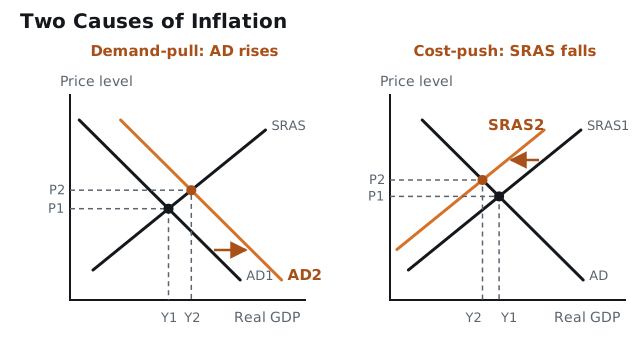
| Demand-pull inflation | Cost-push inflation | |
|---|---|---|
| Cause | AD increases | SRAS decreases |
| Real output | Rises | Falls |
| Unemployment | Falls | Rises |
Suppose the example country of Ostmark sees its main trading partner boom, and exports climb. AD shifts right, and Ostmark gets demand-pull inflation with more jobs. Now suppose a storm closes Ostmark's ports for months and raises shipping costs. SRAS shifts left, and Ostmark gets cost-push inflation with fewer jobs.
Two shocks can arrive together. If AD and SRAS both decrease, output falls for sure, while the price level change depends on which shift is larger.
Key Terms
Practice Questions
6 questions. Nothing here is recorded or scored.
- Question 1MOD-2.H.1
Consumer confidence rises sharply in the example country of Lorvane. In the short run, what happens to real output and the price level?
- A.Real output rises and the price level rises.
- B.Real output falls and the price level rises.
- C.Real output rises and the price level falls.
- D.Both fall.
Check answerHide answer
Answer: A
- A.
- Correct. Higher confidence raises consumption, shifting AD right. Output, employment and the price level all rise.
- B.
- Rising prices with falling output come from a decrease in SRAS.
- C.
- Rising output with falling prices comes from an increase in SRAS.
- D.
- Both fall after a decrease in AD.
- Question 2MOD-2.H.2
A severe drought destroys crops across a country. In the short run, which of the following is most likely?
- A.Real GDP rises and the price level falls.
- B.Real GDP falls and the price level falls.
- C.Real GDP falls and the price level rises.
- D.Real GDP rises and the price level rises.
Check answerHide answer
Answer: C
- A.
- That describes a positive supply shock.
- B.
- A falling price level comes with a decrease in AD.
- C.
- Correct. The drought is a negative supply shock. SRAS shifts left, lowering output and employment and raising the price level.
- D.
- Rising output and prices come from an increase in AD.
- Question 3MOD-2.H.3
Rising export sales push a country's price level up while employment grows. This is an example of
- A.cost-push inflation
- B.demand-pull inflation
- C.deflation
- D.stagflation
Check answerHide answer
Answer: B
- A.
- Cost-push inflation comes with falling output and employment.
- B.
- Correct. Higher exports increase AD, which raises both the price level and employment: demand-pull inflation.
- C.
- The price level is rising.
- D.
- Stagflation pairs rising prices with falling output.
- Question 4MOD-2.H.2, MOD-2.H.3
Which of the following correctly compares demand-pull and cost-push inflation in the short run?
- A.Both raise real GDP.
- B.Demand-pull lowers the price level, and cost-push raises it.
- C.Both are caused by shifts in SRAS.
- D.Demand-pull raises real GDP, and cost-push lowers real GDP.
Check answerHide answer
Answer: D
- A.
- Cost-push inflation lowers real GDP.
- B.
- Both raise the price level.
- C.
- Demand-pull comes from a shift in AD.
- D.
- Correct. An AD increase raises output with prices. An SRAS decrease raises prices while output falls.
- Question 5MOD-2.H.1
Firms across the economy cut their investment plans. On a correctly labeled AD-AS graph, which of the following shows the short-run result?
- A.AD shifts right; real GDP and the price level rise.
- B.SRAS shifts left; real GDP falls and the price level rises.
- C.AD shifts left; real GDP and the price level fall.
- D.SRAS shifts right; real GDP rises and the price level falls.
Check answerHide answer
Answer: C
- A.
- Lower investment reduces AD.
- B.
- Investment plans are part of demand, not production costs.
- C.
- Correct. Less investment shifts AD left. The new equilibrium has lower real GDP, lower employment and a lower price level.
- D.
- Nothing in the event lowers production costs.
- Question 6MOD-2.H.1, MOD-2.H.2
In the same year, government spending rises and the price of energy falls sharply. Which of the following is certain in the short run?
- A.The price level rises.
- B.The price level falls.
- C.Real GDP falls.
- D.Real GDP rises.
Check answerHide answer
Answer: D
- A.
- AD rising pushes prices up, but SRAS rising pushes them down, so the price change is indeterminate.
- B.
- The same opposing pushes make a price fall uncertain.
- C.
- Both shifts raise real GDP.
- D.
- Correct. Higher government spending shifts AD right and cheaper energy shifts SRAS right. Both raise real GDP.
Practice every topic in Unit 3
CED Codes
MOD-2.H.1 · MOD-2.H.2 · MOD-2.H.3