3.7 Long-Run Self-Adjustment
See how flexible wages and prices return the economy to full employment after a shock, and how shifts in LRAS mark long-run economic growth.
Part 1 of 4 Wages Adjust Over Time
Long-run self-adjustment is the economy's return to full-employment output without government action. Wages and other input prices adjust, SRAS shifts, and unemployment goes back to its natural rate.
Self-adjustment depends on the difference between the short run and the long run. In the short run, wages are sticky, so a shock moves output away from Yf. Over time, contracts expire and wages respond to the labor market.
Part 2 of 4 Closing a Recessionary Gap
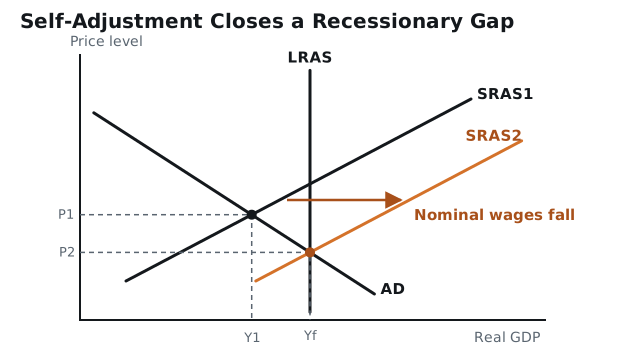
In a recessionary gap, unemployment is above the natural rate. Many workers compete for few jobs, so nominal wages fall as contracts are renewed. Lower wages cut production costs, and SRAS shifts right. The economy slides down AD until SRAS crosses AD on LRAS. Output returns to Yf at a lower price level.
In the figure, the price level falls from P1 to P2 while real GDP rises from Y1 to Yf. Unemployment falls back to the natural rate.
Part 3 of 4 Closing an Inflationary Gap
In an inflationary gap, unemployment is below the natural rate. Firms compete for scarce workers, so nominal wages rise. Higher wages raise costs, and SRAS shifts left. Output falls back to Yf, and the price level ends higher than where it started.
| Starting point | Nominal wages | SRAS | Long-run price level | Long-run output |
|---|---|---|---|---|
| Recessionary gap | Fall | Shifts right | Lower | Yf |
| Inflationary gap | Rise | Shifts left | Higher | Yf |
The same process follows a supply shock. After an energy price spike shifts SRAS left, unemployment rises above the natural rate. Wages then fall over time, and SRAS shifts back right to full employment.
Part 4 of 4 Shifts in LRAS
Self-adjustment returns the economy to Yf. Shifts in LRAS move Yf itself. A rightward shift in LRAS shows economic growth: more resources, better technology or higher productivity raise the full-employment level of output. A leftward shift shows a loss of capacity.
Self-adjustment returns output to Yf. Economic growth moves Yf.
Key Terms
Practice Questions
6 questions. Nothing here is recorded or scored.
- Question 1MOD-2.I.1
An economy is in a recessionary gap, and the government takes no action. Which of the following happens in the long run?
- A.Nominal wages rise, SRAS shifts left and output falls further.
- B.Nominal wages fall, SRAS shifts right and output returns to full employment.
- C.AD shifts right on its own until the gap closes.
- D.LRAS shifts left to meet short-run equilibrium.
Check answerHide answer
Answer: B
- A.
- Wages fall, not rise, when unemployment is above the natural rate.
- B.
- Correct. High unemployment pushes nominal wages down. Lower costs shift SRAS right until AD and SRAS cross on LRAS at a lower price level.
- C.
- Self-adjustment works through wages and SRAS.
- D.
- Long-run capacity does not change because of a recession.
- Question 2MOD-2.I.1
Without policy action, how does an economy in an inflationary gap return to long-run equilibrium?
- A.Nominal wages rise, SRAS shifts left and the price level rises further.
- B.Nominal wages fall, SRAS shifts right and the price level falls.
- C.AD shifts left on its own.
- D.LRAS shifts right to meet short-run equilibrium.
Check answerHide answer
Answer: A
- A.
- Correct. With unemployment below the natural rate, firms compete for workers and nominal wages rise. SRAS shifts left until output returns to Yf at a higher price level.
- B.
- Wages rise, not fall, when labor is scarce.
- C.
- Self-adjustment works through wages and SRAS.
- D.
- LRAS depends on resources and technology.
- Question 3MOD-2.I.1
After self-adjustment from a recessionary gap is complete, compared with the original short-run equilibrium, which of the following is true?
- A.Real GDP is higher and the price level is higher.
- B.Real GDP is lower and the price level is lower.
- C.Real GDP is higher and the price level is lower.
- D.Real GDP is unchanged and the price level is higher.
Check answerHide answer
Answer: C
- A.
- SRAS shifts right, which lowers the price level.
- B.
- Output rises to Yf.
- C.
- Correct. The rightward shift of SRAS raises output to full employment and lowers the price level.
- D.
- Output rises from below Yf to Yf.
- Question 4MOD-2.I.2
The example country of Ardunay builds new ports and trains its workforce in new technology. Which of the following best shows the long-run effect?
- A.SRAS shifts left.
- B.AD shifts left.
- C.The economy moves along LRAS.
- D.LRAS shifts right.
Check answerHide answer
Answer: D
- A.
- Better capital and skills lower costs and raise capacity.
- B.
- The investment itself adds to AD, and the capacity gain shows in LRAS.
- C.
- LRAS is vertical, and capacity changes shift it.
- D.
- Correct. More capital and better technology raise full-employment output, shifting LRAS right. That shift is economic growth.
- Question 5MOD-2.I.1
A spike in energy prices shifts SRAS left. If the government does nothing, what happens over time?
- A.Wages rise, and SRAS shifts further left.
- B.Unemployment stays above the natural rate permanently.
- C.Unemployment above the natural rate pushes wages down, and SRAS shifts back right.
- D.AD shifts right on its own to restore output.
Check answerHide answer
Answer: C
- A.
- Wages fall, not rise, when unemployment is high.
- B.
- Flexible wages restore full employment in the long run.
- C.
- Correct. Higher unemployment lowers nominal wages over time, which reduces costs and shifts SRAS back toward its original position.
- D.
- Self-adjustment works through SRAS.
- Question 6MOD-2.I.1, MOD-2.I.2
Which of the following correctly distinguishes long-run self-adjustment from economic growth?
- A.Self-adjustment shifts LRAS; growth shifts SRAS.
- B.Both move the economy to a new full-employment output.
- C.Self-adjustment returns output to the existing full-employment level; growth raises the full-employment level itself.
- D.Self-adjustment requires fiscal policy; growth does not.
Check answerHide answer
Answer: C
- A.
- This swaps the two shifts.
- B.
- Self-adjustment returns to the same Yf.
- C.
- Correct. Self-adjustment shifts SRAS until output equals Yf. Growth shifts LRAS and raises Yf.
- D.
- Self-adjustment happens without policy.
Practice every topic in Unit 3
CED Codes
MOD-2.I.1 · MOD-2.I.2