3.8 Fiscal Policy
Use government spending, taxes and transfers to close output gaps, calculate the policy needed with multipliers, and see why fiscal policy has lags.
Part 1 of 4 Fiscal Policy Tools
Fiscal policy is the use of government spending and taxes or transfer payments to reach goals such as full employment and stable prices. Fiscal policy works by shifting aggregate demand.
Government spending is part of AD, so a change in spending shifts AD directly. Taxes and transfers change disposable income first. Households then change their consumption, so taxes and transfers shift AD indirectly.
| Expansionary fiscal policy | Contractionary fiscal policy | |
|---|---|---|
| When | Recessionary gap | Inflationary gap |
| Actions | Raise spending, cut taxes or raise transfers | Cut spending, raise taxes or cut transfers |
| Short-run effect | AD rises: output, employment and price level rise | AD falls: output, employment and price level fall |
Part 2 of 4 Closing a Gap on the Graph
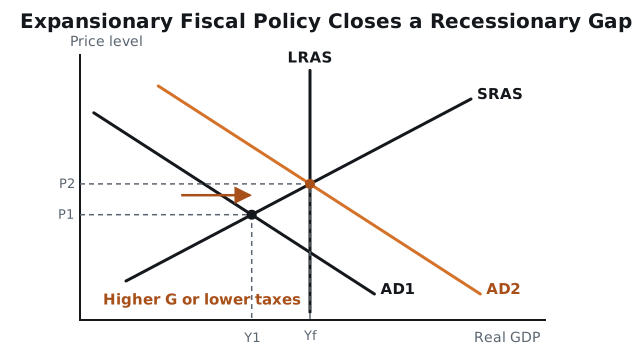
In a recessionary gap, expansionary policy shifts AD right until short-run equilibrium reaches LRAS. Real output rises to Yf, unemployment falls to the natural rate, and the price level rises. Contractionary policy in an inflationary gap shifts AD left, lowering output to Yf and easing the upward pressure on prices.
Part 3 of 4 Using the Multipliers
The multipliers from Topic 3.2 show how big a policy change needs to be. Suppose an example economy has a recessionary gap of $200 billion and an MPC of 0.75. The spending multiplier is 4, so government spending must rise by $200 billion divided by 4, or $50 billion. The tax multiplier is -3, so taxes must fall by $200 billion divided by 3, about $66.7 billion.
The tax cut must be larger than the spending increase, because each dollar of spending moves AD more than each dollar of tax cut. Households save part of any tax cut before the rounds of spending begin.
Part 4 of 4 Lags in Discretionary Policy
Discretionary fiscal policy needs new laws, and new laws take time. Fiscal policy lags come from three delays. Officials need time to recognize the problem in economic data. The legislature needs time to agree on and pass a law. The money then needs time to be spent, or the tax change needs time to reach households.
Key Terms
Practice Questions
6 questions. Nothing here is recorded or scored.
- Question 1POL-1.A.5
An economy is in a recessionary gap. Which fiscal policy would close the gap?
- A.Raise taxes
- B.Cut government spending
- C.Cut transfer payments
- D.Raise government spending
Check answerHide answer
Answer: D
- A.
- Higher taxes reduce AD and widen the gap.
- B.
- Lower spending reduces AD.
- C.
- Lower transfers reduce disposable income and AD.
- D.
- Correct. Higher government spending shifts AD right, raising output toward full employment.
- Question 2POL-1.A.3
Which statement about how fiscal policy affects aggregate demand is correct?
- A.Government spending shifts AD directly, while taxes shift AD indirectly through consumption.
- B.Taxes shift AD directly, while government spending shifts AD through consumption.
- C.Both shift SRAS.
- D.Neither affects AD in the short run.
Check answerHide answer
Answer: A
- A.
- Correct. Government purchases are part of AD. Taxes change disposable income first, and households then change consumption.
- B.
- This swaps the two channels.
- C.
- Fiscal policy works through AD.
- D.
- Fiscal policy affects AD in the short run.
- Question 3POL-1.A.4, POL-1.A.5
An economy has a recessionary gap of $120 billion and an MPC of 0.75. Using the spending multiplier, what increase in government spending would close the gap?
- A.$30 billion
- B.$40 billion
- C.$90 billion
- D.$120 billion
Check answerHide answer
Answer: A
- A.
- Correct. The spending multiplier is 1 / 0.25 = 4, so $120 billion / 4 = $30 billion.
- B.
- Forty billion uses the tax multiplier of 3.
- C.
- Ninety billion multiplies the gap by the MPC.
- D.
- The multiplier means spending need not rise by the full gap.
- Question 4POL-1.A.4, POL-1.A.5
An economy has an inflationary gap of $90 billion and an MPC of 0.9. Using the tax multiplier, which change in taxes would close the gap?
- A.Cut taxes by $10 billion
- B.Raise taxes by $9 billion
- C.Raise taxes by $10 billion
- D.Raise taxes by $90 billion
Check answerHide answer
Answer: C
- A.
- An inflationary gap calls for lower AD, so taxes rise.
- B.
- Nine billion uses the spending multiplier of 10.
- C.
- Correct. The tax multiplier is -0.9 / 0.1 = -9. Raising taxes by $90 billion / 9 = $10 billion lowers real GDP by $90 billion.
- D.
- The multiplier means taxes need not change by the full gap.
- Question 5POL-1.B.1
Lawmakers in the example country of Merrivale spend eight months debating a highway program while the economy is in a recession. This delay is an example of
- A.an automatic stabilizer
- B.a lag in discretionary fiscal policy
- C.the multiplier effect
- D.self-adjustment
Check answerHide answer
Answer: B
- A.
- An automatic stabilizer needs no new law.
- B.
- Correct. The time needed to decide on and pass a new law is a lag in discretionary fiscal policy.
- C.
- The multiplier describes spending rounds after a policy takes effect.
- D.
- Self-adjustment works through wages without any policy.
- Question 6POL-1.A.6, POL-1.A.7
An economy is in an inflationary gap, and the government cuts spending. On a correctly labeled AD-AS graph, what happens in the short run?
- A.SRAS shifts right; the price level falls and output rises.
- B.AD shifts right; output and the price level rise.
- C.LRAS shifts left; output falls.
- D.AD shifts left; output and the price level fall.
Check answerHide answer
Answer: D
- A.
- Spending cuts affect demand.
- B.
- Lower spending reduces AD.
- C.
- Fiscal policy does not move LRAS in the short run.
- D.
- Correct. Lower government spending shifts AD left, lowering real output and the price level toward full employment.
Practice every topic in Unit 3
CED Codes
POL-1.A.1 · POL-1.A.2 · POL-1.A.3 · POL-1.A.4 · POL-1.A.5 · POL-1.A.6 · POL-1.A.7 · POL-1.B.1