3.9 Automatic Stabilizers
Learn how taxes and transfer programs change on their own as GDP rises and falls, softening recessions and cooling booms without any new law.
Part 1 of 3 Policy That Runs Without a Vote
Automatic stabilizers are taxes and transfer programs that change with GDP under laws already in place. They push against recessions and booms without any new decision by lawmakers.
Automatic stabilizers avoid the recognition and decision lags of discretionary policy. The rules are written in advance, so the response begins as soon as incomes change.
Discretionary policy needs lawmakers to see a problem, agree on a response and pass a law. Automatic stabilizers skip those steps.
Part 2 of 3 Taxes as Stabilizers
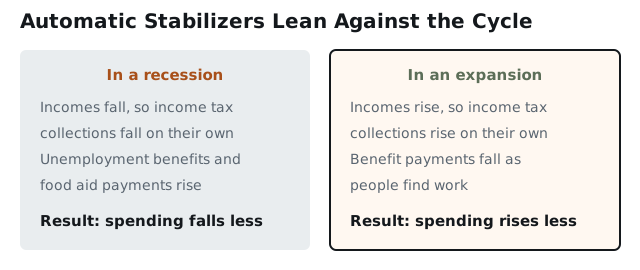
When GDP falls, incomes fall, and income tax collections fall with them. Households keep a larger share of what they still earn, which keeps consumption from falling as far.
When GDP rises, tax collections rise automatically. Households keep a smaller share of each extra dollar, which slows the growth of consumption and keeps the economy from overheating.
An example shows the size of the effect. Suppose a household's income falls from $60,000 to $50,000 and its income tax falls from $9,000 to $7,000. Its after-tax income falls by $8,000, less than the $10,000 drop in earnings.
Part 3 of 3 Transfers as Stabilizers
Social programs make transfer payments that also move against the cycle. In a recession, more people qualify for unemployment benefits and food aid, so payments rise and support spending. In an expansion, people find jobs and leave the programs, so payments fall.
| Stabilizer | In a recession | In an expansion |
|---|---|---|
| Income tax collections | Fall | Rise |
| Unemployment benefits | Rise | Fall |
| Food aid and other income support | Rise | Fall |
| Effect on AD | Smaller decrease | Smaller increase |
Automatic stabilizers soften the business cycle without erasing it. A deep recession usually needs discretionary policy or time for self-adjustment as well.
Stabilizers affect the government budget too. In a recession, tax collections fall while transfer payments rise, so a budget deficit grows without any new law. In an expansion, the deficit shrinks for the same reasons.
Automatic stabilizers make recessions shallower and booms milder.
Key Terms
Practice Questions
6 questions. Nothing here is recorded or scored.
- Question 1POL-1.C.1
Automatic stabilizers are
- A.new laws passed to fight a recession
- B.taxes and transfer programs that change with GDP without new legislation
- C.changes in wages that close output gaps
- D.decisions by firms to hold more inventory
Check answerHide answer
Answer: B
- A.
- New laws are discretionary policy.
- B.
- Correct. Under laws already in place, tax collections and transfers move with GDP and push against the business cycle.
- C.
- Wage changes are part of long-run self-adjustment.
- D.
- Inventory choices are business decisions.
- Question 2POL-1.C.2
During a recession, income tax collections fall even though no tax rates change. How does this help the economy?
- A.It raises interest rates, which increases investment.
- B.It lowers the price level directly.
- C.It shifts LRAS to the right.
- D.Households keep more of their income, so consumption falls less.
Check answerHide answer
Answer: D
- A.
- Tax collections do not work through interest rates here.
- B.
- The effect works through spending.
- C.
- Tax collections do not change long-run capacity.
- D.
- Correct. Lower tax payments leave more disposable income, which supports consumption and limits the fall in AD.
- Question 3POL-1.C.4
Which of the following is an automatic stabilizer?
- A.Unemployment benefits that rise as more people lose their jobs
- B.A new bridge program approved by the legislature
- C.A one-time tax rebate passed during a recession
- D.A rise in nominal wages during a boom
Check answerHide answer
Answer: A
- A.
- Correct. Benefit payments rise on their own when unemployment rises, supporting spending without a new law.
- B.
- A new spending program is discretionary.
- C.
- A rebate that needs a new law is discretionary.
- D.
- Wage changes are market adjustments.
- Question 4POL-1.C.3
During a strong expansion, which of the following happens automatically?
- A.Transfer payments rise and tax collections fall.
- B.Tax collections rise and transfer payments fall, slowing the growth of consumption.
- C.The government passes a law raising tax rates.
- D.Tax collections and transfers both rise.
Check answerHide answer
Answer: B
- A.
- That pattern happens in a recession.
- B.
- Correct. Higher incomes bring higher tax payments, and fewer people draw benefits. Both slow spending and help keep the economy from overheating.
- C.
- A new law is discretionary policy.
- D.
- Transfers fall as people find work.
- Question 5POL-1.C.1, POL-1.C.2
Compared with discretionary fiscal policy, automatic stabilizers
- A.require a new vote each time they act
- B.have longer decision lags
- C.begin working as soon as incomes change, without new legislation
- D.shift LRAS instead of AD
Check answerHide answer
Answer: C
- A.
- Automatic stabilizers work under existing laws.
- B.
- They skip the decision lag.
- C.
- Correct. Because the rules are written in advance, the response starts as soon as incomes change, avoiding decision lags.
- D.
- They act through AD.
- Question 6POL-1.C.1, POL-1.C.2, POL-1.C.3
A country replaces its income tax with a fixed dollar tax per person that does not change with income. What is the likely effect on business cycles?
- A.Recessions and expansions would become milder.
- B.Business cycles would disappear.
- C.Recessions and expansions would become larger, because tax collections would no longer move with income.
- D.Only the price level would change.
Check answerHide answer
Answer: C
- A.
- A fixed tax removes a stabilizer, so cycles would not become milder.
- B.
- Cycles come from many shocks and would continue.
- C.
- Correct. With a fixed tax, collections no longer fall in recessions or rise in booms, so disposable income swings more and AD swings more.
- D.
- The change affects spending and output as well as prices.
Practice every topic in Unit 3
CED Codes
POL-1.C.1 · POL-1.C.2 · POL-1.C.3 · POL-1.C.4