4.1 Financial Assets
How liquidity, rate of return and risk compare cash, deposits, bonds and stocks, why old bond prices fall when rates rise, and what holding money costs.
Part 1 of 3 Three Ways to Compare Assets
A financial asset is anything a person holds to store wealth: cash, a checking balance, a bond, a share of stock. Every financial asset can be compared on three attributes. Liquidity is how quickly the asset can pay for something without losing value. Rate of return is what the asset earns, as a percentage of what the holder paid. Risk is the chance the asset returns less than expected or loses value.
The most liquid forms of money are cash and demand deposits, the checking balances a person can spend at any time with a debit card or a check. People can also hold their wealth in bonds, which pay interest, or in stocks, which are shares of ownership called equity.
| Asset | Liquidity | Rate of return | Risk |
|---|---|---|---|
| Cash | Highest: spend it now | None | Low, though inflation shrinks what it buys |
| Demand deposits | Very high: spend by card or check | Little or none | Low |
| Bonds | Lower: sell the bond first | Interest payments | Price can fall before maturity; the issuer can default |
| Stocks | Lower: sell the shares first | Dividends plus any rise in price | Highest: the price can fall well below what the buyer paid |
Read down the table and a pattern appears. The assets that are easiest to spend tend to earn the least. A saver gives up liquidity to get a higher return, and usually accepts more risk with it.
| Bond | Stock | |
|---|---|---|
| What the buyer owns | A loan to a government or a firm | A share of ownership in a corporation |
| What the buyer receives | Fixed interest payments, then the face value at maturity | Dividends if the firm pays them, plus any gain in price |
| Main risk | Rates rise and the price falls, or the issuer fails to pay | Profits fall and the share price falls |
Part 2 of 3 Why Old Bond Prices Fall When Rates Rise
Priya owns a bond she bought for $1,000. The bond pays $40 of interest every year with no end date, a 4% return on her $1,000. A year later, interest rates in the economy rise, and new bonds pay 5%. A buyer with $1,000 can now get $50 a year from a new bond.
No buyer will pay Priya $1,000 for $40 a year when $1,000 buys $50 a year elsewhere. To sell her bond, Priya must accept a lower price. The price falls until $40 a year is a 5% return to the buyer: $40 divided by 0.05 is $800. Priya's loss shows the inverse relationship between interest rates and the prices of bonds already issued.
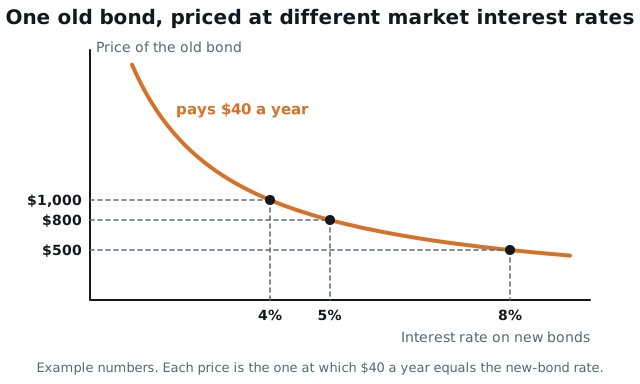
The same logic runs in reverse. If new bonds paid only 2%, Priya's $40 a year would look generous, and buyers would bid her bond's price above $1,000.
When interest rates rise, the prices of bonds already issued fall. When interest rates fall, those prices rise.
Part 3 of 3 The Cost of Holding Money
Money in a wallet or a checking account earns little or nothing. The opportunity cost of holding money is the interest a person could have earned by holding an interest-bearing asset, such as a bond, instead.
Suppose Priya keeps $2,000 in her checking account for a year while bonds pay 5%. She gives up $100 of interest for the convenience of being able to spend that money at any moment. If bond rates rise to 8%, the same choice costs her $160.
Key Terms
Practice Questions
6 questions. Nothing here is recorded or scored.
- Question 1MEA-3.A.1
Which of the following assets is the most liquid?
- A.A government bond with a face value of $300 that matures in ten years
- B.A $300 balance in a checking account
- C.Shares of stock with a market value of $300
- D.A $300 certificate of deposit that charges a penalty for early withdrawal
Check answerHide answer
Answer: B
- A.
- The bond must be sold before the $300 can be spent, and its price on the day of the sale may be below its face value.
- B.
- Correct. A checking balance is a demand deposit, which the owner can spend at any moment by card or check. Demand deposits and cash are the most liquid forms of money.
- C.
- The shares must be sold first, and the price can change between today and the day of the sale.
- D.
- The certificate of deposit can be cashed early only by paying a penalty, so it spends less easily than a checking balance.
- Question 2MEA-3.A.3
Tarn's Bond
Last year Tarn paid $1,000 for a newly issued government bond that pays $30 of interest every year until it matures. This year, newly issued government bonds of the same length pay 6% a year. Tarn wants to sell his bond to buy a used car.
What will most likely happen to the price Tarn can get for his bond, and why?
- A.The price rises above $1,000, because higher interest rates make every bond earn more.
- B.The price stays at $1,000, because Tarn's bond still pays the same $30 a year.
- C.The price falls below $1,000, because the government must now pay Tarn 6% instead of 3%.
- D.The price falls below $1,000, because buyers can earn more from a new bond than from Tarn's fixed $30 a year.
Check answerHide answer
Answer: D
- A.
- Tarn's bond keeps paying $30 a year no matter what happens to market rates. Higher rates on new bonds make his fixed payment less attractive, which pushes his price down.
- B.
- The $30 payment is what makes the price fall. Buyers compare it with the $60 that a new $1,000 bond pays and offer Tarn less.
- C.
- The direction is right and the reason is wrong. The government still pays Tarn $30 a year; the payment on an existing bond does not change when market rates change.
- D.
- Correct. Tarn's bond pays a fixed $30. A buyer with $1,000 can get $60 a year from a new bond, so nobody pays $1,000 for $30 a year. Tarn must cut his price until his bond's return matches what new bonds offer. Bond prices and interest rates move in opposite directions.
- Question 3MEA-3.A.4
Ana keeps $5,000 in a checking account that pays no interest. Government bonds pay 4% a year. What is Ana's opportunity cost of holding the money for one year?
- A.$0, because money in a checking account does not lose value
- B.$20 of interest
- C.$200 of interest
- D.$5,000, the amount she holds as money
Check answerHide answer
Answer: C
- A.
- An opportunity cost is the value of the best option given up, even when no money is lost. Ana gives up the $200 a bond would have paid.
- B.
- This uses 0.4% instead of 4%. Four percent of $5,000 is 0.04 x $5,000 = $200.
- C.
- Correct. The opportunity cost of holding money is the interest given up. Four percent of $5,000 is $200 a year.
- D.
- Ana keeps her $5,000. What she gives up is the interest the $5,000 could have earned.
- Question 4MEA-3.A.2
Which of the following best describes a share of stock?
- A.A share of ownership in a corporation
- B.A loan to a government that pays a fixed amount of interest
- C.A deposit that the owner can spend at any time by writing a check
- D.A bank's promise to repay a deposit with interest after a fixed term
Check answerHide answer
Answer: A
- A.
- Correct. A stock is equity: the buyer becomes a part owner of the corporation and may receive dividends.
- B.
- This describes a bond. A bondholder is a lender who receives interest; a stockholder is an owner.
- C.
- This describes a demand deposit, the most liquid form of money after cash.
- D.
- This describes a certificate of deposit, an interest-bearing deposit at a bank.
- Question 5MEA-3.A.4, MEA-3.A.3
Suppose interest rates on bonds rise throughout an economy. Which of the following describes the effect on the opportunity cost of holding money and on the amount of money people choose to hold?
- A.The opportunity cost rises, and people choose to hold more money.
- B.The opportunity cost rises, and people choose to hold less money.
- C.The opportunity cost falls, and people choose to hold more money.
- D.The opportunity cost falls, and people choose to hold less money.
Check answerHide answer
Answer: B
- A.
- A higher opportunity cost makes holding money less attractive, so people hold less of it.
- B.
- Correct. Holding money means giving up the interest a bond pays. When bond rates rise, that sacrifice grows, so people move more of their wealth out of money and into bonds.
- C.
- Higher bond rates raise what a person gives up by holding money. The opportunity cost goes up.
- D.
- The opportunity cost moves in the same direction as bond rates, so it rises here.
- Question 6MEA-3.A.1, MEA-3.A.2
Leon is saving for retirement in 40 years. He wants the highest expected rate of return and accepts high risk and low liquidity. Which asset best fits his goal?
- A.Cash kept in a home safe
- B.A balance in a checking account
- C.A savings account at a bank
- D.Shares of stock in a young, fast-growing company
Check answerHide answer
Answer: D
- A.
- Cash is the most liquid asset and earns nothing, so it fails Leon's goal of a high return.
- B.
- A checking balance is highly liquid and pays little or no interest.
- C.
- A savings account is safe and liquid, and it pays a low interest rate.
- D.
- Correct. Stocks carry the most risk and must be sold before they can be spent, and over long periods they offer the highest expected return of these choices. Leon gives up liquidity and safety to get that return.
Practice every topic in Unit 4
CED Codes
MEA-3.A.1 · MEA-3.A.2 · MEA-3.A.3 · MEA-3.A.4