4.2 Nominal v. Real Interest Rates
The nominal interest rate is the rate on the loan; the real rate subtracts inflation. How lenders set rates ahead and how to find the real rate after.
Part 1 of 3 Two Rates on One Loan
Every loan has two interest rates. The nominal interest rate is the rate written on the loan, with no adjustment for inflation. The real interest rate is the nominal rate minus inflation. The real rate measures what the lender actually gains in purchasing power.
Inflation matters because interest is paid in dollars, and inflation changes what each dollar buys. A saver who earns 6% on a deposit while prices rise 4% can buy only about 2% more at the end of the year. Her real interest rate is 2%. If inflation were 7%, her real rate would be negative 1%: the deposit grew, and it buys less than when she made it.
Part 2 of 3 Setting a Rate Before the Loan
A lender and a borrower agree on the nominal rate before anyone knows what inflation will be. So they build the rate from two parts: the real rate they expect and the inflation they expect. Expected inflation is their forecast of inflation over the life of the loan.
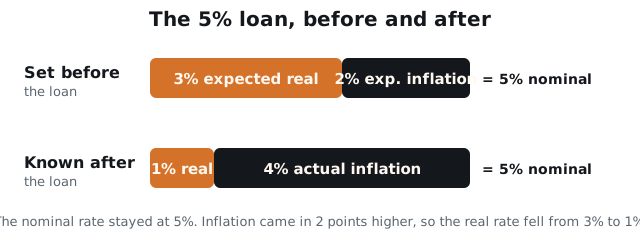
A credit union lends Marco money for a used car. The credit union wants a 3% real return and expects 2% inflation, so it charges a 5% nominal rate. If the lender had expected 4% inflation, it would have charged 7% to keep the same 3% real return.
Part 3 of 3 Calculating the Real Rate Afterward
The real rate a loan actually earned can be calculated only in hindsight. Subtract the inflation that actually happened from the nominal rate. Marco's loan carries 5%. If inflation turns out to be 4%, the credit union's real return is 1%, two points less than it planned.
| Actual inflation | Real interest rate | Who comes out ahead |
|---|---|---|
| 1% | 5% - 1% = 4% | The lender: it earns more purchasing power than planned |
| 2% | 5% - 2% = 3% | Neither: the real rate is what both expected |
| 4% | 5% - 4% = 1% | The borrower: Marco repays with dollars that buy less |
Inflation higher than expected lowers the real interest rate. The borrower gains and the lender loses.
Key Terms
Practice Questions
6 questions. Nothing here is recorded or scored.
- Question 1MEA-3.B.1
Which of the following defines the nominal interest rate?
- A.The interest rate on a loan minus the inflation rate
- B.The interest rate a borrower pays after subtracting taxes
- C.The interest rate stated on a loan, before any adjustment for inflation
- D.The interest rate a central bank pays on bank reserves
Check answerHide answer
Answer: C
- A.
- Subtracting inflation gives the real interest rate.
- B.
- Taxes play no part in the definition of the nominal interest rate.
- C.
- Correct. The nominal rate is the rate written on the loan or deposit. It says nothing about what the interest will buy.
- D.
- That is interest on reserves, one of a central bank's administered rates.
- Question 2MEA-3.B.3
A bank paid 6% interest on a one-year deposit. Inflation over that year was 2.5%. What real interest rate did the depositor earn?
- A.2.4%
- B.3.5%
- C.6.0%
- D.8.5%
Check answerHide answer
Answer: B
- A.
- This divides 6 by 2.5. The real rate subtracts inflation from the nominal rate.
- B.
- Correct. The real interest rate in hindsight is the nominal rate minus actual inflation: 6% - 2.5% = 3.5%.
- C.
- This is the nominal rate. It ignores the 2.5% of purchasing power that inflation took away.
- D.
- This adds inflation to the nominal rate. Inflation lowers the real return, so it is subtracted.
- Question 3MEA-3.B.2
A lender wants to earn a 4% real interest rate and expects 3% inflation over the life of a loan. What nominal interest rate should the lender charge?
- A.1%
- B.4%
- C.7%
- D.12%
Check answerHide answer
Answer: C
- A.
- This subtracts expected inflation from the desired real rate. Expected inflation is added to protect the lender's purchasing power.
- B.
- Charging 4% would leave the lender with a real return of only about 1% once 3% inflation arrives.
- C.
- Correct. Lenders set the nominal rate as the expected real rate plus expected inflation: 4% + 3% = 7%.
- D.
- This multiplies the two rates. The parts of a nominal rate are added.
- Question 4MEA-3.B.2
Expected inflation rises from 2% to 5%. Lenders and borrowers still expect the same real interest rate. What happens to nominal interest rates on new loans?
- A.They rise by about 3 percentage points.
- B.They fall by about 3 percentage points, because borrowers will repay with dollars that buy less.
- C.They stay the same, because the expected real interest rate has not changed.
- D.They rise by about 5 percentage points.
Check answerHide answer
Answer: A
- A.
- Correct. The nominal rate is the expected real rate plus expected inflation. With the real part unchanged, a 3-point rise in expected inflation adds 3 points to the nominal rate.
- B.
- Repaying with cheaper dollars hurts lenders, so lenders demand a higher nominal rate, and nominal rates go up.
- C.
- The nominal rate contains expected inflation. Holding the real part constant, the nominal rate must rise as expected inflation rises.
- D.
- Expected inflation rose by 3 points, from 2% to 5%. The nominal rate rises by the change, which is 3 points.
- Question 5MEA-3.B.3, MEA-3.B.2
Odile's Loan
Odile borrows $10,000 from a credit union for one year at a 5% nominal interest rate. When they sign, Odile and the credit union both expect 2% inflation over the year. Inflation for the year turns out to be 6%.
Which of the following correctly describes the result of Odile's loan?
- A.The real interest rate was 3%, as both sides planned when they signed.
- B.The real interest rate was negative 1%, so the credit union gained at Odile's expense.
- C.The real interest rate was 11%, so the credit union gained at Odile's expense.
- D.The real interest rate was negative 1%, so Odile gained at the credit union's expense.
Check answerHide answer
Answer: D
- A.
- A 3% real rate was the plan, based on 2% expected inflation. Actual inflation was 6%, so the real rate came out lower.
- B.
- The calculation is right and the winner is wrong. A negative real rate means the lender is repaid with less purchasing power than it lent.
- C.
- This adds inflation to the nominal rate. The real rate subtracts actual inflation: 5% - 6% = -1%.
- D.
- Correct. In hindsight the real rate is 5% - 6% = -1%. Odile repays dollars that buy less than the dollars she borrowed, so the unexpected inflation moved purchasing power from the lender to the borrower.
- Question 6MEA-3.B.1, MEA-3.B.3
Which of the following loans paid the lender the highest real interest rate?
- A.A 4% nominal rate in a year with 1% inflation
- B.An 8% nominal rate in a year with 7% inflation
- C.A 6% nominal rate in a year with 4% inflation
- D.A 10% nominal rate in a year with 9.5% inflation
Check answerHide answer
Answer: A
- A.
- Correct. Subtract inflation from each nominal rate: 4% - 1% = 3%, the highest of the four. The others give 1%, 2% and 0.5%.
- B.
- The nominal rate is the highest-looking number, and 7% inflation leaves a real rate of only 1%.
- C.
- This loan earned a real rate of 6% - 4% = 2%, one point less than the 4% loan.
- D.
- The largest nominal rate here earned the smallest real rate: 10% - 9.5% = 0.5%.
Practice every topic in Unit 4
CED Codes
MEA-3.B.1 · MEA-3.B.2 · MEA-3.B.3