4.3 Definition, Measurement, and Functions of Money
What money is, the three jobs it does, and how to calculate M1, M2 and the monetary base from data, including which transactions change each measure.
Part 1 of 3 What Counts as Money
Money is any asset that people accept as payment. Paper bills, coins and checking balances are money because a seller takes them without asking questions. Without money, a baker who wants shoes must find a shoemaker who wants bread. Money removes that search.
A credit card is not money. Paying by credit card takes out a short-term loan from the card company. The debt is later paid with money, usually from a checking account. The card balance is a debt the cardholder owes, and the money that repays it sits in a bank account.
Part 2 of 3 Three Jobs Money Does
| Function | What it means | Example |
|---|---|---|
| Medium of exchange | People hand money over to buy goods and services | A student pays $12 for a haircut |
| Unit of account | Prices and debts are stated in money, so values can be compared | A $900 laptop costs three times a $300 tablet |
| Store of value | Money holds purchasing power from today into the future | A summer paycheck saved and spent in December |
Money is a store of value, and not a perfect one. Inflation shrinks what each dollar buys, so savers often move wealth into assets that earn a return. A dollar bill kept for ten years still pays for things, and it pays for less of them each year that prices rise.
Part 3 of 3 Measuring the Money Supply
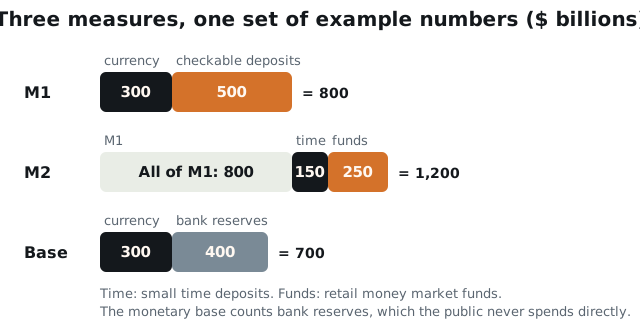
Economists measure the money supply with monetary aggregates. M1 is the narrow measure: currency in circulation, checkable deposits and other highly liquid deposits. M2 is broader: all of M1 plus near-monies such as small time deposits and retail money market fund balances.
The monetary base, often labeled MB or M0, is a different measure. The base counts currency in circulation plus bank reserves, the cash in bank vaults and the deposits banks keep at the central bank.
| Measure | Calculation | Total |
|---|---|---|
| M1 | Currency 300 + checkable deposits 500 | 800 |
| M2 | M1 800 + small time deposits 150 + retail money market funds 250 | 1,200 |
| Monetary base | Currency 300 + bank reserves 400 | 700 |
Some transactions move money from one category to another without changing the total. Kai deposits $100 of cash into his checking account. Currency falls by $100 and checkable deposits rise by $100, so M1 and M2 stay the same. His bank's reserves rise by the $100 his currency fell, so the monetary base stays the same too.
Key Terms
Practice Questions
5 questions. Nothing here is recorded or scored.
- Question 1MEA-3.C.2
A bookstore prices a novel at $18 and a cookbook at $36, so a shopper can see at a glance that the cookbook costs twice as much. Which function of money does this illustrate?
- A.Medium of exchange
- B.Store of value
- C.Monetary base
- D.Unit of account
Check answerHide answer
Answer: D
- A.
- Money is a medium of exchange when it is handed over in a purchase. The shopper here is comparing prices, and no payment has happened yet.
- B.
- A store of value carries purchasing power into the future. Comparing two prices today does not involve saving.
- C.
- The monetary base is a measure of currency plus reserves. It is not a function of money.
- D.
- Correct. Stating prices in one common unit lets buyers compare values. That is money serving as a unit of account.
- Question 2MEA-3.C.1
Jae pays for a $60 jacket with a credit card. Which statement about the payment is accurate?
- A.Jae has taken out a short-term loan; money changes hands when he pays the card balance.
- B.The $60 card balance is counted in M1.
- C.The $60 card balance is counted in M2 and not in M1.
- D.The credit card is part of the monetary base because stores accept it.
Check answerHide answer
Answer: A
- A.
- Correct. Money is an asset accepted as payment. A credit card balance is a debt Jae owes. He settles it later with money, usually from a checking account.
- B.
- M1 counts currency and liquid deposits that people own. A card balance is a debt Jae owes, so it is not counted.
- C.
- M2 counts M1 plus near-monies such as small time deposits. Debts owed on credit cards appear in neither measure.
- D.
- The monetary base is currency in circulation plus bank reserves. Credit cards are not part of it.
- Question 3MEA-3.C.4
Money in Ardley
The data below describe the imaginary country of Ardley, in billions of dollars. Currency in circulation: 400. Checkable deposits: 600. Small time deposits: 200. Retail money market funds: 300. Bank reserves: 450.
Using the data, what is the value of Ardley's monetary base?
- A.$850 billion
- B.$1,000 billion
- C.$1,050 billion
- D.$1,450 billion
Check answerHide answer
Answer: A
- A.
- Correct. The monetary base is currency in circulation plus bank reserves: 400 + 450 = $850 billion.
- B.
- This is M1, currency plus checkable deposits. The monetary base swaps the deposits for bank reserves.
- C.
- This adds checkable deposits to reserves. The base counts currency, not deposits.
- D.
- This adds reserves to M1. The base contains only currency and reserves.
- Question 4MEA-3.C.3
A family moves $2,000 from its checking account into a small certificate of deposit. What happens to M1 and M2?
- A.M1 does not change, and M2 rises by $2,000.
- B.M1 falls by $2,000, and M2 does not change.
- C.M1 and M2 both fall by $2,000.
- D.M1 rises by $2,000, and M2 falls by $2,000.
Check answerHide answer
Answer: B
- A.
- The checking balance left M1, so M1 falls. M2 already counted that balance, so it does not rise.
- B.
- Correct. Checkable deposits are in M1 and small time deposits are in M2 only. The move takes $2,000 out of M1. M2 counts both accounts, so its total stays the same.
- C.
- M2 includes small time deposits, so the $2,000 is still in M2 after the move.
- D.
- The money left the checking account, which is part of M1, so M1 falls.
- Question 5MEA-3.C.3, MEA-3.C.4
Riya deposits $500 of cash, which she had kept at home, into her checking account. What is the immediate effect on M1 and on the monetary base?
- A.M1 rises by $500, and the monetary base does not change.
- B.M1 does not change, and the monetary base rises by $500.
- C.M1 rises by $500, and the monetary base rises by $500.
- D.M1 does not change, and the monetary base does not change.
Check answerHide answer
Answer: D
- A.
- Riya's $500 was already counted in M1 as currency. It moved to another part of M1.
- B.
- Currency in circulation fell by the same $500 that reserves rose, so the base is unchanged.
- C.
- The deposit changes the form of money and adds none. Loans the bank makes later can create new money, and the deposit itself does not.
- D.
- Correct. Currency falls by $500 and checkable deposits rise by $500, so M1 is unchanged. The bank's reserves rise by the $500 that left circulation, so the base, currency plus reserves, is unchanged too.
Practice every topic in Unit 4
CED Codes
MEA-3.C.1 · MEA-3.C.2 · MEA-3.C.3 · MEA-3.C.4