4.4 Banking and the Expansion of the Money Supply
How banks record reserves and loans on balance sheets, how a deposit lets the banking system create money, and how to calculate the money multiplier.
Part 1 of 4 A Bank's Balance Sheet
Commercial banks and credit unions are depository institutions: they accept deposits and make loans. Each one records its position on a balance sheet, also called a T-account. Assets, what the bank owns, go on the left. Liabilities, what the bank owes, plus owner's equity go on the right. The two sides always total the same amount.
| Assets | Amount | Liabilities and equity | Amount |
|---|---|---|---|
| Required reserves | $18,000 | Demand deposits | $180,000 |
| Excess reserves | $7,000 | Owner's equity | $20,000 |
| Loans | $150,000 | ||
| Government bonds | $25,000 | ||
| Total | $200,000 | Total | $200,000 |
A deposit is a liability because the bank owes it back to the customer. A loan is an asset because the borrower owes the bank. Banks practice fractional reserve banking: they keep only a fraction of deposits as reserves and lend or invest the rest. Reserves split into two parts. Required reserves equal the required reserve ratio times deposits: 10% of $180,000 is $18,000. Excess reserves are everything above that, here $7,000.
Part 2 of 4 How a Deposit Becomes New Money
Jonah takes $1,000 of cash from a drawer at home and deposits it at Larchmont Bank. Larchmont's demand deposits rise by $1,000 and its reserves rise by $1,000. With a 10% required reserve ratio, $100 of the new reserves is required and $900 is excess.
Excess reserves are the basis of new money. Larchmont lends the $900 to a customer, who spends it at a hardware store. The store deposits the $900 at another bank, which keeps $90 as required reserves and lends $810. Each round, a bank lends 90% of what it received.
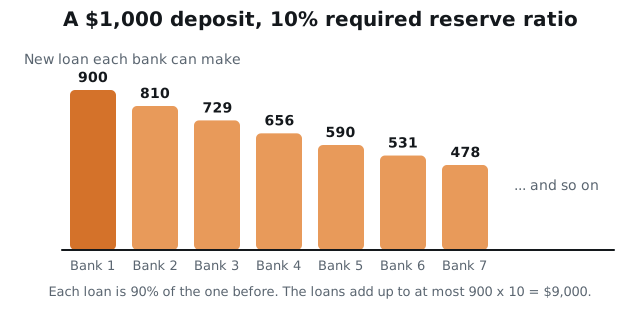
The money multiplier is the ratio of the money supply to the monetary base. Its maximum value is the reciprocal of the required reserve ratio. With a 10% ratio, the maximum multiplier is 1 / 0.10 = 10. The banking system can create up to $900 x 10 = $9,000 of new deposits from Jonah's deposit.
| Source | Change in money supply at once | Maximum further change | Maximum total change |
|---|---|---|---|
| Cash already held by the public is deposited | $0 | $900 x 10 = $9,000 | $9,000 |
| The central bank buys a $1,000 bond from a household, which deposits the payment | +$1,000 | $900 x 10 = $9,000 | $10,000 |
| The central bank buys a $1,000 bond from a bank | $0 | $1,000 x 10 = $10,000 | $10,000 |
Part 3 of 4 Why the Real Multiplier Is Smaller
The simple multiplier gives a ceiling. Real money creation is smaller for two reasons. First, banks may choose to hold excess reserves instead of lending all of them. Second, people may keep some of their money as cash, and cash in a wallet never returns to a bank to support another loan. Each choice cuts the chain short.
Part 4 of 4 Reserve Requirements Today
The money multiplier model fits a banking system with limited reserves. The United States banking system has ample reserves, and there the Federal Reserve's key policy tool is interest on reserves.
Banks create money when they lend excess reserves. The simple money multiplier shows the most they could create.
Balance sheet calculations still build the core idea: lending creates deposits, and deposits are money. Topic 4.6 shows how a central bank with ample reserves steers interest rates through the rates it administers.
Key Terms
Practice Questions
6 questions. Nothing here is recorded or scored.
- Question 1POL-2.A.3, POL-2.A.1
Fernhill Bank
Fernhill Bank operates in a banking system with a required reserve ratio of 20%. Its balance sheet: assets are reserves of $75,000, loans of $265,000 and government bonds of $60,000; liabilities are demand deposits of $300,000; owner's equity is $100,000. Assume banks lend all excess reserves and the public holds no additional currency.
How large are Fernhill Bank's excess reserves?
- A.$15,000
- B.$60,000
- C.$75,000
- D.$135,000
Check answerHide answer
Answer: A
- A.
- Correct. Required reserves are 20% of demand deposits: 0.20 x $300,000 = $60,000. Excess reserves are total reserves minus required reserves: $75,000 - $60,000 = $15,000.
- B.
- This is required reserves, the amount the bank must keep. Excess reserves are what is left above it.
- C.
- This is total reserves. Part of it, $60,000, is required.
- D.
- This adds government bonds to reserves. Bonds are a separate asset.
- Question 2POL-2.A.4, POL-2.A.6, POL-2.A.7
What is the maximum amount by which the banking system can increase the money supply as a result of Fernhill Bank's excess reserves?
- A.$3,000
- B.$15,000
- C.$75,000
- D.$150,000
Check answerHide answer
Answer: C
- A.
- This multiplies by the reserve ratio instead of dividing by it.
- B.
- This is what Fernhill alone can lend. As the loan is spent and redeposited, other banks lend again.
- C.
- Correct. The maximum money multiplier is 1 / 0.20 = 5. Excess reserves of $15,000 times 5 gives $75,000.
- D.
- This uses a multiplier of 10. With a 20% ratio, the maximum multiplier is 1 / 0.20 = 5.
- Question 3POL-2.A.7
The required reserve ratio is 25%. What is the maximum value of the money multiplier?
- A.0.25
- B.0.75
- C.1.33
- D.4
Check answerHide answer
Answer: D
- A.
- This is the reserve ratio itself. The multiplier is its reciprocal.
- B.
- This is the share of each deposit a bank can lend. The multiplier is 1 divided by the reserve ratio.
- C.
- This is 1 / 0.75, the reciprocal of the lending share. Use the reserve ratio, 0.25.
- D.
- Correct. The maximum money multiplier is the reciprocal of the required reserve ratio: 1 / 0.25 = 4.
- Question 4POL-2.A.8
Which of the following would make the actual increase in the money supply smaller than the amount the simple money multiplier predicts?
- A.Households keep part of the money they borrow as cash instead of depositing it.
- B.Banks lend all of their excess reserves.
- C.The central bank lowers the required reserve ratio.
- D.The central bank buys government bonds from banks.
Check answerHide answer
Answer: A
- A.
- Correct. Cash held outside banks never returns as a deposit, so it cannot back another round of loans. The chain of lending stops short of the maximum.
- B.
- The simple multiplier already assumes banks lend every dollar of excess reserves. Lending it all produces the full predicted amount.
- C.
- A lower reserve ratio raises the multiplier and allows more money creation.
- D.
- A bond purchase adds reserves, which allows more money creation. It does not make the multiplier smaller.
- Question 5POL-2.A.2, POL-2.A.1
Which of the following describes fractional reserve banking?
- A.A bank keeps all of its deposits as reserves.
- B.A bank keeps part of its deposits as reserves and lends or invests the rest.
- C.A bank lends deposits only after the central bank approves each loan.
- D.A bank records loans as liabilities and deposits as assets.
Check answerHide answer
Answer: B
- A.
- A bank that kept every deposit in reserve would be practicing full reserve banking and would make no loans from deposits.
- B.
- Correct. Under fractional reserve banking, reserves equal only a fraction of deposits. Loans made from the rest create new deposits.
- C.
- Central banks do not approve individual loans. Banks decide which loans to make.
- D.
- This reverses the balance sheet. Loans are assets owed to the bank; deposits are liabilities the bank owes.
- Question 6POL-2.A.4, POL-2.A.5, POL-2.A.6
The required reserve ratio is 10%. The central bank buys $10,000 of bonds from a household, and the household deposits the full payment in its checking account. Banks lend all excess reserves, and the public holds no additional currency. What is the maximum total increase in the money supply?
- A.$1,000
- B.$10,000
- C.$90,000
- D.$100,000
Check answerHide answer
Answer: D
- A.
- This is the bank's required reserves on the new deposit, not a change in the money supply.
- B.
- This counts the new deposit and leaves out every loan made from the excess reserves.
- C.
- This counts only the new loans. The household's $10,000 deposit is also new money, because a bond is not part of the money supply.
- D.
- Correct. The deposit itself adds $10,000 of new money, because the bond was not money. The bank keeps $1,000 as required reserves and has $9,000 of excess reserves, which can create up to $9,000 x 10 = $90,000 more. The total is $100,000.
Practice every topic in Unit 4
CED Codes
POL-2.A.1 · POL-2.A.2 · POL-2.A.3 · POL-2.A.4 · POL-2.A.5 · POL-2.A.6 · POL-2.A.7 · POL-2.A.8