4.5 The Money Market
Draw and explain the money market: why money demand slopes down, why money supply is vertical, and how the nominal interest rate moves to equilibrium.
Part 1 of 4 The Demand for Money
The money market is the model in which the demand for money and the supply of money set the nominal interest rate. The vertical axis is the nominal interest rate. The horizontal axis is the quantity of money. The graph shows how much money people want to hold at each interest rate.
Money demand slopes downward. People hold money for convenience, and holding it means giving up the interest a bond would pay. At a 2% interest rate, that sacrifice is small, so people hold a lot of money. At 8%, the opportunity cost of holding money is four times larger, so people move more of their wealth into bonds.
A change in the nominal interest rate moves the economy along the money demand curve. Other changes shift the curve. When the price level rises, the same groceries and rent cost more dollars, so people want to hold more money at every interest rate. Money demand shifts right. A rise in real GDP shifts money demand right for the same reason: people buy more, so they need more money for transactions.
Part 2 of 4 The Supply of Money
The central bank determines the monetary base. Given that base, the money supply does not depend on the nominal interest rate, so the money supply curve is a vertical line. Monetary policy that adds reserves to a limited-reserves banking system shifts the money supply curve right; draining reserves shifts it left.
Part 3 of 4 Equilibrium and Disequilibrium
Equilibrium in the money market is the nominal interest rate at which the quantity of money demanded equals the quantity supplied. At any other rate, market forces push the rate back.
| Interest rate is | What exists | What people do | Result |
|---|---|---|---|
| Above equilibrium | A surplus of money: people hold more money than they want | They use the extra money to buy bonds | Bond prices rise and interest rates fall |
| Below equilibrium | A shortage of money: people want more money than they hold | They sell bonds to get money | Bond prices fall and interest rates rise |
The money market adjusts through the bond market. Topic 4.1 showed that bond prices and interest rates move in opposite directions, so buying bonds pushes interest rates down and selling bonds pushes them up.
Part 4 of 4 Shifts in the Money Market
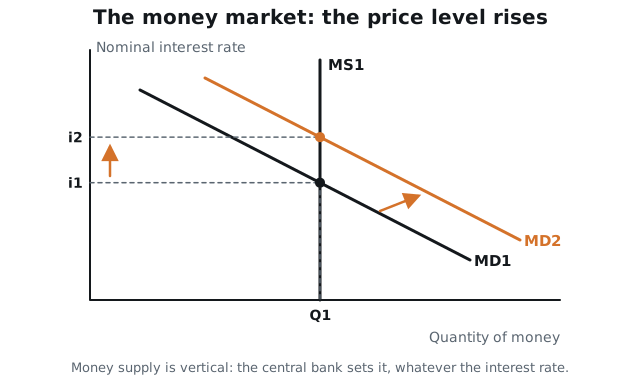
| Change | Curve that shifts | Nominal interest rate |
|---|---|---|
| The price level rises | Money demand shifts right | Rises |
| Real GDP falls in a recession | Money demand shifts left | Falls |
| The central bank adds reserves (limited reserves) | Money supply shifts right | Falls |
| The central bank drains reserves (limited reserves) | Money supply shifts left | Rises |
When money demand rises and the money supply stays fixed, the nominal interest rate rises.
Key Terms
Practice Questions
6 questions. Nothing here is recorded or scored.
- Question 1MKT-3.A.1
Why does the demand for money slope downward?
- A.A higher nominal interest rate makes bonds riskier to hold.
- B.A higher price level reduces the amount of money people need.
- C.A higher nominal interest rate raises the opportunity cost of holding money.
- D.The central bank supplies less money when interest rates are high.
Check answerHide answer
Answer: C
- A.
- Bond risk is not why money demand slopes down. The slope comes from the interest people give up by holding money.
- B.
- A higher price level raises the money people need, and it shifts the whole curve rather than moving along it.
- C.
- Correct. Money pays little or no interest. When rates on bonds rise, holding money means giving up more interest, so people hold less money at higher rates.
- D.
- This describes money supply, and the money supply curve is vertical. Money demand is about how much the public wants to hold.
- Question 2MKT-3.A.2
Why is the money supply curve drawn as a vertical line?
- A.The central bank determines the monetary base, so the quantity of money does not depend on the nominal interest rate.
- B.People want to hold the same amount of money at every interest rate.
- C.Banks lend more at higher interest rates, so the quantity of money rises with the rate.
- D.Money demand stays fixed when interest rates change.
Check answerHide answer
Answer: A
- A.
- Correct. Given a monetary base set by the central bank, the money supply is the same at every nominal interest rate. A quantity that does not respond to the rate is drawn as a vertical line.
- B.
- This describes money demand, and it is wrong about demand too: people hold less money at higher rates.
- C.
- A quantity that rose with the rate would be drawn as an upward-sloping line. The model holds the money supply fixed at every rate.
- D.
- Money demand slopes downward. The question asks about the supply curve.
- Question 3MKT-3.C.1
In the money market, the nominal interest rate is above its equilibrium level. Which of the following describes what happens next?
- A.There is a shortage of money; people sell bonds, bond prices fall, and the interest rate rises.
- B.There is a surplus of money; people sell bonds, bond prices fall, and the interest rate rises.
- C.There is a shortage of money; the central bank must print more money to lower the interest rate.
- D.There is a surplus of money; people buy bonds, bond prices rise, and the interest rate falls.
Check answerHide answer
Answer: D
- A.
- A shortage of money occurs below equilibrium. Above equilibrium, the high cost of holding money makes people want less money than exists.
- B.
- With extra money on hand, people buy bonds. Selling bonds is the response to a shortage.
- C.
- Above equilibrium there is a surplus, and market forces bring the rate down without any action by the central bank.
- D.
- Correct. Above equilibrium, people hold more money than they want. They use the extra money to buy bonds. Rising bond prices mean falling interest rates, and the rate falls until the surplus disappears.
- Question 4MKT-3.D.1
The price level rises, and the central bank keeps the money supply unchanged. What happens in the money market?
- A.Money demand increases, and the nominal interest rate rises.
- B.The money supply increases, and the nominal interest rate falls.
- C.Money demand decreases, and the nominal interest rate falls.
- D.Money demand increases, and the nominal interest rate does not change.
Check answerHide answer
Answer: A
- A.
- Correct. At a higher price level, people need more dollars for the same purchases, so money demand shifts right. With a vertical money supply, the equilibrium nominal interest rate rises.
- B.
- The central bank held the money supply constant. The price level shifts money demand.
- C.
- Higher prices raise the money people need, so demand increases.
- D.
- With a vertical money supply, any shift in demand changes the equilibrium interest rate.
- Question 5MKT-3.D.1
In an economy with limited reserves, real GDP falls in a recession. At the same time, the central bank adds reserves to the banking system, which increases the money supply. What is the effect on the equilibrium nominal interest rate?
- A.It rises.
- B.It falls.
- C.It does not change.
- D.The direction cannot be determined.
Check answerHide answer
Answer: B
- A.
- Each change by itself lowers the nominal interest rate, so together they cannot raise it.
- B.
- Correct. Lower real GDP means fewer purchases, so money demand shifts left, which lowers the rate. A larger money supply shifts supply right, which also lowers the rate. Both changes push the rate down.
- C.
- Both shifts lower the rate. The rate would stay the same only if one shift raised it by the amount the other lowered it.
- D.
- The direction is certain because both shifts lower the rate. Only the size of the fall is uncertain.
- Question 6MKT-3.B.1
Money Demand in Corvessa
In the imaginary country of Corvessa, the central bank holds the money supply at $800 billion. The quantity of money demanded at each nominal interest rate is: 3%, $1,000 billion; 4%, $900 billion; 5%, $800 billion; 6%, $700 billion.
What is the equilibrium nominal interest rate in Corvessa?
- A.3%
- B.4%
- C.5%
- D.6%
Check answerHide answer
Answer: C
- A.
- At 3%, people want $1,000 billion, more than the $800 billion supplied. The shortage pushes the rate up.
- B.
- At 4%, people want $900 billion, more than the $800 billion supplied. The rate is still too low.
- C.
- Correct. Equilibrium is where the quantity of money demanded equals the quantity supplied. At 5%, people want to hold $800 billion, exactly the money supply.
- D.
- At 6%, people want only $700 billion, so there is a $100 billion surplus that pushes the rate down.
Practice every topic in Unit 4
CED Codes
MKT-3.A.1 · MKT-3.A.2 · MKT-3.B.1 · MKT-3.C.1 · MKT-3.D.1