4.6 Monetary Policy
How a central bank with ample reserves steers rates with interest on reserves, how open market operations work with limited reserves, and effects on AD.
Part 1 of 5 Goals and Tools
A central bank conducts monetary policy: it influences interest rates to reach goals such as stable prices and full employment. In the United States, the central bank is the Federal Reserve.
Many central banks aim to keep a policy rate inside a target range. The policy rate is the interest rate banks charge each other for overnight loans of reserves. In the United States, the policy rate is the federal funds rate.
| Tool | What it is |
|---|---|
| Interest on reserves | The rate the central bank pays banks on reserves held at the central bank; an administered rate |
| Discount rate | The rate the central bank charges banks that borrow reserves from it; an administered rate |
| Open market operations | The central bank buys bonds (adding reserves) or sells bonds (removing reserves) |
| Required reserve ratio | The share of deposits banks must hold as reserves |
Which tools a central bank uses depends on how many reserves its banking system holds. Economies with limited reserves and economies with ample reserves run policy differently.
Part 2 of 5 Ample Reserves: Steering Rates With Administered Rates
United States banks hold ample reserves, so the Federal Reserve relies on interest on reserves as its main policy tool. The Federal Reserve controls its policy rate mainly through administered interest rates.
The reserve market graph shows why. The vertical axis is the policy rate and the horizontal axis is the quantity of reserves. Demand for reserves is flat at the bottom, at the interest-on-reserves rate. A bank that can earn that rate from the central bank, with no risk, will not lend reserves to another bank for less. With ample reserves, the vertical supply of reserves crosses that flat section.
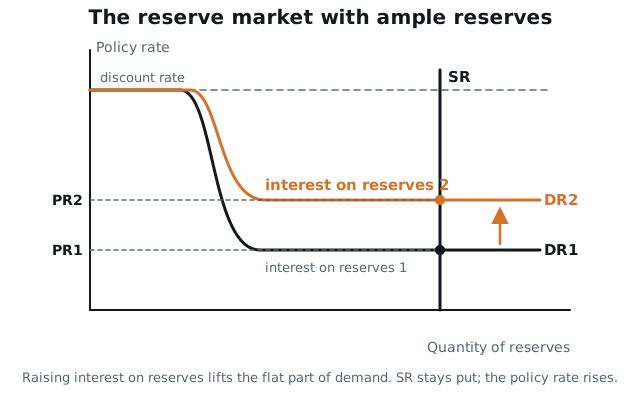
Two results follow. To raise the policy rate, the central bank raises interest on reserves, and the flat part of demand moves up with it. Changing the quantity of reserves a little does not move the rate, because supply still crosses the flat part. With ample reserves, adding or removing money barely moves the nominal interest rate. The administered rates do that work.
Part 3 of 5 Limited Reserves: Changing the Quantity of Reserves
In an economy with limited reserves, supply crosses the downward-sloping part of reserve demand, so the quantity of reserves matters. An open market purchase adds reserves and raises the monetary base; an open market sale removes reserves and lowers the base. Through the money multiplier, the money supply changes by more than the base. A larger money supply shifts the money supply curve right in the money market and lowers the nominal interest rate.
| Limited reserves | Ample reserves | |
|---|---|---|
| How to lower the policy rate | Buy bonds to add reserves and raise the money supply | Lower interest on reserves and the other administered rates |
| Effect of a small change in reserves | Moves the policy rate | Leaves the policy rate where it is |
| Graph to draw | Money market: shift the money supply curve | Reserve market: shift the flat part of reserve demand |
Part 4 of 5 From the Policy Rate to Output and Prices
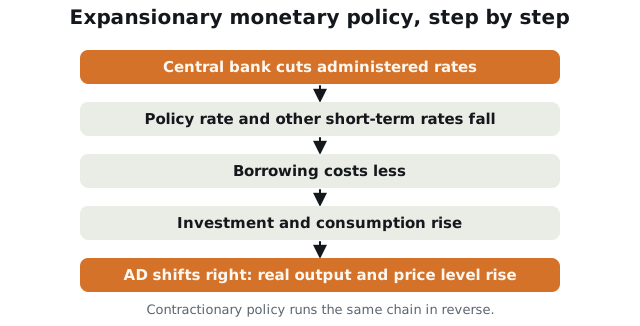
Central banks influence the nominal interest rate in the short run, and that rate affects investment and consumption. Expansionary monetary policy lowers rates to close a negative (recessionary) output gap. Contractionary monetary policy raises rates to close a positive (inflationary) output gap.
| Situation | Ample reserves | Limited reserves | Short-run effects |
|---|---|---|---|
| Recessionary gap | Lower interest on reserves | Open market purchase | Rates fall; AD, real output and the price level rise; unemployment falls |
| Inflationary gap | Raise interest on reserves | Open market sale | Rates rise; AD, real output and the price level fall; unemployment rises |
The money market, the reserve market and the AD-AS model can each show these short-run effects. A full answer often uses two of them: one graph for the interest rate and the AD-AS graph for output and the price level.
Part 5 of 5 Why Policy Takes Time
Monetary policy lags slow every action. Data on output and prices arrive weeks after the fact, so the central bank needs time to recognize a problem. After a rate change, firms need months to plan and build new projects, and households need time to change big purchases. A rate cut in a recession may raise spending only after the economy has started to recover on its own.
With ample reserves, the central bank moves interest rates by changing the rates it administers, led by interest on reserves.
Key Terms
- Monetary base
- Required reserve ratio
- Reserves
- Administered interest rates
- Ample reserves
- Central bank
- Contractionary monetary policy
- Discount rate
- Expansionary monetary policy
- Federal funds rate
- Interest on reserves
- Limited reserves
- Monetary policy
- Monetary policy lags
- Open market operations
- Policy rate
- Reserve market
Practice Questions
6 questions. Nothing here is recorded or scored.
- Question 1POL-1.D.2
The banking system in the United States has ample reserves. Which tool does the Federal Reserve use as its key policy tool?
- A.The required reserve ratio
- B.The interest rate it pays on reserves
- C.Large bond sales that make reserves scarce on purpose
- D.Payments of new currency mailed directly to households
Check answerHide answer
Answer: B
- A.
- The United States banking system has ample reserves, so the Federal Reserve's key policy tool is interest on reserves. The required reserve ratio is not its key tool.
- B.
- Correct. With ample reserves, the Federal Reserve steers the policy rate by setting interest on reserves and its other administered rates.
- C.
- In an ample-reserves system, small changes in reserves do not move the policy rate. Draining reserves is not how the Federal Reserve sets rates.
- D.
- Monetary policy works through interest rates and bank reserves. Mailing money to households is not one of its tools.
- Question 2POL-1.D.1, POL-1.D.6, POL-1.D.7
An economy with ample reserves has a positive (inflationary) output gap. Which action should its central bank take?
- A.Lower the interest rate it pays on reserves.
- B.Buy government bonds on the open market.
- C.Lower the discount rate.
- D.Raise the interest rate it pays on reserves.
Check answerHide answer
Answer: D
- A.
- Lowering interest on reserves lowers rates and raises spending, which would widen an inflationary gap.
- B.
- A bond purchase adds reserves, which points toward lower rates, and with ample reserves it would barely move the policy rate.
- C.
- A lower discount rate makes borrowing reserves cheaper. That is an expansionary move.
- D.
- Correct. To close an inflationary gap, the central bank raises interest rates. With ample reserves, it does this by raising its administered rates, led by interest on reserves. Higher rates reduce investment and consumption.
- Question 3POL-1.D.3, POL-1.D.4
A central bank in an economy with limited reserves conducts an open market purchase. Which of the following describes the effects?
- A.Reserves increase, and the money supply increases by more than the monetary base.
- B.Reserves decrease, and the money supply decreases by more than the monetary base.
- C.Reserves increase, and the money supply increases by exactly the change in the monetary base.
- D.Reserves do not change, and the money supply increases.
Check answerHide answer
Answer: A
- A.
- Correct. The central bank pays for the bonds by adding to bank reserves, which raises the monetary base. With limited reserves, banks lend the new excess reserves, and the money multiplier makes the money supply grow by more than the base.
- B.
- This describes an open market sale. A purchase adds reserves.
- C.
- With limited reserves, lending the new excess reserves expands the money supply beyond the change in the base.
- D.
- The central bank pays for the bonds with reserves, so reserves rise.
- Question 4POL-1.D.5, POL-1.D.6, POL-1.D.9
The Reserve Market in Talvan
The imaginary country of Talvan has ample reserves in its banking system. On the reserve market graph, the vertical supply of reserves crosses the flat lower section of reserve demand, where the policy rate equals the 4% the central bank pays as interest on reserves. The central bank now buys a small amount of government bonds and leaves all of its administered rates unchanged.
What will happen to Talvan's policy rate?
- A.It will fall below 4%.
- B.It will rise above 4%.
- C.It will stay at 4%.
- D.It will fall to zero.
Check answerHide answer
Answer: C
- A.
- No bank lends reserves overnight for less than the 4% it can earn from the central bank. A small bond purchase does not change that.
- B.
- Adding reserves cannot raise the policy rate, and with ample reserves it does not lower it either.
- C.
- Correct. With ample reserves, reserve supply crosses the flat part of demand, which sits at the interest-on-reserves rate. A small rise in supply moves along that flat part, so the policy rate stays at 4%. Only a change in the administered rate would move it.
- D.
- Banks can earn 4% on reserves at the central bank, so they will not lend them to each other for zero.
- Question 5POL-1.D.7, POL-1.D.8
An economy is in a negative (recessionary) output gap, and the central bank lowers its administered interest rates. What are the short-run effects on real output and the price level?
- A.Real output increases, and the price level decreases.
- B.Real output increases, and the price level increases.
- C.Real output decreases, and the price level increases.
- D.Real output decreases, and the price level decreases.
Check answerHide answer
Answer: B
- A.
- A rightward shift of aggregate demand moves the economy up along short-run aggregate supply, so the price level rises.
- B.
- Correct. Lower rates make borrowing cheaper, so investment and consumption rise. Aggregate demand shifts right, which raises both real output and the price level in the short run.
- C.
- This pattern comes from a fall in short-run aggregate supply. Monetary policy shifts aggregate demand.
- D.
- This is the result of contractionary policy, which raises rates.
- Question 6POL-1.E.1
Which of the following explains a lag in monetary policy?
- A.The central bank must get approval from the legislature before each change in interest rates.
- B.The law allows interest rates to change only once each year.
- C.Banks may not change the rates on new loans until the next government budget passes.
- D.The central bank needs time to recognize a problem, and firms and households need time to change their spending after a rate change.
Check answerHide answer
Answer: D
- A.
- Needing legislative approval is a source of delay for fiscal policy. A central bank can change its rates at its own meetings.
- B.
- Central banks can change rates at any meeting, and they often meet several times a year.
- C.
- Banks set the rates on new loans themselves. The government budget does not control those rates.
- D.
- Correct. Monetary policy acts with delays. Data arrive late, so the central bank needs time to see the problem. After a rate change, firms and households need months to change their borrowing and spending.
Practice every topic in Unit 4
CED Codes
POL-1.D.1 · POL-1.D.2 · POL-1.D.3 · POL-1.D.4 · POL-1.D.5 · POL-1.D.6 · POL-1.D.7 · POL-1.D.8 · POL-1.D.9 · POL-1.E.1