6.1 Balance of Payments Accounts
How the current account and the capital and financial account record a country's trade and asset flows, why the two balance, and how to calculate each.
Part 1 of 3 Two Accounts
The balance of payments (BOP) is the accounting record of a country's transactions with the rest of the world over a period, usually a year. The BOP has two parts: the current account (CA) and the capital and financial account (CFA).
| Account | What goes in it | Examples |
|---|---|---|
| Current account | Net exports (balance of trade), net income from abroad and net unilateral transfers | Selling wheat abroad; dividends from a foreign company; money sent home by a worker abroad |
| Capital and financial account | Purchases and sales of assets between countries, and financial capital transfers | A foreign firm buys a local factory; a local saver buys foreign bonds |
Neither account has to balance on its own. The current account may show a surplus or a deficit, and so may the balance of trade inside it. A capital and financial account surplus means financial capital is flowing in; a deficit means it is flowing out. A country can run a trade deficit and still have a smaller current account deficit, if it earns income from assets abroad.
Part 2 of 3 Credits and Debits
Every transaction gets a sign. A credit is any transaction that brings money into the country, such as an export or a foreigner buying a domestic bond. A debit is any transaction that sends money out, such as an import or a resident buying a foreign stock.
| Transaction | Account | Credit or debit |
|---|---|---|
| A Sorvanan mill sells fabric to a buyer abroad | Current account (exports) | Credit |
| A Sorvanan family buys an imported car | Current account (imports) | Debit |
| A foreign bank pays interest to a Sorvanan bondholder | Current account (income) | Credit |
| A Sorvanan worker abroad sends money home | Current account (transfers) | Credit |
| A foreign company buys a Sorvanan hotel | Capital and financial account | Credit |
| A Sorvanan pension fund buys foreign government bonds | Capital and financial account | Debit |
Part 3 of 3 Why the Accounts Balance
The sum of all credits should match the sum of all debits, so the current account and the capital and financial account add up to zero. A country that buys more goods and services from abroad than it sells must pay for the difference. The country pays by selling assets to foreigners or by borrowing from them. Those sales show up as a capital and financial account surplus.
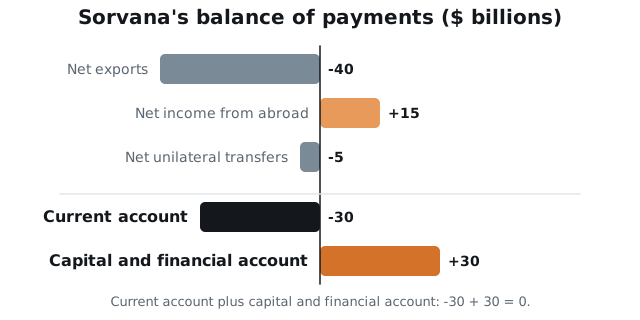
In the example, Sorvana exports $260 billion and imports $300 billion, so net exports are -$40 billion. Adding net income of +$15 billion and net transfers of -$5 billion gives a current account of -$30 billion. The capital and financial account must then be +$30 billion: foreigners bought $30 billion more Sorvanan assets than Sorvanans bought abroad.
A current account deficit is matched by a capital and financial account surplus of the same size.
Key Terms
Practice Questions
6 questions. Nothing here is recorded or scored.
- Question 1MEA-4.A.1
Which of the following transactions is recorded in a country's current account?
- A.A foreign company buys a factory located in the country.
- B.The country's firms sell machinery to buyers abroad.
- C.A resident of the country buys bonds issued by a foreign government.
- D.Foreign investors buy shares of stock in the country's firms.
Check answerHide answer
Answer: B
- A.
- Buying a factory is a purchase of an asset, recorded in the capital and financial account.
- B.
- Correct. The current account records net exports, net income from abroad and net unilateral transfers. Selling machinery abroad is an export.
- C.
- Buying foreign bonds is a purchase of a financial asset, recorded in the capital and financial account.
- D.
- Buying shares of stock is a purchase of a financial asset, recorded in the capital and financial account.
- Question 2MEA-4.A.6, MEA-4.A.3
A resident of Sorvana buys shares of stock in a company based in another country. How is this recorded in Sorvana's balance of payments?
- A.As a credit in the current account
- B.As a debit in the current account
- C.As a credit in the capital and financial account
- D.As a debit in the capital and financial account
Check answerHide answer
Answer: D
- A.
- Stock purchases are asset transactions, which belong in the capital and financial account. Money also leaves the country here, so it is not a credit.
- B.
- The current account records goods, services, income and transfers. A stock purchase is an asset transaction.
- C.
- The account is right and the sign is wrong. Money flows out of Sorvana, which makes the entry a debit.
- D.
- Correct. Buying a foreign asset is recorded in the capital and financial account. Money flows out of Sorvana to pay for the shares, so the entry is a debit.
- Question 3MEA-4.A.1, MEA-4.A.2
Ardley's International Accounts
In one year, the imaginary country of Ardley exports $500 billion of goods and services and imports $560 billion. Ardley's residents earn $25 billion more income from foreign assets than foreigners earn from Ardley's assets. Ardley sends $15 billion more in gifts, remittances and aid abroad than it receives.
What is the balance on Ardley's current account?
- A.A deficit of $60 billion
- B.A deficit of $50 billion
- C.A deficit of $20 billion
- D.A surplus of $50 billion
Check answerHide answer
Answer: B
- A.
- This is the balance of trade alone. The current account also includes net income and net transfers.
- B.
- Correct. Net exports are $500 - $560 = -$60 billion. Add net income from abroad of +$25 billion and net unilateral transfers of -$15 billion: -60 + 25 - 15 = -$50 billion.
- C.
- This adds the $15 billion of transfers instead of subtracting it. Ardley sends more than it receives, so transfers are negative.
- D.
- The size is right and the sign is wrong. Imports and transfers out exceed exports and income in, so the account is in deficit.
- Question 4MEA-4.A.6, MEA-4.A.5
If all transactions are recorded correctly, what is the balance on Ardley's capital and financial account?
- A.A deficit of $50 billion
- B.A balance of $0
- C.A surplus of $50 billion
- D.A surplus of $60 billion
Check answerHide answer
Answer: C
- A.
- The two accounts have opposite signs. A current account deficit means the capital and financial account is in surplus.
- B.
- The capital and financial account need not balance on its own; it offsets the current account.
- C.
- Correct. The current account and the capital and financial account sum to zero. A current account deficit of $50 billion is matched by a capital and financial account surplus of $50 billion.
- D.
- This matches the balance of trade. The offset must match the whole current account, -$50 billion.
- Question 5MEA-4.A.4
A country's capital and financial account shows a surplus. What does this mean?
- A.Foreigners bought more of the country's assets than its residents bought abroad, so financial capital flowed in on net.
- B.The country exported more goods and services than it imported.
- C.The country's residents bought more foreign assets than foreigners bought of the country's assets.
- D.The country's government collected more in taxes than it spent.
Check answerHide answer
Answer: A
- A.
- Correct. A surplus in the capital and financial account is a net financial capital inflow: more money came in from asset sales to foreigners than went out for asset purchases abroad.
- B.
- Exports and imports are in the current account. This describes a trade surplus.
- C.
- This describes a capital and financial account deficit, a net financial capital outflow.
- D.
- This is a government budget surplus, which is not part of the balance of payments.
- Question 6MEA-4.A.2, MEA-4.A.6
A country has a current account deficit. Which of the following must be true?
- A.Its balance of trade is also in deficit.
- B.Its capital and financial account also has a deficit.
- C.Its capital and financial account has a surplus of the same size.
- D.Its exports are smaller than its imports of financial assets.
Check answerHide answer
Answer: C
- A.
- A current account deficit usually comes with a trade deficit, and it does not have to. Large net transfers abroad could create a current account deficit even with a trade surplus.
- B.
- If both accounts were in deficit, they could not sum to zero.
- C.
- Correct. The current account and the capital and financial account sum to zero, so a current account deficit is always matched by a capital and financial account surplus.
- D.
- Exports of goods and services are compared with imports of goods and services, in the current account. Asset purchases are in a different account.
Practice every topic in Unit 6
CED Codes
MEA-4.A.1 · MEA-4.A.2 · MEA-4.A.3 · MEA-4.A.4 · MEA-4.A.5 · MEA-4.A.6