5.7 Public Policy and Economic Growth
How policies on productivity, work, infrastructure and technology raise long-run growth, and how supply-side fiscal policy shifts AD and AS.
Part 1 of 2 Policies That Raise Growth
Long-run growth depends on how much each worker produces and on how many people work. Public policies that change productivity or labor force participation change real GDP per capita and economic growth.
| Policy | What it changes | Example |
|---|---|---|
| Education and training subsidies | Human capital per worker | Grants that pay community college tuition for welders and electricians |
| Spending on infrastructure | Public capital that firms rely on | A new port that cuts shipping times |
| Funding for research and technology | Technology | Public grants for university research on batteries |
| Tax credits for new equipment | Physical capital per worker | A credit for firms that buy new machinery |
| Child care support for working parents | Labor force participation | Subsidized child care that lets more parents take jobs |
The imaginary country of Velmora funds a program that trains 50,000 adults as machinists. The trained workers produce more per hour. Velmora's productivity rises, and so does its potential output. Velmora also builds a rail line between its two largest cities. Freight that took two days now takes one, so the same trucks and workers deliver more goods each week.
Labor force participation matters as much as productivity. When more adults who want jobs can take them, employment rises, and the aggregate production function says output rises with employment. Policies that remove barriers to work, such as the cost of child care, raise real GDP per capita this way.
Part 2 of 2 Supply-Side Fiscal Policy
Supply-side fiscal policies change taxes and spending to change incentives. A lower tax on wages raises the reward for working an extra hour. A tax credit for research raises the reward for inventing. Because these policies change what households and firms choose to do, they can move both aggregate demand and aggregate supply. Their effects differ between the short run and the long run.
Take a cut in income tax rates. In the short run, households keep more of each paycheck and spend more, so aggregate demand shifts right. Over time, the higher reward for work can raise labor force participation and hours, and firms that keep more profit can invest more. Short-run aggregate supply and long-run aggregate supply shift right.
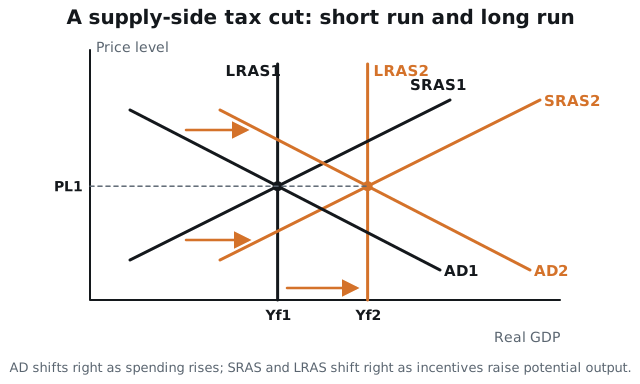
| Policy | Short run | Long run |
|---|---|---|
| Income tax cut | AD rises as households spend more | SRAS and LRAS can rise as people work more |
| Investment tax credit | AD rises as firms buy equipment | LRAS rises as the capital stock grows |
| Infrastructure spending | AD rises from government purchases | LRAS rises as roads and ports raise productivity |
Policies that raise productivity or bring more people into work shift long-run aggregate supply right.
Key Terms
Practice Questions
6 questions. Nothing here is recorded or scored.
- Question 1POL-4.A.2
A government builds high-speed internet lines to rural towns so that firms there can sell online. What is the most likely long-run effect?
- A.Productivity falls, and the long-run aggregate supply curve shifts to the left.
- B.Only aggregate demand changes, and potential output stays the same.
- C.The natural rate of unemployment rises, and real GDP per capita falls.
- D.Productivity rises, and the long-run aggregate supply curve shifts to the right.
Check answerHide answer
Answer: D
- A.
- Useful infrastructure helps firms produce more, so productivity rises.
- B.
- The construction spending raises aggregate demand in the short run, and the finished network raises potential output in the long run.
- C.
- Better connections make it easier for firms to hire and sell. That raises output per person.
- D.
- Correct. Infrastructure is public capital that firms use. Better connections let the same workers produce and sell more, which raises productivity and potential output.
- Question 2POL-4.A.3
Which of the following best describes supply-side fiscal policy?
- A.Changes in the interest rate the central bank pays on reserves
- B.Increases in government purchases designed only to raise aggregate demand during a recession
- C.Changes in taxes and government spending designed to change incentives to work, save, invest and innovate
- D.Limits on imports designed to protect domestic producers
Check answerHide answer
Answer: C
- A.
- Interest on reserves is a monetary policy tool, not fiscal policy.
- B.
- Spending aimed only at aggregate demand is demand-side fiscal policy.
- C.
- Correct. Supply-side fiscal policies work through incentives. By changing what households and firms gain from working, saving and investing, they aim to raise aggregate supply and potential output.
- D.
- Import limits are trade policy, not supply-side fiscal policy.
- Question 3POL-4.A.3
A government cuts income tax rates, which raises the after-tax reward for working. Which of the following describes the likely effects?
- A.In the short run aggregate supply decreases; in the long run aggregate demand decreases.
- B.In the short run aggregate demand increases; in the long run aggregate supply and potential output can increase.
- C.In the short run nothing changes; in the long run only aggregate demand increases.
- D.In the short run aggregate demand decreases; in the long run potential output decreases.
Check answerHide answer
Answer: B
- A.
- A tax cut raises after-tax income and the reward for work. Neither effect lowers supply or demand.
- B.
- Correct. Households keep more income, so they spend more and aggregate demand rises soon. Over time, the higher reward for work can raise labor force participation and hours, which raises aggregate supply and potential output.
- C.
- Higher disposable income raises spending soon after the cut. The long-run effect is on supply.
- D.
- Lower taxes raise spending and work effort. Both effects push output up.
- Question 4POL-4.A.1
A government subsidizes child care so that more parents who want jobs can take them. Holding population constant, what is the most likely effect?
- A.Labor force participation and employment rise, so real GDP per capita rises.
- B.Labor force participation falls, so real GDP per capita falls.
- C.Employment rises, and real GDP per capita falls because the population grows.
- D.Real GDP per capita stays the same, because productivity did not change.
Check answerHide answer
Answer: A
- A.
- Correct. Policies that affect labor force participation affect real GDP per capita. More people working means more output for the same population.
- B.
- Lower child care costs make it easier to work, so participation rises.
- C.
- The question holds population constant. More output for the same population raises output per person.
- D.
- Output can rise even with unchanged productivity, because more people are employed.
- Question 5POL-4.A.1
Which policy is most likely to raise long-run growth by increasing human capital?
- A.Raising the interest rate the central bank pays on reserves
- B.Sending a one-time rebate check to every household
- C.Paying tuition for technical training programs
- D.Placing a tariff on imported machinery
Check answerHide answer
Answer: C
- A.
- Interest on reserves is a short-run stabilization tool. It does not build skills.
- B.
- A one-time rebate raises spending briefly. It does not raise what workers can produce.
- C.
- Correct. Training raises workers' skills, which raises human capital per worker and productivity, the source of long-run growth.
- D.
- A tariff makes machinery more expensive, which tends to lower physical capital, and it does nothing for skills.
- Question 6POL-4.A.2, POL-4.A.3
A government gives firms a tax credit for buying new equipment. Which of the following describes the effects in the short run and the long run?
- A.Aggregate demand decreases in the short run, and potential output decreases in the long run.
- B.Aggregate supply decreases in the short run, and aggregate demand increases in the long run.
- C.Potential output increases immediately, and aggregate demand does not change.
- D.Aggregate demand increases in the short run as firms buy equipment, and potential output increases in the long run as the capital stock grows.
Check answerHide answer
Answer: D
- A.
- The credit encourages spending and capital, so both effects are increases.
- B.
- The credit encourages investment, which does not lower supply.
- C.
- Buying equipment is spending, so aggregate demand rises first. Capacity grows only after the equipment is installed.
- D.
- Correct. Equipment purchases are investment spending, so aggregate demand rises right away. Once installed, the equipment raises capital per worker, which raises productivity and long-run aggregate supply.
Practice every topic in Unit 5
CED Codes
POL-4.A.1 · POL-4.A.2 · POL-4.A.3