6.3 The Foreign Exchange Market
Draw the foreign exchange market, explain where currency demand and supply come from, and show how surpluses and shortages push the rate to equilibrium.
Part 1 of 3 Drawing the Market
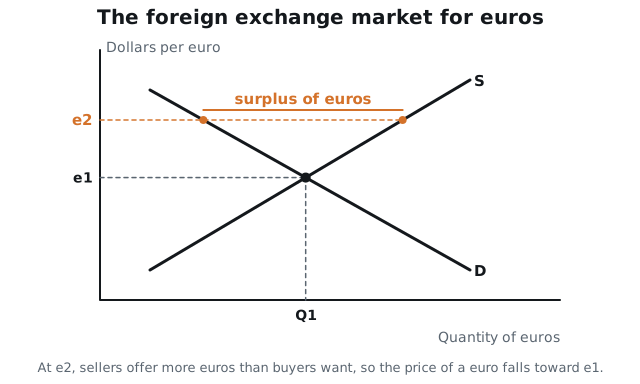
The foreign exchange market works like any other market, with a currency as the good. For the market for euros, the vertical axis is the price of a euro (dollars per euro) and the horizontal axis is the quantity of euros.
The demand for euros comes from people who want euro-area goods, services and financial assets and must pay in euros. An American store importing Italian olive oil and a Canadian saver buying German bonds both demand euros. Demand slopes downward: when euros are cheaper, euro-area goods and assets cost less in other currencies, so buyers want more euros.
The supply of euros comes from euro-area residents who need other currencies to buy foreign goods, services and assets. A French tourist visiting Chicago supplies euros to get dollars. Supply slopes upward: when each euro buys more dollars, foreign goods look cheaper to euro holders, so they offer more euros.
The model treats a currency like wheat or apples. The exchange rate is the price, and the quantity is the number of euros traded in a period.
Part 2 of 3 Equilibrium and Disequilibrium
The equilibrium exchange rate is the rate at which the quantity of euros demanded equals the quantity supplied. At any other rate, market forces push the rate back.
| Rate is | What exists | Result |
|---|---|---|
| Above equilibrium | A surplus: more euros offered than wanted | Sellers accept fewer dollars per euro; the euro depreciates toward e1 |
| Below equilibrium | A shortage: more euros wanted than offered | Buyers pay more dollars per euro; the euro appreciates toward e1 |
Part 3 of 3 Two Markets, One Trade
Every currency trade appears in two markets. Someone who buys euros with dollars demands euros and supplies dollars in the same trade. So a rise in the demand for euros is also a rise in the supply of dollars. When the euro appreciates against the dollar, the dollar depreciates against the euro.
Demand for a currency comes from foreigners buying the country's goods and assets. Supply comes from its own residents buying abroad.
Key Terms
Practice Questions
6 questions. Nothing here is recorded or scored.
- Question 1MKT-5.B.1
Which of the following creates demand for euros in the foreign exchange market?
- A.A German tourist exchanges euros for dollars to visit Florida.
- B.A French firm buys United States government bonds.
- C.A store in Ohio imports shoes from Italy and must pay the maker in euros.
- D.A family in Spain buys a television made in Japan.
Check answerHide answer
Answer: C
- A.
- The tourist gives up euros to get dollars, which supplies euros.
- B.
- The French firm needs dollars to buy United States bonds, so it supplies euros.
- C.
- Correct. Demand for a currency comes from people who want to buy that country's goods, services or assets. The Ohio store needs euros to buy Italian shoes.
- D.
- The Spanish family pays for a Japanese product, so it supplies euros to get yen.
- Question 2MKT-5.B.2
Why does the supply curve of euros slope upward in the market for euros priced in dollars?
- A.When each euro buys more dollars, euro-area goods are cheaper for Americans, so Americans buy more euros.
- B.The European Central Bank prints more euros whenever the exchange rate rises.
- C.A higher exchange rate lowers interest rates in the euro area.
- D.When each euro buys more dollars, American goods and assets are cheaper for euro holders, so they offer more euros.
Check answerHide answer
Answer: D
- A.
- A higher price of the euro makes euro-area goods more expensive for Americans, and the choice also describes demand for euros.
- B.
- The supply curve describes euro holders trading in the market. It is not a rule for printing money.
- C.
- The upward slope comes from the choices of euro holders, not from changes in interest rates.
- D.
- Correct. Supply of a currency comes from its holders making payments in other currencies. A higher price of the euro lets euro holders buy more dollars, so dollar goods and assets look cheaper and they supply more euros.
- Question 3MKT-5.D.1
In a foreign exchange market, the exchange rate is below its equilibrium level. What happens next?
- A.A shortage of the currency exists, and the currency appreciates toward equilibrium.
- B.A surplus of the currency exists, and the currency depreciates further.
- C.A shortage of the currency exists, and the currency depreciates further.
- D.The quantities are equal, so the exchange rate does not change.
Check answerHide answer
Answer: A
- A.
- Correct. Below equilibrium, buyers want more of the currency than sellers offer. Buyers bid the price of the currency up, so it appreciates until the shortage disappears.
- B.
- A surplus exists above equilibrium, not below it.
- C.
- A shortage pushes the price of the currency up.
- D.
- The quantities are equal only at the equilibrium rate.
- Question 4MKT-5.C.1
The Market for Pells
The schedule shows the market for pells, the currency of the imaginary country of Pellandia, priced in dollars. At $0.40 per pell, 900 million pells are demanded and 500 million are supplied. At $0.50: 800 million demanded, 600 million supplied. At $0.60: 700 million demanded, 700 million supplied. At $0.70: 600 million demanded, 800 million supplied.
What is the equilibrium exchange rate in the market for pells?
- A.$0.40 per pell
- B.$0.50 per pell
- C.$0.60 per pell
- D.$0.70 per pell
Check answerHide answer
Answer: C
- A.
- At $0.40, buyers want 900 million pells and sellers offer 500 million, a shortage.
- B.
- At $0.50, buyers want 800 million and sellers offer 600 million, still a shortage.
- C.
- Correct. At $0.60 per pell, the quantity demanded and the quantity supplied are both 700 million pells.
- D.
- At $0.70, sellers offer 800 million and buyers want 600 million, a surplus.
- Question 5MKT-5.D.1
Suppose the exchange rate is $0.70 per pell. Which of the following describes the market?
- A.There is a shortage of 200 million pells, and the pell appreciates.
- B.There is a surplus of 200 million pells, and the pell depreciates.
- C.There is a surplus of 200 million pells, and the pell appreciates.
- D.There is a surplus of 100 million pells, and the pell depreciates.
Check answerHide answer
Answer: B
- A.
- Quantity supplied exceeds quantity demanded at $0.70, which is a surplus.
- B.
- Correct. At $0.70, 800 million pells are supplied and 600 million are demanded, a surplus of 200 million. Sellers accept fewer dollars per pell, so the pell depreciates toward $0.60.
- C.
- A surplus pushes the price of the pell down, so the pell depreciates.
- D.
- The surplus is 800 - 600 = 200 million pells.
- Question 6MKT-5.B.1, MKT-5.B.2
Americans want more euro-area goods. In the market for euros, demand for euros increases. What is the matching change in the market for dollars priced in euros?
- A.The supply of dollars increases.
- B.The demand for dollars increases.
- C.The supply of dollars decreases.
- D.Nothing changes in the market for dollars.
Check answerHide answer
Answer: A
- A.
- Correct. Americans who want euros pay for them with dollars. Every euro bought with dollars is a dollar supplied, so higher demand for euros is the same event as a higher supply of dollars.
- B.
- Demand for dollars comes from people who want American goods or assets. This change is about Americans buying abroad.
- C.
- Americans are offering more dollars to get euros, so the supply of dollars rises.
- D.
- Every currency trade appears in both markets.
Practice every topic in Unit 6
CED Codes
MKT-5.B.1 · MKT-5.B.2 · MKT-5.C.1 · MKT-5.D.1