6.4 Effect of Changes in Policies and Economic Conditions on the Foreign Exchange Market
What shifts currency demand and supply, from tastes and incomes to tariffs and interest rates, and how fiscal and monetary policy move exchange rates.
Part 1 of 3 What Shifts the Curves
An exchange rate changes when the demand for a currency or its supply shifts. Demand for a country's currency depends on how much foreigners want its goods, services and assets. Supply depends on how much its own residents want foreign goods, services and assets.
Take the imaginary country of Sorvana, whose currency is the sorv, and its trading partner, the United States. The graph prices the sorv in dollars, so a higher point on the vertical axis means a stronger sorv. For each change below, decide whether it changes how many sorvs foreigners want or how many sorvs Sorvanans offer.
| Change | Curve that shifts | The sorv |
|---|---|---|
| Americans develop a taste for Sorvanan furniture | Demand for sorvs rises | Appreciates |
| Incomes in the United States rise, so Americans buy more imports, including Sorvanan goods | Demand for sorvs rises | Appreciates |
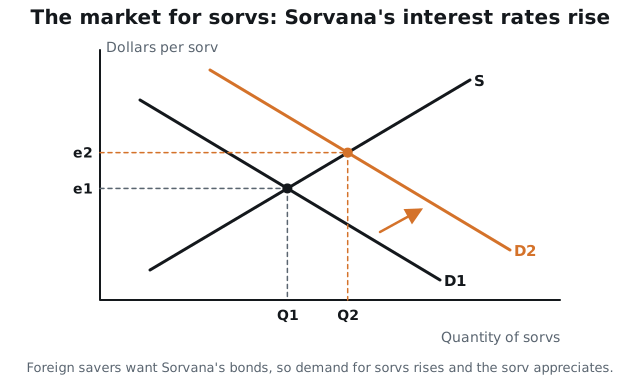
| Real interest rates in Sorvana rise above those in the United States | Demand for sorvs rises; Sorvanan savers also keep more funds at home, lowering supply | Appreciates |
| Sorvana's inflation is higher than United States inflation | Demand for sorvs falls, supply of sorvs rises | Depreciates |
| Sorvana puts a tariff or a quota on American goods | Supply of sorvs falls, because Sorvanans buy fewer American goods | Appreciates |
Part 2 of 3 Fiscal Policy and the Exchange Rate
Fiscal policy changes aggregate demand, output and prices, and it can also move the exchange rate. Suppose Sorvana raises government spending and borrows to pay for it. Government borrowing pushes Sorvana's real interest rate up. Foreign savers want the higher return, so they demand more sorvs to buy Sorvanan bonds. The sorv appreciates.
Part 3 of 3 Monetary Policy and the Exchange Rate
Monetary policy works through the same channel. Suppose Sorvana's central bank lowers the interest rate it pays on reserves to fight a recession. Interest rates in Sorvana fall, so Sorvanan bonds pay less than foreign bonds. Foreign savers buy fewer Sorvanan assets, and Sorvanan savers move funds abroad. Demand for sorvs falls and supply rises, so the sorv depreciates.
| Policy in Sorvana | Sorvana's interest rates | The sorv |
|---|---|---|
| Expansionary fiscal policy (more borrowing) | Rise | Appreciates |
| Contractionary fiscal policy (less borrowing) | Fall | Depreciates |
| Expansionary monetary policy | Fall | Depreciates |
| Contractionary monetary policy | Rise | Appreciates |
A full answer names each link in order. For a contractionary monetary policy in Sorvana: interest on reserves rises, Sorvanan interest rates rise, foreign demand for Sorvanan bonds rises, demand for sorvs rises, and the sorv appreciates.
Higher interest rates make a country's assets more attractive, so demand for its currency rises and it appreciates.
Key Terms
Practice Questions
6 questions. Nothing here is recorded or scored.
- Question 1MKT-5.E.1
Consumers in Japan develop a strong taste for furniture made in Sorvana. What happens to the demand for sorvs and to the value of the sorv?
- A.Demand for sorvs decreases, and the sorv depreciates.
- B.Demand for sorvs increases, and the sorv appreciates.
- C.Supply of sorvs increases, and the sorv depreciates.
- D.Demand for sorvs increases, and the sorv depreciates.
Check answerHide answer
Answer: B
- A.
- A new taste for Sorvanan goods raises demand for Sorvana's currency.
- B.
- Correct. Japanese buyers need sorvs to pay for Sorvanan furniture. Demand for sorvs shifts right, and the sorv appreciates.
- C.
- Supply of sorvs comes from Sorvanans buying abroad. This change is about foreigners buying from Sorvana.
- D.
- Higher demand raises the price of the currency, which is an appreciation.
- Question 2MKT-5.E.3
Sorvana's central bank raises the interest rate it pays on reserves, and interest rates in Sorvana rise. What is the effect on the sorv in the foreign exchange market?
- A.Demand for sorvs decreases as foreign savers sell Sorvanan bonds, and the sorv depreciates.
- B.Supply of sorvs increases as Sorvanans buy more imports, and the sorv depreciates.
- C.Demand for sorvs increases, and the sorv depreciates.
- D.Demand for sorvs increases as foreign savers buy Sorvanan bonds, and the sorv appreciates.
Check answerHide answer
Answer: D
- A.
- Higher rates attract foreign savers. They buy Sorvanan bonds, which raises demand for sorvs.
- B.
- Contractionary monetary policy lowers spending, including spending on imports, so it does not raise the supply of sorvs.
- C.
- An increase in demand raises the price of the currency.
- D.
- Correct. Higher Sorvanan interest rates make Sorvanan assets more attractive. Foreign savers need sorvs to buy them, so demand for sorvs rises and the sorv appreciates.
- Question 3MKT-5.E.2
Sorvana's government increases spending and borrows to pay for it, which raises Sorvana's real interest rate. Through the interest-rate effect, what happens to the sorv?
- A.Sorvanan savers buy more foreign bonds, so the supply of sorvs rises and the sorv depreciates.
- B.The government prints sorvs to pay for the spending, so the sorv depreciates.
- C.Foreign savers buy more Sorvanan bonds, so demand for sorvs rises and the sorv appreciates.
- D.The exchange rate does not change, because fiscal policy affects only aggregate demand.
Check answerHide answer
Answer: C
- A.
- A higher Sorvanan rate makes savers keep funds at home and draws foreign funds in. It does not push funds abroad.
- B.
- The question says the spending is financed by borrowing.
- C.
- Correct. Higher real interest rates make Sorvanan assets more attractive to foreigners. Their demand for sorvs rises, so the sorv appreciates.
- D.
- Fiscal policy can change interest rates, which moves exchange rates.
- Question 4MKT-5.E.1
Sorvana places a tariff on goods imported from the United States. In the market for sorvs priced in dollars, what happens?
- A.The supply of sorvs decreases, and the sorv appreciates.
- B.The supply of sorvs increases, and the sorv depreciates.
- C.The demand for sorvs decreases, and the sorv depreciates.
- D.The demand for sorvs increases, and the sorv depreciates.
Check answerHide answer
Answer: A
- A.
- Correct. The tariff makes American goods more expensive in Sorvana, so Sorvanans buy fewer of them and offer fewer sorvs in exchange for dollars. A smaller supply of sorvs raises their price.
- B.
- Sorvanans buy fewer American goods, so they supply fewer sorvs.
- C.
- The tariff changes what Sorvanans buy abroad, which is the supply side of the market for sorvs.
- D.
- An increase in demand would make the sorv appreciate, and the tariff works through supply.
- Question 5MKT-5.E.1
Inflation in Sorvana runs well above inflation in the United States for several years. What is the likely effect on the sorv?
- A.The sorv appreciates against the dollar.
- B.The sorv depreciates against the dollar.
- C.The sorv does not change in value, because inflation affects only domestic prices.
- D.The sorv appreciates, because higher prices mean each sorv is worth more.
Check answerHide answer
Answer: B
- A.
- Relatively high inflation makes a country's goods less attractive abroad, which weakens its currency.
- B.
- Correct. Sorvanan goods become more expensive compared with American goods. Americans buy fewer Sorvanan goods, which lowers demand for sorvs, and Sorvanans buy more American goods, which raises the supply of sorvs. Both changes lower the value of the sorv.
- C.
- Inflation changes the relative prices of the two countries' goods, which changes trade and the exchange rate.
- D.
- Higher prices mean each sorv buys less, both at home and abroad. That is a loss of value.
- Question 6MKT-5.E.3
The central bank of the United States lowers its administered interest rates, and interest rates in the United States fall. In the market for dollars priced in sorvs, what happens?
- A.Demand for dollars increases, and the dollar appreciates.
- B.Supply of dollars decreases, and the dollar appreciates.
- C.Demand for dollars decreases, and the dollar depreciates.
- D.Demand for dollars decreases, and the dollar appreciates.
Check answerHide answer
Answer: C
- A.
- Lower rates reduce foreign interest in American assets, which lowers demand for dollars.
- B.
- Americans move funds abroad to earn more, which increases the supply of dollars.
- C.
- Correct. Lower American interest rates make American assets less attractive. Foreign savers buy fewer of them, so demand for dollars falls and the dollar depreciates.
- D.
- Lower demand lowers the price of the currency, so the dollar depreciates.
Practice every topic in Unit 6
CED Codes
MKT-5.E.1 · MKT-5.E.2 · MKT-5.E.3