6.5 Changes in the Foreign Exchange Market and Net Exports
How appreciation and depreciation change the prices foreigners pay, and so change a country's exports, imports, net exports and aggregate demand.
Part 1 of 3 Prices Across the Border
A change in the exchange rate changes what goods cost across a border, even when no seller changes a price. The new costs move exports, imports and net exports. Net exports are part of aggregate demand.
The imaginary country of Sorvana sells a bicycle for 400 sorvs. At $0.50 per sorv, an American pays 400 x $0.50 = $200. If the sorv appreciates to $0.60, the same bicycle costs an American $240. Meanwhile, a $30 American video game that cost a Sorvanan 60 sorvs at the old rate now costs only 50 sorvs.
| Good | Price at $0.50 per sorv | Price at $0.60 per sorv |
|---|---|---|
| Sorvanan bicycle, 400 sorvs, bought by an American | $200 | $240 |
| American video game, $30, bought by a Sorvanan | 60 sorvs | 50 sorvs |
Part 2 of 3 Appreciation and Depreciation at Work
Factors that make a currency appreciate cause that country's exports to fall and its imports to rise. Its goods cost foreigners more, and foreign goods cost its residents less. As a result, net exports fall.
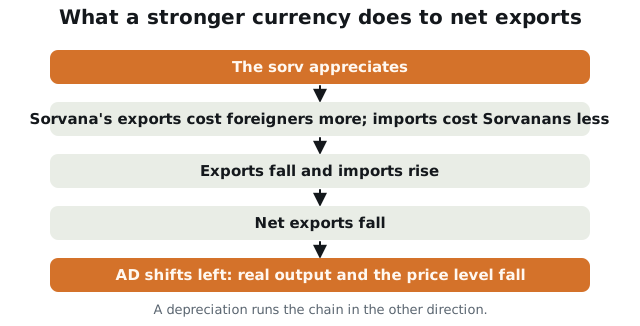
The bicycle maker did not raise its price, and the game maker did not cut its price. Only the exchange rate moved. American buyers respond to the higher dollar price by buying fewer Sorvanan bicycles, and Sorvanan buyers respond to the lower sorv price by buying more American games.
Factors that make a currency depreciate work the other way. Its exports rise and its imports fall, so net exports rise. A weaker sorv would make Sorvanan bicycles cheaper abroad and American games more expensive in Sorvana.
| Currency | Exports | Imports | Net exports | Aggregate demand |
|---|---|---|---|---|
| Appreciates | Fall | Rise | Fall | Shifts left |
| Depreciates | Rise | Fall | Rise | Shifts right |
Part 3 of 3 From Net Exports to Output
Net exports are a component of aggregate demand. When net exports fall, aggregate demand shifts left: real output and the price level fall, and unemployment rises. When net exports rise, aggregate demand shifts right: real output and the price level rise, and unemployment falls.
The size of the effect depends on how much buyers respond to the new prices. The direction does not: a stronger sorv always lowers Sorvana's net exports, other things equal.
Appreciation lowers net exports and aggregate demand. Depreciation raises them.
Key Terms
Practice Questions
6 questions. Nothing here is recorded or scored.
- Question 1MKT-5.F.1
A country's currency appreciates. What happens to its exports and imports?
- A.Exports decrease, and imports increase.
- B.Exports increase, and imports decrease.
- C.Exports increase, and imports increase.
- D.Exports decrease, and imports decrease.
Check answerHide answer
Answer: A
- A.
- Correct. An appreciation makes the country's goods more expensive for foreigners, so exports fall, and makes foreign goods cheaper at home, so imports rise.
- B.
- This is the effect of a depreciation.
- C.
- A stronger currency makes exports harder to sell, so exports fall.
- D.
- A stronger currency makes foreign goods cheaper, so imports rise.
- Question 2MKT-5.F.2
A country's currency depreciates. What happens to its net exports and aggregate demand?
- A.Net exports decrease, and aggregate demand decreases.
- B.Net exports increase, and aggregate demand decreases.
- C.Net exports decrease, and aggregate demand increases.
- D.Net exports increase, and aggregate demand increases.
Check answerHide answer
Answer: D
- A.
- This is the effect of an appreciation.
- B.
- Net exports are a component of aggregate demand, so they move it in the same direction.
- C.
- A depreciation raises net exports.
- D.
- Correct. A weaker currency makes exports cheaper abroad and imports dearer at home. Exports rise and imports fall, so net exports rise. Net exports are part of aggregate demand, so aggregate demand rises.
- Question 3MKT-5.F.1
A Sorvanan bicycle sells for 500 sorvs. The sorv appreciates from $0.40 to $0.50. What happens to the price of the bicycle for an American buyer?
- A.It falls from $250 to $200.
- B.It rises from $200 to $250.
- C.It stays at $200, because the price in sorvs did not change.
- D.It rises from $500 to $625.
Check answerHide answer
Answer: B
- A.
- This reverses the before and after prices. An appreciation of the sorv raises the dollar price of Sorvanan goods.
- B.
- Correct. At $0.40 per sorv, 500 sorvs cost 500 x $0.40 = $200. At $0.50, they cost $250. The stronger sorv raises the dollar price.
- C.
- The sorv price stayed the same, and each sorv now costs more dollars.
- D.
- This treats the price in sorvs as a price in dollars. Convert 500 sorvs at the exchange rate.
- Question 4MKT-5.F.2
An economy is in a recession, and its currency depreciates sharply. What are the likely short-run effects on real output and unemployment?
- A.Real output decreases, and unemployment increases.
- B.Real output increases, and unemployment increases.
- C.Real output increases, and unemployment decreases.
- D.Real output does not change, because the exchange rate affects only prices.
Check answerHide answer
Answer: C
- A.
- This would follow an appreciation, which lowers net exports.
- B.
- More output requires more workers, so unemployment falls.
- C.
- Correct. The depreciation raises net exports, which shifts aggregate demand right. Firms produce more and hire more workers, so real output rises and unemployment falls.
- D.
- The exchange rate changes net exports, a part of aggregate demand, so it changes real output.
- Question 5MKT-5.F.2
Which of the following would most likely increase a country's net exports?
- A.A depreciation of the country's currency
- B.An appreciation of the country's currency
- C.A rise in the country's interest rates that attracts foreign savings
- D.A rise in incomes in the country that raises purchases of imports
Check answerHide answer
Answer: A
- A.
- Correct. A weaker currency makes the country's goods cheaper abroad and foreign goods dearer at home, so exports rise, imports fall and net exports rise.
- B.
- An appreciation lowers net exports.
- C.
- Foreign savings arriving raise demand for the currency, which appreciates and lowers net exports.
- D.
- Higher imports lower net exports.
- Question 6MKT-5.F.1
Real interest rates in Pellandia rise above those of its trading partners, and the pell appreciates. What is the effect on Pellandia's net exports and aggregate demand?
- A.Net exports increase, and aggregate demand increases.
- B.Net exports increase, and aggregate demand decreases.
- C.Net exports decrease, and aggregate demand increases.
- D.Net exports decrease, and aggregate demand decreases.
Check answerHide answer
Answer: D
- A.
- A stronger pell lowers net exports.
- B.
- A stronger pell lowers net exports, and net exports move aggregate demand in the same direction.
- C.
- Lower net exports reduce aggregate demand.
- D.
- Correct. The appreciation makes Pellandian goods more expensive abroad and foreign goods cheaper in Pellandia. Exports fall and imports rise, so net exports fall, and aggregate demand falls with them.
Practice every topic in Unit 6
CED Codes
MKT-5.F.1 · MKT-5.F.2