6.6 Real Interest Rates and International Capital Flows
How differences in real interest rates move financial capital between countries, and what that does to exchange rates, loanable funds and the BOP.
Part 1 of 3 Capital Follows the Higher Return
Savers and investors can buy assets in any country. When real interest rates differ across countries, the relative values of domestic and foreign assets change. Financial capital flows toward the country with the relatively higher real interest rate.
Suppose the imaginary country of Pellandia, whose currency is the pell, offers a 4% real return on government bonds, while similar American bonds offer 2%. American savers sell some of their American bonds and buy Pellandian bonds instead. To pay for them, they trade dollars for pells. Pellandia receives a net capital inflow, which shows up as a surplus in its capital and financial account.
Part 2 of 3 Three Markets Move Together
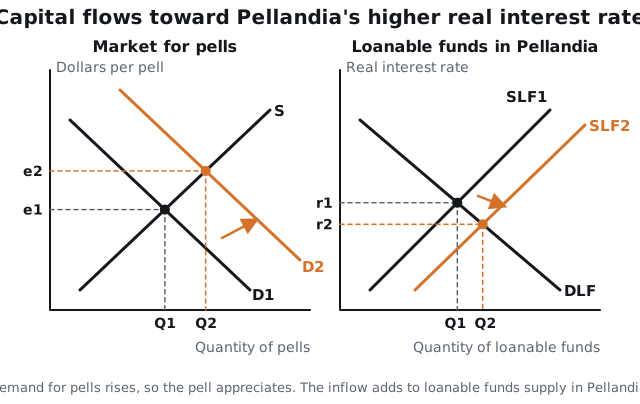
| Market or account | Effect |
|---|---|
| Foreign exchange market for pells | Americans need pells to buy Pellandian bonds: demand for pells rises and the pell appreciates |
| Pellandia's loanable funds market | Foreign savings add to the supply of loanable funds: supply shifts right, pulling Pellandia's real rate down |
| Pellandia's balance of payments | Capital and financial account moves toward surplus |
| Pellandia's net exports | The stronger pell lowers exports and raises imports, so net exports fall |
The two sides of the balance of payments move together here. A capital and financial account surplus is matched by a current account deficit, and the appreciation that the inflow causes is what pushes net exports down.
Part 3 of 3 Central Banks and Capital Flows
A central bank sets the path of short-term interest rates at home, so its decisions change how much foreign capital arrives. If Pellandia's central bank raises interest on reserves, Pellandian interest rates rise, more foreign funds flow in, and the pell appreciates. If it lowers its administered rates, funds flow out and the pell depreciates. These flows connect three parts of the course. Interest rates come from monetary policy and the loanable funds market. Exchange rates come from the foreign exchange market. Net exports feed aggregate demand.
The United States is in the opposite position in this example. Funds leave American bond markets, so the supply of loanable funds in the United States shifts left, and the dollar depreciates against the pell.
Financial capital flows toward the higher real interest rate, and the currency of the country receiving it appreciates.
Key Terms
Practice Questions
6 questions. Nothing here is recorded or scored.
- Question 1MKT-5.G.1
Toward which country will financial capital tend to flow?
- A.The country with the relatively lower real interest rate
- B.The country with the relatively higher real interest rate
- C.The country with the larger current account surplus
- D.The country with the higher inflation rate
Check answerHide answer
Answer: B
- A.
- A lower real rate pays savers less, so funds flow out of that country.
- B.
- Correct. Savers want the highest real return. Financial capital flows toward the country whose assets pay the relatively higher real interest rate.
- C.
- A current account surplus is matched by a capital and financial account deficit, which is a net outflow.
- D.
- Higher inflation lowers the real return on a given nominal rate.
- Question 2MKT-5.G.1
Pellandia's real interest rate rises relative to the rest of the world. What happens to the pell and to Pellandia's capital and financial account?
- A.The pell depreciates, and the capital and financial account moves toward surplus.
- B.The pell appreciates, and the capital and financial account moves toward deficit.
- C.The pell appreciates, and the capital and financial account moves toward surplus.
- D.The pell depreciates, and the capital and financial account moves toward deficit.
Check answerHide answer
Answer: C
- A.
- Foreign savers need pells to buy Pellandian assets, so demand for the pell rises.
- B.
- An inflow of financial capital is a surplus in the capital and financial account.
- C.
- Correct. Foreign savers buy Pellandian assets, which requires pells, so the pell appreciates. The asset purchases are a financial capital inflow, which moves the capital and financial account toward surplus.
- D.
- Both parts are reversed. These are the effects of a fall in Pellandia's relative real rate.
- Question 3MKT-5.G.1
Foreign savings flow into Pellandia because its real interest rate is relatively high. What is the effect in Pellandia's loanable funds market?
- A.The supply of loanable funds increases, which puts downward pressure on the real interest rate.
- B.The supply of loanable funds decreases, which raises the real interest rate further.
- C.The demand for loanable funds increases, which raises the real interest rate further.
- D.Nothing changes, because foreign savings do not enter the loanable funds market.
Check answerHide answer
Answer: A
- A.
- Correct. Foreign savings add to the funds available to Pellandian borrowers, shifting supply right. The higher supply pushes Pellandia's real interest rate down from its high level.
- B.
- Funds are arriving, which adds to supply.
- C.
- The inflow comes from lenders, so it affects supply, not demand.
- D.
- In an open economy, net capital inflow adds to the funds that finance investment.
- Question 4MKT-5.G.2
Sorvana's central bank lowers its administered interest rates, and Sorvanan interest rates fall. What are the likely effects on net capital inflows into Sorvana and on the sorv?
- A.Net capital inflows increase, and the sorv appreciates.
- B.Net capital inflows increase, and the sorv depreciates.
- C.Net capital inflows decrease, and the sorv appreciates.
- D.Net capital inflows decrease, and the sorv depreciates.
Check answerHide answer
Answer: D
- A.
- Lower rates push savers toward other countries, so inflows fall.
- B.
- Lower rates reduce inflows, and reduced demand for sorvs lowers their value.
- C.
- Fewer inflows mean less demand for the sorv, so it depreciates.
- D.
- Correct. Lower Sorvanan interest rates make Sorvanan assets less attractive. Less foreign money flows in and more Sorvanan money flows out, so demand for sorvs falls and the sorv depreciates.
- Question 5MKT-5.G.1
American savers move funds out of the United States to buy bonds in Pellandia, where real interest rates are higher. What is the effect in the United States loanable funds market?
- A.The supply of loanable funds increases, which lowers the United States real interest rate.
- B.The supply of loanable funds decreases, which puts upward pressure on the United States real interest rate.
- C.The demand for loanable funds decreases, which lowers the United States real interest rate.
- D.The demand for loanable funds increases, which raises the United States real interest rate.
Check answerHide answer
Answer: B
- A.
- Funds are leaving the United States, so the supply available there shrinks.
- B.
- Correct. Savings leaving the United States are no longer available to American borrowers, so supply shifts left and the real interest rate faces upward pressure.
- C.
- The outflow comes from lenders, so it changes supply, not demand.
- D.
- American borrowers have not changed their plans. The change is on the lending side.
- Question 6MKT-5.G.1
Two Interest Rates
Government bonds in the imaginary country of Sorvana pay a nominal interest rate of 6%, and Sorvana's inflation rate is 4%. Similar bonds in Pellandia pay a nominal rate of 5%, and Pellandia's inflation rate is 1%. Savers in both countries can buy bonds in either country.
Based only on real interest rates, which of the following is most likely?
- A.Financial capital flows from Pellandia to Sorvana, because Sorvana's nominal interest rate is higher.
- B.Financial capital flows from Pellandia to Sorvana, because Sorvana's real interest rate is 10%.
- C.No financial capital flows, because the nominal interest rates differ by only 1 percentage point.
- D.Financial capital flows from Sorvana to Pellandia, because Pellandia's real interest rate is 4% and Sorvana's is 2%.
Check answerHide answer
Answer: D
- A.
- Savers care about real returns. Sorvana's higher nominal rate is mostly eaten by its 4% inflation.
- B.
- This adds inflation to the nominal rate. The real rate subtracts it: 6% - 4% = 2%.
- C.
- The real rates differ by 2 percentage points, enough to draw savers toward Pellandia.
- D.
- Correct. Real rate = nominal rate - inflation. Sorvana: 6% - 4% = 2%. Pellandia: 5% - 1% = 4%. Capital flows toward the higher real rate, which is Pellandia's.
Practice every topic in Unit 6
CED Codes
MKT-5.G.1 · MKT-5.G.2