1.1 Scarcity
Scarcity for AP Microeconomics: why limited resources force trade-offs, the factors of production, and why established knowledge can be non-rival.
Part 1 of 4 What Scarcity Means
Scarcity is the condition of having too few resources to meet all of a society's wants and needs. Because the resources fall short, using a resource one way means not using it another way. Economists call that choice a trade-off.
Picture the town of Harlow Bend with one empty 40-acre lot. The town council can approve a park, 120 new apartments or a solar farm. The lot can hold only one of them. Choosing the park means the town goes without the apartments and the solar power. Every economic trade-off starts from scarcity.
Scarcity applies to rich societies too. A wealthy country still has a fixed number of hours in a day, a fixed amount of land and a limited number of workers. Its wants keep growing faster than its resources.
Part 2 of 4 The Factors of Production
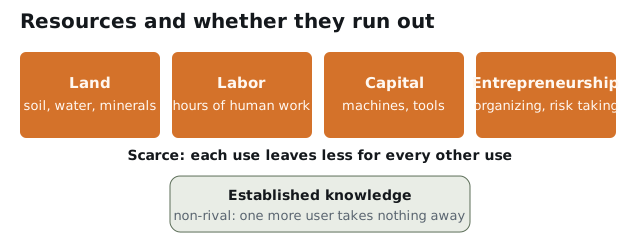
Economists sort the resources used to make goods and services into groups called the factors of production. The usual list has four factors.
| Factor | What it is | Harlow Bend example |
|---|---|---|
| Land | Natural resources: soil, water, minerals, forests | The 40-acre lot itself |
| Labor | The time and effort of people who work | The crew that would build the park |
| Capital | Tools, machines and buildings made to produce other goods | The bulldozers and mowers the crew uses |
| Entrepreneurship | Organizing the other factors and taking the risk of a new venture | The developer who plans the apartments |
Most factors of production are scarce. A worker who spends an hour building the park cannot spend that hour building apartments. A bulldozer on one site is not on another site.
Part 3 of 4 When a Resource Is Not Scarce
Some resources may not be scarce. Established knowledge is the main example. A resource is non-rival when one person's use leaves the same amount for everyone else. The method for mixing concrete is non-rival. One construction crew using the method does not stop another crew in another town from using it the same day.
A bag of cement is rival. Once one crew pours it, no other crew can pour it. The knowledge of how to mix the cement can serve every crew at once. Because established knowledge is non-rival, it may not be scarce, even though the materials it works on are.
Scarcity is permanent. Every society must choose how to use its land, labor, capital and entrepreneurship.
Part 4 of 4 Scarcity and Shortage Compared
Scarcity and shortage sound alike and mean different things. Unit 2 covers shortages in detail.
| Scarcity | Shortage | |
|---|---|---|
| What it is | Too few resources for all wants | Buyers want more of a good than sellers offer at the current price |
| How long it lasts | Always; it never goes away | Until the price rises or supply grows |
| Harlow Bend example | One lot, three possible uses | Concert tickets priced so low that they sell out in a minute |
Key Terms
Practice Questions
6 questions. Nothing here is recorded or scored.
- Question 1MKT-1.A.1
The Harlow Bend Lot
The town of Harlow Bend owns one empty 40-acre lot. The council is choosing among three uses: a public park, an apartment complex with 120 units, or a solar farm. A local firm has offered to share, free of charge, a published design method for laying out solar panels; other towns already use the same method. The council has a fixed construction budget and a limited number of town workers for the year.
Which of the following best explains why the council must choose among the three uses?
- A.The lot, budget and workers cannot support all three uses.
- B.The solar design method can be used by only one town at a time.
- C.The town has a shortage of apartments at the current rent.
- D.A command economy assigns land to only one use per year.
Check answerHide answer
Answer: A
- A.
- Correct. Scarcity means resources fall short of wants, so using the lot one way gives up the other uses. The lot can hold only one project, and the budget and workers are limited.
- B.
- The design method is established knowledge that other towns already use. Knowledge like this is non-rival, so it is the one resource in the passage that is not limited.
- C.
- A shortage is a market situation at a particular price. The choice exists because of scarcity, which would remain even if rents changed.
- D.
- The passage says nothing about the economic system. Any system faces the same trade-off because the resources are scarce.
- Question 2MKT-1.A.2
Which resource in the passage is most likely to be non-rival?
- A.The 40-acre lot of town land
- B.The published solar design method
- C.The town's limited crew of workers
- D.The fixed construction budget
Check answerHide answer
Answer: B
- A.
- Land is rival. If the park uses the lot, the apartments cannot.
- B.
- Correct. Established knowledge is non-rival: Harlow Bend using the method takes nothing away from the other towns already using it. That is why some knowledge may not be scarce.
- C.
- Labor is rival. An hour a worker spends on the park cannot also be spent on the solar farm.
- D.
- Each dollar spent on one project is gone for the others, so the budget is scarce.
- Question 3MKT-1.A.2
The solar farm would use solar panels and mounting frames that were built in a factory. In economics, the panels and frames are classified as which factor of production?
- A.Land
- B.Labor
- C.Capital
- D.Entrepreneurship
Check answerHide answer
Answer: C
- A.
- Land is natural resources. The panels and frames were manufactured, so they are capital.
- B.
- Labor is human time and effort. The panels are equipment, so they are capital.
- C.
- Correct. Capital is equipment and other goods made to produce other goods. The panels and frames will produce electricity.
- D.
- Entrepreneurship is organizing resources and taking risk. The panels themselves are a produced tool, which is capital.
- Question 4MKT-1.A.1
Which of the following statements about scarcity is correct?
- A.Scarcity ends once a country produces on its production possibilities curve.
- B.Scarcity exists only when the price of a good is set below the equilibrium price.
- C.Scarcity applies to natural resources only, since workers and machines can always be added.
- D.Scarcity exists in every society, because wants exceed the resources available to meet them.
Check answerHide answer
Answer: D
- A.
- Producing on the curve uses resources efficiently, and the society still cannot have everything. Scarcity remains.
- B.
- That describes a shortage. Scarcity exists at every price.
- C.
- Labor and capital are also limited. A society has only so many workers and machines at a time.
- D.
- Correct. Scarcity is the permanent gap between wants and resources. Rich and poor societies alike face it.
- Question 5MKT-1.A.2
A software firm writes a new method for compressing video files and posts it online for anyone to use. Thousands of other firms begin using the method the same week. Which of the following best describes the method as a resource?
- A.It is non-rival, so it may not be scarce even though the computers that run it are scarce.
- B.It is capital, because firms use it to produce other goods, and all capital is non-rival.
- C.It is scarce, because only a limited number of firms can read the posting at once.
- D.It is land, because it is a resource that was not produced by any firm.
Check answerHide answer
Answer: A
- A.
- Correct. One firm's use of the method leaves just as much for every other firm. Established knowledge with this property may not be scarce. The computers are rival and scarce.
- B.
- Physical capital such as a server is rival: one firm using a server blocks another from using it. The method is knowledge, and that is why it is non-rival.
- C.
- The passage says thousands use it the same week. Another firm reading it takes nothing away from the others.
- D.
- The method was written by a firm. Land refers to natural resources such as soil, water and minerals.
- Question 6MKT-1.A.1
Nadia can spend Saturday afternoon working a shift at a cafe or studying for an exam. She chooses to study. Which statement best describes her choice?
- A.She faces no trade-off, because studying does not cost her any money.
- B.Her time is scarce, so the hours spent studying cannot be spent working.
- C.Her time is non-rival, because she can use it for either activity.
- D.Her choice shows a shortage of cafe shifts at the current wage.
Check answerHide answer
Answer: B
- A.
- A trade-off does not need a payment. She gives up the wages and other value of the shift.
- B.
- Correct. Nadia's afternoon is a limited resource. Using it to study means giving up the shift, which is an economic trade-off caused by scarcity.
- C.
- Her time is rival: an hour used for one activity cannot be used for the other.
- D.
- Nothing in the situation describes a market shortage. Her choice comes from the scarcity of her own time.
Practice every topic in Unit 1
CED Codes
MKT-1.A.1 · MKT-1.A.2