1.2 Resource Allocation and Economic Systems
Resource allocation for AP Microeconomics: the three basic questions and how command, market and mixed economies answer them, with their limits.
Part 1 of 3 The Three Questions Every Society Answers
Because resources are scarce, every society must decide how to use them. The decision about who gets which resources and what they make is called resource allocation. Resource allocation comes down to three basic questions.
- What goods and services will be produced, and how much of each?
- How will those goods and services be produced: with which workers, tools and methods?
- Who will consume the goods and services once they exist?
Take bread in the fictional country of Velloria. Velloria must decide how many loaves to bake instead of other goods. Velloria must decide whether bakers use hand labor or large machines. Velloria must also decide which households get the loaves. Every flour sack and every baker's hour used for bread is unavailable for anything else, so each answer is a trade-off.
Part 2 of 3 Three Economic Systems
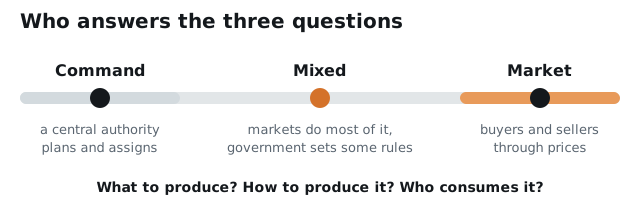
The answers depend on the economic system a society adopts. Each system has its own institutional arrangements, such as laws about who owns property. Each system also has its own way of coordinating decisions: a method for steering scarce resources to their uses and handing out what gets made.
| System | Who decides | How decisions are coordinated |
|---|---|---|
| Command economy | A central government authority | Plans and orders: the authority sets output targets, assigns resources and decides who receives goods |
| Market economy | Individual buyers and sellers | Prices: sellers produce what buyers will pay for, and buyers receive goods by paying the price |
| Mixed economy | Markets for most goods, government for some | Prices for most goods, plus government rules, taxes and public services |
A market economy relies on property rights. A baker invests in an oven only when the law protects her ownership of the oven and the bread she sells.
Part 3 of 3 Similarities, Differences and Limits
All three systems answer the same three questions, and all three face scarcity. The systems differ in who answers the questions and how the answers are coordinated. A system that works well for one goal may work poorly for another, so every system has limits.
| Command economy | Market economy | |
|---|---|---|
| Who answers the three questions | A central planner | Millions of buyers and sellers |
| Main signal | Orders and targets | Prices and profits |
| A common limit | Planners can lack information about what people want, and workers may have weak incentives | Some goods, such as national defense, may be underprovided, and income may be very unequal |
Mixed economies try to keep the strengths of both. In Velloria, private bakeries decide what bread to bake and at what price. The government inspects the bakeries for food safety and funds free school lunches. Prices still guide most of Velloria's bread, and the government steps in where the market alone would leave a gap.
The system a society adopts decides who answers the three questions and how.
Key Terms
Practice Questions
6 questions. Nothing here is recorded or scored.
- Question 1MKT-1.B.2
Two Island Economies
Two fictional island nations produce fish, bread and housing. On Ostiva, a national planning board decides each year how many tons of fish to catch, which boats and crews to use, and how much fish each household receives. On Pell Harbor, private firms decide what to produce based on the prices buyers are willing to pay, and households receive goods by paying those prices. Pell Harbor's government also runs public schools and enforces contracts.
Ostiva is best described as which type of economic system?
- A.A market economy, because households receive goods each year
- B.A mixed economy, because Ostiva produces three different goods
- C.A command economy, because a central board answers what, how and for whom
- D.A traditional economy, because fishing is an old industry on the island
Check answerHide answer
Answer: C
- A.
- Households receive goods in every system. What matters is that the planning board, and not prices, decides who receives them.
- B.
- The number of goods does not define the system. A mixed economy combines markets with government, and Ostiva uses only central planning.
- C.
- Correct. In a command economy, a central authority plans output, assigns resources and distributes goods. Ostiva's planning board does all three.
- D.
- The passage describes a planning board making the decisions, which defines a command economy.
- Question 2MKT-1.B.2
Pell Harbor uses markets for most goods and its government provides schools and enforces contracts. Pell Harbor is best described as which of the following?
- A.A command economy, because the government runs the schools
- B.A pure market economy, because private firms decide what to produce
- C.A command economy, because the government enforces contracts
- D.A mixed economy, because it combines markets with some government roles
Check answerHide answer
Answer: D
- A.
- One government service does not make a command economy. Private firms and prices still decide most production.
- B.
- A pure market economy would have no government role in production. Pell Harbor's public schools make it mixed.
- C.
- Enforcing contracts supports markets. It does not mean a central authority decides what to produce.
- D.
- Correct. Prices guide most decisions on Pell Harbor, and the government also provides schools and enforces contracts. That combination is a mixed economy.
- Question 3MKT-1.B.1
On Ostiva, the planning board decides whether crews use small hand-net boats or large trawlers. This decision answers which basic economic question?
- A.How will the goods be produced?
- B.What goods will be produced?
- C.Who will consume the goods?
- D.Why are resources scarce?
Check answerHide answer
Answer: A
- A.
- Correct. Choosing boats and methods is the how question: which inputs and techniques produce the fish.
- B.
- The what question concerns which goods and how much of each, such as how many tons of fish to catch.
- C.
- The for-whom question concerns which households receive the fish.
- D.
- That is not one of the three basic allocation questions. Scarcity is the reason the three questions must be answered.
- Question 4MKT-1.B.2
Which of the following is a limitation economists often point out about command economies?
- A.Command economies cannot answer the question of who consumes goods.
- B.Planners may not have enough information about what people want and what resources cost.
- C.Command economies face no scarcity, because the planner controls all resources.
- D.Command economies rely too heavily on prices to coordinate decisions.
Check answerHide answer
Answer: B
- A.
- Command economies do answer that question: the planner assigns goods to households.
- B.
- Correct. A central planner must decide for millions of people without the price signals that carry that information in markets. Output can end up mismatched with wants.
- C.
- Every system faces scarcity. Controlling resources does not make them unlimited.
- D.
- Prices are the coordinating mechanism of a market economy. Command economies rely on plans and orders.
- Question 5MKT-1.B.1, MKT-1.B.2
Which of the following is true of command, market and mixed economies alike?
- A.Each uses prices as the main way to allocate goods.
- B.Each gives all decisions to a central government authority.
- C.Each must decide what to produce, how to produce it and who consumes it.
- D.Each eliminates scarcity once its institutions are in place.
Check answerHide answer
Answer: C
- A.
- Command economies rely on plans and orders more than prices.
- B.
- Only a command economy gives the main decisions to a central authority.
- C.
- Correct. The three basic questions come from scarcity, and every system must answer them. The systems differ in who answers and how.
- D.
- No economic system eliminates scarcity. Each one allocates scarce resources in its own way.
- Question 6MKT-1.B.1, MKT-1.B.2
In a market economy, which of the following most directly determines who consumes a good?
- A.An order from a central planning board
- B.The amount of land the seller owns
- C.A rule that every household gets an equal share
- D.A buyer's willingness and ability to pay the price
Check answerHide answer
Answer: D
- A.
- A planning board distributes goods in a command economy.
- B.
- Land ownership affects what a seller can produce. Price and willingness to pay decide who buys.
- C.
- Equal shares would be a government distribution rule, which pure markets do not use.
- D.
- Correct. In a market economy, goods go to buyers who pay the price. Price is the coordinating mechanism that distributes output.
Practice every topic in Unit 1
CED Codes
MKT-1.B.1 · MKT-1.B.2