1.3 Production Possibilities Curve
The production possibilities curve for AP Microeconomics: efficiency, opportunity cost from a table, the curve's shape, and what shifts it in or out.
Part 1 of 4 What the Curve Shows
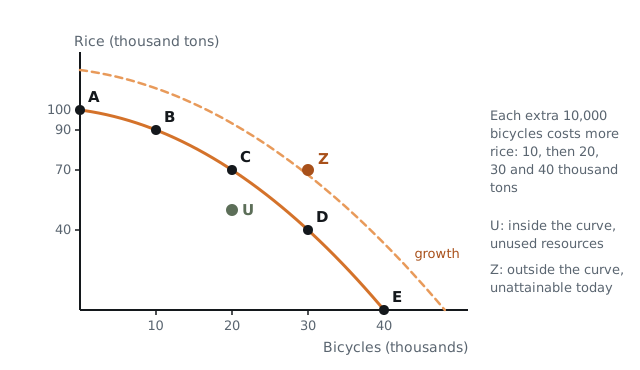
A production possibilities curve (PPC) is a model of the trade-offs a society faces when it allocates its resources between two goods. Each point on the curve is a combination the society can produce with all of its resources and its current technology.
The fictional country of Velloria produces two goods: bicycles and rice. The table lists five combinations Velloria can produce in a year when it uses all of its resources.
| Point | Bicycles (thousands) | Rice (thousand tons) | Rice given up for the last 10,000 bicycles |
|---|---|---|---|
| A | 0 | 100 | None |
| B | 10 | 90 | 10 |
| C | 20 | 70 | 20 |
| D | 30 | 40 | 30 |
| E | 40 | 0 | 40 |
Part 2 of 4 Reading Points on the Graph
| Where the point is | What it means | Velloria example |
|---|---|---|
| On the curve | Efficient: all resources are used, so more of one good means less of the other | Points A to E |
| Inside the curve | Inefficient: some resources are unemployed or underutilized | Point U, 20 bicycles and 50 tons of rice |
| Outside the curve | Unattainable with current resources and technology | Point Z, 30 bicycles and 70 tons of rice |
The curve also shows scarcity. Velloria cannot reach point Z, however much it wants to. Moving from U to C costs nothing, because putting idle resources to work gives Velloria more of both goods.
Part 3 of 4 Opportunity Cost and the Shape of the Curve
Moving along the curve shows opportunity cost: what Velloria gives up to get more of the other good. From B to C, Velloria gains 10,000 bicycles and gives up 20,000 tons of rice. The opportunity cost of one bicycle between B and C is 2 tons of rice (20,000 tons divided by 10,000 bicycles).
Velloria's opportunity cost per bicycle rises from 1 ton to 2, 3 and then 4 tons of rice. Rising opportunity cost bends the curve outward. The reason is that resources are not equally good at both jobs. Velloria first moves its factory workers to bicycles. Later it must move skilled rice farmers and rich paddy land, and each extra bicycle costs more rice.
| Opportunity cost as output of one good rises | Shape of the curve |
|---|---|
| Constant | A straight line |
| Increasing | Bowed outward, away from the origin |
| Decreasing | Bowed inward, toward the origin |
Part 4 of 4 Shifting the Curve
The PPC shifts when the quantity or quality of the factors of production changes, or when productivity or technology changes. Economic growth shifts the PPC outward. A larger labor force, more capital or a better method of production all shift the curve out.
Contraction shifts the curve inward. A flood that destroys farmland or a fall in the labor force shrinks what Velloria can produce. A new technology that helps only one good moves only that end of the curve. A better rice seed raises the rice intercept and leaves the bicycle intercept at 40,000.
Key Terms
Practice Questions
6 questions. Nothing here is recorded or scored.
- Question 1MKT-1.C.2
Velloria's Production Possibilities
The table shows combinations of bicycles and rice that the fictional country of Velloria can produce in a year when it uses all of its resources efficiently.
Point | Bicycles (thousands) | Rice (thousand tons) A | 0 | 100 B | 10 | 90 C | 20 | 70 D | 30 | 40 E | 40 | 0 What is the opportunity cost of one bicycle when Velloria moves from point C to point D?
- A.1/3 ton of rice
- B.2 tons of rice
- C.3 tons of rice
- D.30 tons of rice
Check answerHide answer
Answer: C
- A.
- This inverts the ratio. It is the bicycles gained per ton of rice given up, which is the opportunity cost of rice.
- B.
- Two tons per bicycle is the opportunity cost between points B and C, where Velloria gives up 20 thousand tons for 10 thousand bicycles.
- C.
- Correct. From C to D, rice falls from 70 to 40 thousand tons while bicycles rise from 20 to 30 thousand. That is 30 thousand tons given up for 10 thousand bicycles, or 3 tons per bicycle.
- D.
- Thirty is the total rice given up, in thousands of tons, for 10 thousand bicycles. Divide by the bicycles gained to get the cost of one bicycle.
- Question 2MKT-1.C.3
Point | Bicycles (thousands) | Rice (thousand tons) A | 0 | 100 B | 10 | 90 C | 20 | 70 D | 30 | 40 E | 40 | 0 The table shows which of the following about Velloria's opportunity cost of bicycles?
- A.It increases as more bicycles are produced, so the curve is bowed outward from the origin.
- B.It is constant, so the curve is a straight line.
- C.It decreases as more bicycles are produced, so the curve is bowed inward toward the origin.
- D.It is zero, because every point in the table is efficient.
Check answerHide answer
Answer: A
- A.
- Correct. Each extra 10 thousand bicycles costs 10, then 20, 30 and 40 thousand tons of rice. Rising opportunity cost gives a PPC that bows outward.
- B.
- A straight line would need the same rice given up for each 10 thousand bicycles. The amounts rise from 10 to 40.
- C.
- The cost per bicycle rises, from 1 ton to 4 tons, so the curve bows outward from the origin.
- D.
- Efficient points still involve trade-offs. Moving along the curve always gives up some of the other good.
- Question 3MKT-1.C.2
Point | Bicycles (thousands) | Rice (thousand tons) A | 0 | 100 B | 10 | 90 C | 20 | 70 D | 30 | 40 E | 40 | 0 Suppose Velloria produces 20 thousand bicycles and 50 thousand tons of rice. Which of the following is true?
- A.Velloria is producing at an unattainable point.
- B.Velloria is producing inefficiently and could have more of both goods.
- C.Velloria's PPC has shifted inward toward the origin.
- D.Velloria is producing efficiently, because it produces some of each good.
Check answerHide answer
Answer: B
- A.
- An unattainable point lies outside the curve. Fifty thousand tons is less than the 70 thousand Velloria could produce with 20 thousand bicycles.
- B.
- Correct. The efficient combination with 20 thousand bicycles is 70 thousand tons of rice (point C). At 50 thousand tons, some resources are unemployed or underutilized, so Velloria lies inside its PPC.
- C.
- Producing inside the curve does not move the curve. The resources still exist; they are not all being used.
- D.
- Producing both goods does not make a point efficient. Velloria could gain 20 thousand tons of rice with no loss of bicycles.
- Question 4MKT-1.C.4, MKT-1.C.5
Which of the following would shift a country's production possibilities curve outward?
- A.A fall in the unemployment rate
- B.A decision to produce more of one good and less of the other
- C.A hurricane that destroys factories and farmland
- D.An increase in the size of the labor force
Check answerHide answer
Answer: D
- A.
- Putting unemployed workers back to work moves the economy from a point inside the curve toward the curve. The curve itself stays where it is.
- B.
- Changing the mix of output is a movement along the curve.
- C.
- Losing capital and land shrinks what the country can produce, which shifts the curve inward.
- D.
- Correct. More of a factor of production lets the country produce more of both goods. Economic growth shifts the PPC outward.
- Question 5MKT-1.C.4
A country produces wheat and tractors. A new technology raises the output of wheat per acre and has no effect on tractor production. Which change to the country's PPC results?
- A.The wheat end of the curve moves outward and the tractor end stays the same.
- B.The whole curve shifts outward by the same amount on both axes.
- C.The tractor end of the curve moves outward and the wheat end stays the same.
- D.The curve does not move, and the country moves along it toward more wheat.
Check answerHide answer
Answer: A
- A.
- Correct. The technology raises only the maximum amount of wheat. The curve pivots outward along the wheat axis, while the most tractors the country can make is unchanged.
- B.
- A parallel outward shift would need better resources for both goods. The new technology helps only wheat.
- C.
- This reverses the effect. The wheat maximum rises, and the tractor maximum is unchanged.
- D.
- A technology change alters what can be produced, so the curve itself moves.
- Question 6MKT-1.C.3
A production possibilities curve for two goods is a straight line. Which of the following must be true?
- A.The economy has no scarcity in producing these goods.
- B.The opportunity cost of each good is constant.
- C.The opportunity cost of each good rises as more of it is produced.
- D.Every point on the line is unattainable.
Check answerHide answer
Answer: B
- A.
- Any PPC shows scarcity: points outside the line cannot be reached.
- B.
- Correct. A straight PPC has a constant slope, so the trade-off between the goods never changes. That means constant opportunity cost.
- C.
- Rising opportunity cost produces a curve that bows outward.
- D.
- Points on the line are attainable and efficient. Points outside the line are unattainable.
Practice every topic in Unit 1
CED Codes
MKT-1.C.1 · MKT-1.C.2 · MKT-1.C.3 · MKT-1.C.4 · MKT-1.C.5