1.4 Comparative Advantage and Trade
Comparative advantage for AP Microeconomics: absolute and comparative advantage, gains from specialization, and terms of trade that help both sides.
Part 1 of 4 Two Kinds of Advantage
Two producers can trade and both gain, even when one of them is better at making everything. The idea that explains why is comparative advantage.
| Absolute advantage | Comparative advantage | |
|---|---|---|
| Definition | Producing more of a good than another producer with the same quantity of resources | Producing a good at a lower opportunity cost than another producer |
| What you compare | Output | Opportunity cost |
| Does it decide who should specialize? | No | Yes |
Part 2 of 4 Finding Comparative Advantage From a Table
Velloria and Tamsin are two fictional countries. The table shows the most each country can produce in a month if it uses all of its resources on one good.
| Country | Bicycles | Rice (tons) | Opportunity cost of 1 bicycle | Opportunity cost of 1 ton of rice |
|---|---|---|---|---|
| Velloria | 40 | 120 | 3 tons of rice | 1/3 bicycle |
| Tamsin | 20 | 40 | 2 tons of rice | 1/2 bicycle |
Velloria has the absolute advantage in both goods, because it can produce more of each. Tamsin gives up only 2 tons of rice per bicycle, while Velloria gives up 3. Tamsin has the comparative advantage in bicycles. Velloria gives up 1/3 of a bicycle per ton of rice, while Tamsin gives up 1/2. Velloria has the comparative advantage in rice.
Part 3 of 4 Gains From Trade
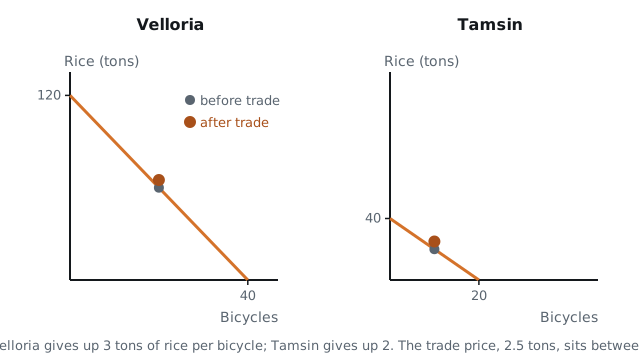
Specialization according to comparative advantage lets the two countries trade and consume beyond their own PPCs. Before trade, Velloria makes 20 bicycles and 60 tons of rice. Tamsin makes 10 bicycles and 20 tons. Together they have 30 bicycles and 80 tons.
Now Tamsin makes only bicycles: 20 of them. Velloria makes 10 bicycles and 90 tons of rice. Together they have 30 bicycles and 90 tons, 10 tons more than before. Tamsin then trades 10 bicycles to Velloria for 25 tons of rice.
| Country | Before trade | After trade | Gain |
|---|---|---|---|
| Velloria | 20 bicycles, 60 tons | 20 bicycles, 65 tons | 5 tons of rice |
| Tamsin | 10 bicycles, 20 tons | 10 bicycles, 25 tons | 5 tons of rice |
Part 4 of 4 Terms of Trade That Help Both Sides
The terms of trade are the rate at which one good is exchanged for the other. A trade helps both countries only when the price lies between their two opportunity costs.
Tamsin will sell a bicycle only if it receives more than 2 tons of rice, its own opportunity cost. Velloria will buy a bicycle only if it pays less than 3 tons, its own opportunity cost. Any price between 2 and 3 tons of rice per bicycle helps both countries. The trade above used 2.5 tons.
Specialize by lowest opportunity cost, then trade at a price between the two opportunity costs.
Key Terms
Practice Questions
6 questions. Nothing here is recorded or scored.
- Question 1MKT-2.A.1, MKT-2.A.2
Corn and Cloth
The table shows the maximum amount of corn or cloth that each of two fictional countries, Aldmoor and Brevia, can produce in a year if it uses all of its resources on one good. Each country has the same quantity of resources, and opportunity costs are constant.
Country | Corn (tons) | Cloth (bolts) Aldmoor | 60 | 30 Brevia | 40 | 10 Which of the following is correct?
- A.Aldmoor has the comparative advantage in both goods.
- B.Brevia has the absolute advantage in corn.
- C.Aldmoor has the absolute advantage in both goods and the comparative advantage in cloth.
- D.Aldmoor has the absolute advantage in both goods and the comparative advantage in corn.
Check answerHide answer
Answer: C
- A.
- A country cannot have the comparative advantage in both goods when opportunity costs differ. Brevia gives up less cloth per ton of corn.
- B.
- Brevia produces 40 tons of corn and Aldmoor produces 60. Aldmoor has the absolute advantage in corn.
- C.
- Correct. Aldmoor produces more of each good with the same resources, so it has the absolute advantage in both. Its opportunity cost of a bolt of cloth is 2 tons of corn, below Brevia's 4 tons, so it has the comparative advantage in cloth.
- D.
- Aldmoor gives up 1/2 bolt of cloth per ton of corn, and Brevia gives up 1/4 bolt. Brevia has the lower opportunity cost of corn.
- Question 2MKT-2.B.2
Country | Corn (tons) | Cloth (bolts) Aldmoor | 60 | 30 Brevia | 40 | 10 Which of the following terms of trade would benefit both countries?
- A.1 bolt of cloth for 1 ton of corn
- B.1 bolt of cloth for 3 tons of corn
- C.1 bolt of cloth for 5 tons of corn
- D.1 bolt of cloth for 6 tons of corn
Check answerHide answer
Answer: B
- A.
- Aldmoor gives up 2 tons of corn to make a bolt of cloth. Selling a bolt for 1 ton would leave Aldmoor worse off.
- B.
- Correct. Aldmoor's opportunity cost of a bolt is 2 tons of corn and Brevia's is 4 tons. Any price between 2 and 4 tons per bolt helps both, and 3 tons lies between them.
- C.
- Brevia can make a bolt for 4 tons of corn on its own. Paying 5 tons would leave Brevia worse off.
- D.
- Six tons is above Brevia's opportunity cost of 4 tons per bolt, so Brevia would rather make its own cloth.
- Question 3MKT-2.B.1
Country | Corn (tons) | Cloth (bolts) Aldmoor | 60 | 30 Brevia | 40 | 10 If the two countries specialize according to comparative advantage, which of the following will occur?
- A.Aldmoor will produce both goods, because it has the absolute advantage in both.
- B.Aldmoor will produce corn, Brevia will produce cloth, and both will gain.
- C.Neither country gains, because Brevia is less productive in both goods.
- D.Aldmoor will make cloth, Brevia will make corn, and both will gain.
Check answerHide answer
Answer: D
- A.
- Absolute advantage does not decide specialization. Comparative advantage does, and Brevia has it in corn.
- B.
- This reverses the specialization. Brevia's opportunity cost of cloth, 4 tons of corn per bolt, is the higher of the two.
- C.
- Gains from trade come from different opportunity costs, and Aldmoor and Brevia have them.
- D.
- Correct. Aldmoor has the lower opportunity cost of cloth and Brevia has the lower opportunity cost of corn. Specializing this way and trading at a price between the two opportunity costs lets both consume outside their PPCs.
- Question 4MKT-2.A.1, MKT-2.A.2
Lena can paint a fence in 2 hours or wash a car in 1 hour. Theo can paint the same fence in 6 hours or wash the same car in 2 hours. Who has the comparative advantage in each task?
- A.Lena in painting fences, and Theo in washing cars
- B.Lena in both painting fences and washing cars
- C.Theo in painting fences, and Lena in washing cars
- D.Neither of them, because Lena is faster at both tasks
Check answerHide answer
Answer: A
- A.
- Correct. Lena gives up 2 car washes per fence painted (2 hours divided by 1 hour). Theo gives up 3 car washes per fence (6 hours divided by 2). Lena has the lower opportunity cost of painting, so Theo has the lower opportunity cost of washing.
- B.
- Lena has the absolute advantage in both tasks because she needs fewer hours for each. Comparative advantage can belong to her in only one of them.
- C.
- Theo gives up 3 car washes for each fence, and Lena gives up 2. Lena has the lower opportunity cost of painting.
- D.
- Their opportunity costs differ, 2 washes per fence for Lena and 3 for Theo, so each has a comparative advantage in one task.
- Question 5MKT-2.A.2
Which of the following best describes comparative advantage?
- A.The ability to produce more of a good than another producer with the same resources
- B.The ability to sell a good at a higher price than another producer
- C.The ability to produce a good at a lower opportunity cost than another producer
- D.The ability to produce every good with fewer resources than another producer
Check answerHide answer
Answer: C
- A.
- This defines absolute advantage, which compares output.
- B.
- Comparative advantage concerns opportunity costs of production. Selling prices are a separate matter.
- C.
- Correct. Comparative advantage compares what each producer gives up. It decides which producer should specialize in which good.
- D.
- Using fewer resources for every good is absolute advantage in all goods.
- Question 6MKT-2.B.1, MKT-2.B.2
Two countries have the same opportunity costs for producing two goods. Which of the following is most likely?
- A.The country with the absolute advantage gains, and the other loses.
- B.Both countries gain by specializing in the good they produce more of.
- C.Both countries can consume outside their PPCs by trading.
- D.Neither country can gain from specializing and trading these two goods.
Check answerHide answer
Answer: D
- A.
- Without a difference in opportunity cost, trade at the only acceptable price leaves both countries where they started.
- B.
- Producing more of a good is absolute advantage. With equal opportunity costs, specializing creates no extra output.
- C.
- Consuming outside the PPC needs specialization by comparative advantage, and here neither country has one.
- D.
- Correct. Gains from trade come from differences in opportunity cost. If the costs are the same, the only mutually acceptable price equals both opportunity costs, and neither country gains.
Practice every topic in Unit 1
CED Codes
MKT-2.A.1 · MKT-2.A.2 · MKT-2.B.1 · MKT-2.B.2