1.5 Cost-Benefit Analysis
Cost-benefit analysis for AP Microeconomics: explicit and implicit costs, total benefit as utility or revenue, and the choice with the most net benefit.
Part 1 of 4 The Full Cost of a Choice
A rational decision maker counts every cost of a choice, including the value of the best alternative given up. The value of the best alternative given up is the opportunity cost of the choice. Opportunity costs can be explicit or implicit.
| Explicit cost | Implicit cost | |
|---|---|---|
| What it is | A payment of money to someone else | The value of a resource you already own and use, measured by its best other use |
| Shows up as a bill? | Yes | No |
| Summer course example | $800 of tuition | The $3,000 a summer job would have paid |
Dev is choosing between a summer coding course and a summer job that pays $3,000. The course charges $800 in tuition. The economic cost of the course is $3,800: the $800 explicit cost plus the $3,000 implicit cost. Dev should take the course only if he values it at more than $3,800.
Part 2 of 4 Measuring Total Benefit
Total benefit is measured differently for consumers and firms. For a consumer, total benefit is utility, the satisfaction the consumer gets from a good. For a firm, total benefit is total revenue, the money it collects from sales.
Net benefit is total benefit minus total cost. Net benefit is greatest at the optimal choice.
Part 3 of 4 Choosing the Best Quantity
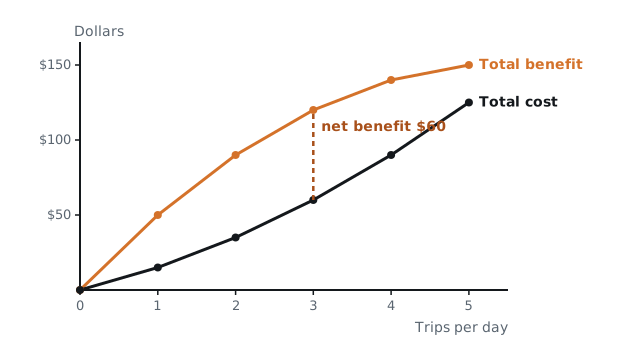
Ruiz Deliveries is a one-van delivery firm deciding how many trips to make each day. Total benefit is the revenue from the trips. Total cost includes fuel, wear on the van and the owner's time.
| Trips per day | Total benefit | Total cost | Net benefit | Marginal benefit | Marginal cost |
|---|---|---|---|---|---|
| 0 | $0 | $0 | $0 | ||
| 1 | $50 | $15 | $35 | $50 | $15 |
| 2 | $90 | $35 | $55 | $40 | $20 |
| 3 | $120 | $60 | $60 | $30 | $25 |
| 4 | $140 | $90 | $50 | $20 | $30 |
| 5 | $150 | $125 | $25 | $10 | $35 |
Net benefit peaks at 3 trips, $60. The marginal columns give the same answer. The third trip adds $30 of benefit and $25 of cost, so the third trip is worth making. The fourth trip adds $20 of benefit and $30 of cost, so the fourth trip lowers net benefit.
Part 4 of 4 When Margins Work and When Totals Are Needed
Some decisions can be made one unit at a time, like the number of delivery trips. For decisions made one unit at a time, comparing marginal benefit with marginal cost is enough. Other decisions cannot be broken into increments. Dev cannot take half of a coding course. For an all-or-nothing choice, compare the total benefit with the total cost of each option. Dev takes the course only if its total benefit to him is greater than its total economic cost of $3,800.
Count implicit costs, then pick the choice with the largest net benefit.
Key Terms
Practice Questions
6 questions. Nothing here is recorded or scored.
- Question 1CBA-1.A.1
Mirela's Weekend Market Stall
Mirela sells handmade candles at a Saturday market. She pays $40 for the stall and $60 for wax and wicks each Saturday. She sells $180 of candles. If she did not run the stall, she would work a Saturday shift at a bookstore that pays $70. She owns the van she uses to drive to the market.
What are Mirela's explicit costs of running the stall for one Saturday?
- A.$100
- B.$70
- C.$170
- D.$180
Check answerHide answer
Answer: A
- A.
- Correct. Explicit costs are money payments to others: $40 for the stall plus $60 for wax and wicks, which is $100.
- B.
- The $70 is the bookstore wage Mirela gives up. It is an implicit cost, since no one sends her a bill for it.
- C.
- This adds the $70 implicit cost to the $100 of explicit costs. That total is the economic cost.
- D.
- The $180 is her revenue, the benefit side of the decision.
- Question 2CBA-1.A.1, CBA-1.A.2
What is Mirela's economic profit, total revenue minus all explicit and implicit costs, for one Saturday?
- A.$80
- B.$110
- C.$180
- D.$10
Check answerHide answer
Answer: D
- A.
- This subtracts only the $100 of explicit costs. The $70 wage she gives up must also be counted.
- B.
- This subtracts only the $70 wage. The $100 of payments for the stall and supplies are costs too.
- C.
- The $180 is total revenue before any costs are subtracted.
- D.
- Correct. Total revenue of $180 minus explicit costs of $100 and the implicit cost of $70 leaves $10. Running the stall beats the bookstore shift by $10.
- Question 3CBA-1.A.1
Mirela's friend says that because Mirela already owns her van, using it on Saturday costs her nothing. Which response is best?
- A.The friend is right, because only payments to other people are costs.
- B.Using the van has an implicit cost: the value of its best other use.
- C.The van's use should be counted as part of total revenue.
- D.The van has a cost only if Mirela has to buy a new van.
Check answerHide answer
Answer: B
- A.
- Payments to others are explicit costs. Economic cost also counts implicit costs, including the value of owned resources.
- B.
- Correct. A resource you own still has an opportunity cost. A rational agent counts that implicit cost when measuring the full economic cost of a choice.
- C.
- Revenue is the money Mirela collects from sales. The van's use is a cost.
- D.
- The opportunity cost exists now. Using the van for the stall gives up its other uses that day.
- Question 4CBA-1.A.2
For a consumer, total benefit is measured by which of the following?
- A.Total revenue, the money the consumer collects from sales
- B.Total cost, the money the consumer spends
- C.Utility, the satisfaction the consumer gets from consuming goods
- D.Net benefit, utility minus total cost
Check answerHide answer
Answer: C
- A.
- Total revenue measures a firm's benefit. A consumer gets satisfaction from consuming.
- B.
- Spending is a cost of the choice. Benefit is the satisfaction gained.
- C.
- Correct. A consumer's total benefit is total utility. For a firm, total benefit is total revenue.
- D.
- Net benefit subtracts costs from total benefit. The question asks for total benefit itself.
- Question 5CBA-1.B.1, CBA-1.B.2
A city council can build a new library for a total cost of $9 million. The council estimates the total benefit at $12 million. Half a library would provide no benefit. Which of the following is the best way to make this decision?
- A.Compare the total benefit with the total cost, and build because net benefit is $3 million.
- B.Compare the marginal benefit of each additional shelf with its marginal cost.
- C.Reject the library, because its total cost is positive.
- D.Build the library only if the explicit cost is zero.
Check answerHide answer
Answer: A
- A.
- Correct. A library is an all-or-nothing choice that cannot be broken into small increments. The council compares totals: $12 million minus $9 million is a net benefit of $3 million, so the library is worth building.
- B.
- Marginal comparisons work for choices made one unit at a time. Half a library provides no benefit, so the decision must be made on totals.
- C.
- Every choice has costs. The question is whether total benefit exceeds total cost, and it does by $3 million.
- D.
- A choice is worth making when total benefit exceeds total cost, including explicit costs.
- Question 6CBA-1.B.1
Hours | Total benefit | Total cost 1 | $40 | $10 2 | $75 | $25 3 | $105 | $45 4 | $125 | $75 5 | $135 | $110 The table shows the total benefit and total cost of different numbers of hours a tutor works each week. How many hours should the tutor work to maximize net benefit?
- A.1 hour
- B.2 hours
- C.3 hours
- D.5 hours
Check answerHide answer
Answer: C
- A.
- Net benefit at 1 hour is $30, less than the $60 available at 3 hours.
- B.
- Net benefit at 2 hours is $50. A third hour adds $30 of benefit for $20 of cost, so working it raises net benefit.
- C.
- Correct. Net benefit is $30, $50, $60, $50 and $25 at 1 to 5 hours. It peaks at 3 hours, $105 minus $45.
- D.
- Five hours gives the largest total benefit, and total cost grows faster. Net benefit at 5 hours is only $25.
Practice every topic in Unit 1
CED Codes
CBA-1.A.1 · CBA-1.A.2 · CBA-1.B.1 · CBA-1.B.2