1.6 Marginal Analysis and Consumer Choice
Marginal analysis and consumer choice for AP Micro: diminishing marginal utility, the utility-per-dollar rule, sunk costs, and MB equals MC.
Part 1 of 3 How the Model Sees a Consumer
Consumer choice theory assumes that consumers face constraints, such as a limited income and limited time, and make the best choice they can within those constraints. In the model, a rational consumer chooses so as to maximize total utility.
Marginal utility is the extra utility from consuming one more unit. Consumers experience diminishing marginal utility: each extra unit of a good adds less satisfaction than the unit before. The first cup of lemonade on a hot day is worth more to you than the fourth.
Part 2 of 3 Marginal Utility per Dollar
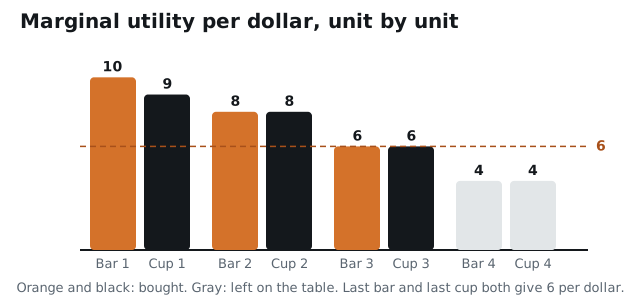
Imani has $9 to spend at a school fair. Granola bars cost $2 each and cups of lemonade cost $1 each. The table shows her marginal utility, measured in utils, and the marginal utility per dollar of each unit.
| Unit | Granola bar MU | Bar MU per dollar ($2) | Lemonade MU | Lemonade MU per dollar ($1) |
|---|---|---|---|---|
| 1st | 20 | 10 | 9 | 9 |
| 2nd | 16 | 8 | 8 | 8 |
| 3rd | 12 | 6 | 6 | 6 |
| 4th | 8 | 4 | 4 | 4 |
Imani buys the unit with the highest marginal utility per dollar first, then the next highest, until her $9 is gone. She ends with 3 bars ($6) and 3 cups ($3). The last dollar spent on each good brings the same marginal utility, 6 utils. Her total utility is 48 + 23 = 71 utils. Any other way to spend $9 gives less. Four bars and one cup, for example, also cost $9 and give only 65 utils.
Part 3 of 3 Marginal Analysis for Any Decision
Marginal analysis compares the additional benefit of doing one more unit of an activity with the additional cost. When marginal benefit is greater than marginal cost, do more. When marginal cost is greater, do less. The optimal quantity is where marginal benefit equals marginal cost, which is also where total benefit net of cost is largest.
Fixed costs that were set by past choices do not change the optimal quantity. A cost that is already paid and cannot be recovered is a sunk cost. Imani paid a $5 entry fee to get into the fair. The fee is the same whether she buys three bars or none, so the fee should not change how she spends her $9.
Compare the next unit's benefit with its cost, and ignore what is already spent.
Key Terms
Practice Questions
6 questions. Nothing here is recorded or scored.
- Question 1CBA-2.A.2, CBA-2.A.4
Jonah's Arcade Budget
Jonah has $12 to spend on arcade games and smoothies. Each game costs $2 and each smoothie costs $4. The table shows the marginal utility, in utils, Jonah gets from each unit.
Unit | Games MU | Smoothies MU 1st | 16 | 40 2nd | 12 | 24 3rd | 8 | 16 4th | 6 | 8 Which combination maximizes Jonah's total utility while spending exactly $12?
- A.6 games and 0 smoothies
- B.2 games and 2 smoothies
- C.4 games and 1 smoothie
- D.0 games and 3 smoothies
Check answerHide answer
Answer: B
- A.
- Six games cost $12, and buying no smoothies skips the first smoothie, which gives 10 utils per dollar, more than any game.
- B.
- Correct. MU per dollar for games is 8, 6, 4, 3, and for smoothies 10, 6, 4, 2. Spending on the highest values first buys smoothie 1, game 1, then game 2 and smoothie 2 at 6 per dollar. That uses $4 + $8 = $12, and the last dollar on each good gives 6 utils.
- C.
- This costs $12 and gives 42 + 40 = 82 utils. Two games and two smoothies give 28 + 64 = 92 utils.
- D.
- Three smoothies cost $12 and give 80 utils. The third smoothie gives only 4 utils per dollar, while the first game gives 8.
- Question 2CBA-2.A.3
Unit | Games MU | Smoothies MU 1st | 16 | 40 2nd | 12 | 24 3rd | 8 | 16 4th | 6 | 8 The marginal utility Jonah gets from each additional game falls from 16 to 12 to 8 to 6 utils. This pattern illustrates which of the following?
- A.Increasing opportunity cost
- B.Negative total utility
- C.A sunk cost
- D.Diminishing marginal utility
Check answerHide answer
Answer: D
- A.
- Increasing opportunity cost describes production trade-offs along a PPC. This pattern concerns satisfaction from consumption.
- B.
- Total utility is still rising, since each game adds positive utils. Only the amount added is falling.
- C.
- A sunk cost is a cost already paid that cannot be recovered. The pattern here describes satisfaction.
- D.
- Correct. Each additional game adds less satisfaction than the one before. That is diminishing marginal utility.
- Question 3CBA-2.A.4
Unit | Games MU | Smoothies MU 1st | 16 | 40 2nd | 12 | 24 3rd | 8 | 16 4th | 6 | 8 Suppose Jonah buys 3 games and 1 smoothie, spending $10. Which of the following is true?
- A.The marginal utility per dollar of the first smoothie is higher than that of the third game.
- B.His marginal utility per dollar is equal for both goods, so he has maximized utility.
- C.He has exceeded his budget of $12.
- D.He should buy more games, because games are cheaper.
Check answerHide answer
Answer: A
- A.
- Correct. The first smoothie gives 40 utils for $4, or 10 per dollar, and the third game gives 8 utils for $2, or 4 per dollar. Jonah could raise his utility by shifting spending toward smoothies.
- B.
- The last game gives 4 utils per dollar and the last smoothie gives 10, so they are not equal.
- C.
- Three games at $2 and one smoothie at $4 cost $10, which is within his budget.
- D.
- Buying a fourth game adds only 3 utils per dollar. A lower price does not mean a better use of the next dollar.
- Question 4CBA-2.B.2
Kai paid a nonrefundable $30 for a concert ticket. On the day of the concert, a friend offers him a free ticket to a basketball game at the same time, which he would enjoy more. What should Kai consider when he decides?
- A.The $30, because going to the basketball game would waste it
- B.Only the price of the basketball ticket, which is zero
- C.Only the benefits and costs the decision can still change
- D.The total of the two ticket prices, $30 plus $0
Check answerHide answer
Answer: C
- A.
- The $30 is gone whichever event he attends, so it should not affect the choice.
- B.
- He should also compare the enjoyment of each event. The free ticket matters, and so does the benefit.
- C.
- Correct. The $30 is a sunk cost that Kai cannot recover. The optimal choice depends on what he gains and gives up from now on, so he should go to the game he enjoys more.
- D.
- Adding the prices mixes a sunk cost into the decision. Only costs and benefits that still change matter.
- Question 5CBA-2.B.1, CBA-2.B.3
A runner is deciding how many miles to run each morning. For the 5th mile, her marginal benefit is greater than her marginal cost. For the 6th mile, her marginal cost is greater than her marginal benefit. What should she do?
- A.Run 6 miles, because the 6th mile still has some benefit
- B.Run 5 miles, because the 6th mile costs more than it adds
- C.Run 4 miles, because marginal benefit falls after the 4th mile
- D.Run as many miles as possible, to maximize total benefit
Check answerHide answer
Answer: B
- A.
- The 6th mile has some benefit, but its cost is larger, so running it lowers net benefit.
- B.
- Correct. Marginal analysis says to keep doing an activity while marginal benefit is at least marginal cost. The 5th mile raises her net benefit, and the 6th would lower it.
- C.
- Falling marginal benefit is normal. What matters is that the 5th mile's benefit is still greater than its cost.
- D.
- Total benefit can keep rising while net benefit falls. The goal is to maximize benefit minus cost.
- Question 6CBA-2.A.1, CBA-2.A.4
A consumer spends her whole budget on pens and notebooks. For the last pen, marginal utility per dollar is 5. For the last notebook, marginal utility per dollar is 9. To raise her total utility, the consumer should do which of the following?
- A.Buy more pens and fewer notebooks
- B.Keep the same purchases, since she has spent her whole budget
- C.Buy more of both goods
- D.Buy fewer pens and more notebooks
Check answerHide answer
Answer: D
- A.
- This moves spending toward the good with the lower marginal utility per dollar, which lowers total utility.
- B.
- Spending the whole budget is not enough. The last dollar spent on each good must also bring equal marginal utility.
- C.
- Her budget is fully spent, so she cannot buy more of both without more income.
- D.
- Correct. A dollar moved from pens to notebooks gains about 9 utils and loses about 5. She should shift spending until marginal utility per dollar is equal for both goods.
Practice every topic in Unit 1
CED Codes
CBA-2.A.1 · CBA-2.A.2 · CBA-2.A.3 · CBA-2.A.4 · CBA-2.B.1 · CBA-2.B.2 · CBA-2.B.3