2.1 Demand
Demand for AP Microeconomics: incentives and constraints, the law of demand, market demand as a sum, and the determinants that shift the demand curve.
Part 1 of 3 Incentives and Constraints
Economic agents respond to incentives. A lower price is an incentive to buy more. Buyers also face constraints: a limited income, limited time, and the laws and regulations that apply to a purchase.
Markets work well only when property rights are clearly defined. A strawberry grower sells a pint because the law says the pint belongs to her until a buyer pays for it. Without that protection, buyers and sellers would have little reason to trade.
Part 2 of 3 The Law of Demand
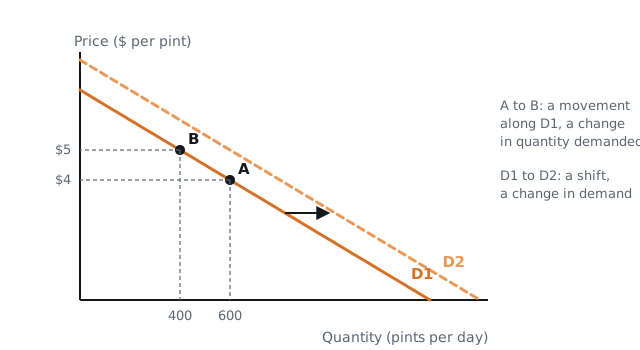
Corvale is a fictional city whose farmers markets sell strawberries by the pint. The law of demand says that when the price of a good changes, the quantity demanded changes in the opposite direction. When the price of a pint rises from $4 to $5, Corvale buyers want 400 pints a day instead of 600. A change in the good's own price causes a movement along the demand curve.
| Price per pint | Households | Restaurants and cafes | Market quantity demanded |
|---|---|---|---|
| $6 | 100 | 100 | 200 |
| $5 | 200 | 200 | 400 |
| $4 | 300 | 300 | 600 |
| $3 | 400 | 400 | 800 |
| $2 | 500 | 500 | 1,000 |
The market demand schedule is the sum of the individual demand schedules. At $4, households want 300 pints and restaurants want 300, so the market quantity demanded is 600.
Three ideas explain why demand curves slope down. The income effect: a lower price leaves buyers with more purchasing power. The substitution effect: a lower price makes the good cheaper compared with other goods. Diminishing marginal utility: each extra pint is worth less to a buyer, so the buyer buys more only at a lower price. For this reason the demand curve is also a marginal benefit curve.
Part 3 of 3 What Shifts Demand
A change in a determinant of demand shifts the whole curve. At every price, buyers want more (a shift right) or less (a shift left).
| Determinant | Example that increases strawberry demand |
|---|---|
| Tastes and preferences | A health report praises strawberries |
| Number of buyers | A college opens in Corvale |
| Income | Incomes rise and strawberries are a normal good |
| Prices of related goods | The price of blueberries, a substitute, rises; or the price of whipped cream, a complement, falls |
| Expectations | Buyers expect prices to rise next week |
Key Terms
Practice Questions
6 questions. Nothing here is recorded or scored.
- Question 1MKT-3.A.4
Mangoes in Port Selwyn
Port Selwyn is a fictional coastal town. The town's weekly market sells fresh mangoes. Last month the price of a mango was $2, and residents bought 900 mangoes a week. This month the price rose to $3, and residents bought 700 mangoes a week. Over the same month, a popular cooking program featured mango recipes.
According to the law of demand, the change in the number of mangoes bought because of the price rise from $2 to $3 is best described as which of the following?
- A.A decrease in quantity demanded, a movement along the demand curve
- B.A decrease in demand, a leftward shift of the demand curve
- C.An increase in quantity supplied, a movement along the demand curve
- D.An increase in demand, because buyers paid more in total
Check answerHide answer
Answer: A
- A.
- Correct. A change in the good's own price changes quantity demanded in the opposite direction. The town moves along its demand curve.
- B.
- A change in the good's own price never shifts its demand curve. Only a determinant, such as tastes or income, shifts the curve.
- C.
- Quantity supplied describes sellers. The question asks about what buyers purchase.
- D.
- Paying more in total does not mean demand increased. The law of demand concerns the quantity bought at each price.
- Question 2MKT-3.B.1
The cooking program makes residents want more mangoes at every price. What happens to the demand curve for mangoes in Port Selwyn?
- A.It shifts to the left, because the price of mangoes rose.
- B.It shifts to the right, because tastes changed in favor of mangoes.
- C.It does not shift, because only income can shift a demand curve.
- D.It becomes vertical, because buyers will pay any price for mangoes.
Check answerHide answer
Answer: B
- A.
- The price rise is a movement along the curve. The change in tastes is what shifts the curve, and it shifts it right.
- B.
- Correct. Tastes and preferences are a determinant of demand. A program that makes mangoes more popular raises the quantity demanded at every price, which shifts the curve right.
- C.
- Income is one determinant among several. Tastes, the number of buyers, related prices and expectations also shift demand.
- D.
- A change in tastes shifts the curve. Nothing in the passage suggests buyers ignore price.
- Question 3MKT-3.A.5
Which of the following best explains why residents bought fewer mangoes at $3 than at $2?
- A.Sellers offered fewer mangoes because the price of mangoes was higher.
- B.The demand for mangoes fell because of the cooking program.
- C.Mangoes now cost more than other fruit, and incomes buy fewer of them.
- D.Each additional mango gave buyers more satisfaction than the one before.
Check answerHide answer
Answer: C
- A.
- The law of supply says sellers offer more at a higher price.
- B.
- The cooking program would raise demand. The drop in purchases came from the price increase.
- C.
- Correct. These are the substitution effect and the income effect. Both explain why quantity demanded falls when the price rises, giving a downward-sloping demand curve.
- D.
- Marginal utility diminishes. Rising marginal utility would not explain fewer purchases at a higher price.
- Question 4MKT-3.A.6
Two buyers are the only buyers in a market. At a price of $6, Buyer 1 wants 4 units and Buyer 2 wants 7 units. What is the market quantity demanded at $6?
- A.3 units
- B.4 units
- C.7 units
- D.11 units
Check answerHide answer
Answer: D
- A.
- Three is the difference between the two buyers. The market quantity is the sum.
- B.
- Four is only Buyer 1's quantity.
- C.
- Seven is only Buyer 2's quantity.
- D.
- Correct. Market demand is the sum of individual demands at each price: 4 plus 7 is 11 units.
- Question 5MKT-3.B.1
Concert tickets and bus rides to the concert hall are complements. If the price of bus rides to the concert hall rises, what happens in the market for concert tickets?
- A.Demand for concert tickets decreases.
- B.Demand for concert tickets increases.
- C.The quantity of concert tickets demanded increases along the demand curve.
- D.Nothing happens, because the price of concert tickets has not changed.
Check answerHide answer
Answer: A
- A.
- Correct. A rise in the price of a complement makes going to the concert more costly overall. Buyers want fewer tickets at every price, so demand for tickets shifts left.
- B.
- Demand rises when the price of a substitute rises. A complement's price rise lowers demand.
- C.
- A movement along the ticket demand curve needs a change in the ticket price. The bus fare is a determinant that shifts the curve.
- D.
- A change in the price of a related good shifts demand even when the good's own price is unchanged.
- Question 6MKT-3.A.3, MKT-3.B.1
A city announces that next month it will ban the sale of plastic water bottles at its parks. This week, park vendors report much higher sales of bottled water. Which determinant of demand best explains the higher sales this week?
- A.A fall in the price of bottled water
- B.Buyers' expectations about future availability
- C.A decrease in the number of buyers at the parks
- D.A rise in the price of a complement
Check answerHide answer
Answer: B
- A.
- The passage reports no price change. A price change would also be a movement along the curve.
- B.
- Correct. Buyers expect the bottles to be unavailable next month, so they buy more now. Expectations are a determinant of demand, and the legal rule is the constraint they respond to.
- C.
- Fewer buyers would lower demand. Sales rose.
- D.
- A higher price for a complement would lower demand for water.
Practice every topic in Unit 2
CED Codes
MKT-3.A.1 · MKT-3.A.2 · MKT-3.A.3 · MKT-3.A.4 · MKT-3.A.5 · MKT-3.A.6 · MKT-3.B.1