2.2 Supply
Supply for AP Microeconomics: the law of supply, market supply as the sum of individual sellers, and the determinants that shift the supply curve.
Part 1 of 2 The Law of Supply
The law of supply says that when the price of a good changes, the quantity supplied changes in the same direction. A higher price is an incentive for sellers to offer more.
Corvale is a fictional city whose farmers markets sell strawberries by the pint. When the price of a pint rises from $4 to $5, growers offer 800 pints a day instead of 600. Growers pick fields they would otherwise leave and bring berries from farther away. A change in the good's own price causes a movement along the supply curve.
| Price per pint | Valley growers | Hill growers | Market quantity supplied |
|---|---|---|---|
| $2 | 120 | 80 | 200 |
| $3 | 240 | 160 | 400 |
| $4 | 360 | 240 | 600 |
| $5 | 480 | 320 | 800 |
| $6 | 600 | 400 | 1,000 |
The market supply schedule is the sum of the individual supply schedules, and the market supply curve slopes upward. At $4, valley growers offer 360 pints and hill growers offer 240, so the market offers 600.
Part 2 of 2 What Shifts Supply
Sellers respond to incentives and to technology. A change in a determinant of supply shifts the whole supply curve.
| Determinant | Example that increases strawberry supply |
|---|---|
| Input prices | The wage for berry pickers falls |
| Technology and productivity | A new picking cart lets each worker fill more pints an hour |
| Number of sellers | Three new farms start selling in Corvale |
| Prices of other goods the seller could produce | The price of lettuce, grown on the same land, falls |
| Expectations | Growers expect lower prices next month and sell more now |
| Government taxes, subsidies and rules | The city pays growers a subsidy per pint |
Each determinant works through the sellers' costs or their options. Cheaper pickers and better carts lower the cost of each pint. More farms add more sellers to the market. A lower lettuce price makes strawberries the better use of a field. A subsidy pays growers part of the cost of each pint.
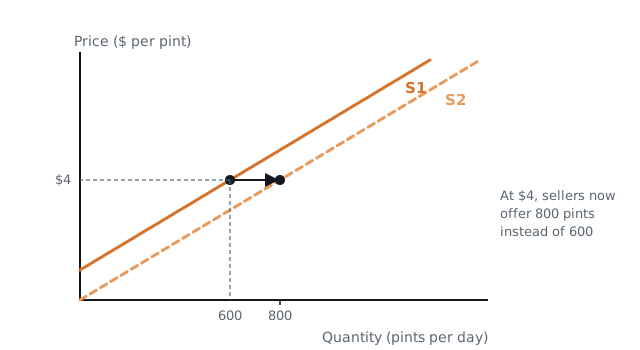
An increase in supply shifts the curve to the right: at $4, growers now offer 800 pints. A decrease shifts the curve to the left. An increase in supply also means sellers will accept a lower price for each quantity, so the curve can be read as moving down as well as right.
Price moves sellers along the supply curve. Costs, technology, the number of sellers and expectations shift it.
Key Terms
Practice Questions
6 questions. Nothing here is recorded or scored.
- Question 1MKT-3.C.2
Bread in Tolland
Tolland is a fictional town with many small bakeries. The table shows the quantity of loaves each of the town's two groups of bakeries is willing to sell each day at several prices.
Price per loaf | North-side bakeries | South-side bakeries $2 | 100 | 60 $3 | 150 | 90 $4 | 200 | 120 What is the market quantity of loaves supplied at $3?
- A.150 loaves
- B.240 loaves
- C.320 loaves
- D.60 loaves
Check answerHide answer
Answer: B
- A.
- This is only the north-side bakeries' quantity. Market supply adds both groups.
- B.
- Correct. Market supply is the sum of individual supplies at each price: 150 plus 90 is 240 loaves.
- C.
- This is the market quantity at $4: 200 plus 120.
- D.
- Sixty is the difference between the two groups at $3. Market supply is the sum.
- Question 2MKT-3.C.1
Price per loaf | North-side bakeries | South-side bakeries $2 | 100 | 60 $3 | 150 | 90 $4 | 200 | 120 The table shows that when the price of a loaf rises from $2 to $4, each group of bakeries offers more loaves. This pattern illustrates which of the following?
- A.An increase in supply
- B.The law of demand
- C.The law of supply
- D.A decrease in quantity supplied
Check answerHide answer
Answer: C
- A.
- An increase in supply is a shift of the whole curve caused by a determinant. A price change moves along the curve.
- B.
- The law of demand describes buyers. Here sellers respond to price.
- C.
- Correct. A higher own price raises quantity supplied, a movement along the supply curve. The market supply curve slopes upward.
- D.
- Quantity supplied rises in the table when the price rises.
- Question 3MKT-3.D.1
Price per loaf | North-side bakeries | South-side bakeries $2 | 100 | 60 $3 | 150 | 90 $4 | 200 | 120 Suppose the price of flour, a key input for Tolland's bakeries, falls sharply. Which of the following is most likely?
- A.Bakeries offer fewer loaves at every price, so the supply curve shifts to the left.
- B.Quantity supplied rises along the existing supply curve.
- C.The demand curve for bread shifts to the right.
- D.Bakeries offer more loaves at every price, so the supply curve shifts to the right.
Check answerHide answer
Answer: D
- A.
- A higher input price would shift supply left. A lower flour price does the opposite.
- B.
- A movement along the supply curve needs a change in the price of bread. The flour price shifts the curve.
- C.
- Flour costs affect sellers. They shift supply, and demand stays where it is.
- D.
- Correct. Input prices are a determinant of supply. Cheaper flour lowers the cost of each loaf, so bakeries offer more at every price.
- Question 4MKT-3.D.1
A farmer can grow either corn or soybeans on the same land. If the price of soybeans rises sharply, what is most likely to happen in the market for corn?
- A.The supply of corn decreases.
- B.The supply of corn increases.
- C.The quantity of corn supplied increases along the supply curve.
- D.The demand for corn decreases.
Check answerHide answer
Answer: A
- A.
- Correct. Soybeans are another good the farmer could produce with the same land. A higher soybean price draws land away from corn, so the supply of corn shifts left.
- B.
- Higher soybean prices make soybeans the more attractive crop, so farmers grow less corn.
- C.
- A movement along the corn supply curve needs a change in the corn price.
- D.
- The change affects what farmers choose to grow, which is supply.
- Question 5MKT-3.D.1
Which of the following would shift the supply curve for laptops to the right?
- A.An increase in the price of laptops
- B.An increase in the wages of laptop assembly workers
- C.A faster assembly method for laptops
- D.An increase in consumer incomes
Check answerHide answer
Answer: C
- A.
- A price change moves along the supply curve. The curve does not shift.
- B.
- Higher input costs shift supply to the left.
- C.
- Correct. Better technology raises productivity and lowers the cost of each laptop. Sellers offer more at every price.
- D.
- Income is a determinant of demand. Supply does not shift.
- Question 6MKT-3.D.1
A government begins paying apple growers $0.10 for every pound of apples they sell. Which of the following best describes the effect on the market supply of apples?
- A.Supply decreases, because growers must report each pound sold.
- B.Quantity supplied decreases along the supply curve.
- C.Supply does not change, because the market price of apples is the same.
- D.Supply increases, because the payment lowers growers' net cost of each pound.
Check answerHide answer
Answer: D
- A.
- The payment rewards each sale. It makes selling more attractive.
- B.
- A subsidy shifts the curve. It is not a change in the apple price.
- C.
- Determinants shift supply even when the market price has not yet changed.
- D.
- Correct. A per-unit subsidy is a government policy that acts like a fall in production cost. Growers offer more apples at every price, so supply shifts right.
Practice every topic in Unit 2
CED Codes
MKT-3.C.1 · MKT-3.C.2 · MKT-3.D.1