2.3 Price Elasticity of Demand
Price elasticity of demand for AP Microeconomics: percentage changes, elastic and inelastic ranges, what affects elasticity, and the total revenue test.
Part 1 of 3 Measuring How Buyers Respond
Elasticity measures how much quantity responds, in percentage terms, to a change in price, income or the price of a related good. Price elasticity of demand measures how much quantity demanded responds to a change in the good's own price.
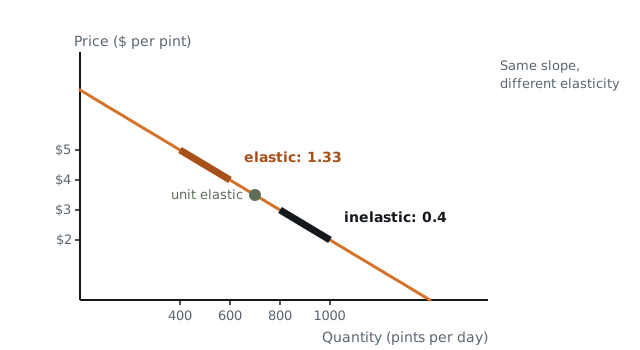
To find each percentage change, divide the change by the starting value. Economists report the magnitude and drop the minus sign. Corvale is a fictional city whose farmers markets sell strawberries by the pint. When the price rises from $4 to $5, quantity demanded falls from 600 to 400 pints.
- Percentage change in quantity: 200 divided by 600 (the starting quantity) is 33.3%.
- Percentage change in price: $1 divided by $4 is 25%.
- Elasticity: 33.3% divided by 25% is 1.33.
Part 2 of 3 Elastic, Inelastic and Unit Elastic
| Magnitude | Description | What it means |
|---|---|---|
| Greater than 1 | Elastic | Quantity changes by a larger percentage than price |
| Less than 1 | Inelastic | Quantity changes by a smaller percentage than price |
| Equal to 1 | Unit elastic | Quantity and price change by the same percentage |
Corvale's demand is elastic between $4 and $5. Lower down the same straight-line curve, a rise from $2 to $3 cuts quantity from 1,000 to 800 pints. Quantity falls 20% while price rises 50%, an elasticity of 0.4, so demand is inelastic there. Elasticity varies along a straight-line demand curve, so slope is not elasticity.
Price elasticity of demand depends on several factors. The most important is the availability of substitutes: the more close substitutes a good has, the more elastic its demand. Demand also tends to be more elastic for goods that take a large share of a budget and when buyers have more time to adjust.
Part 3 of 3 Elasticity and Total Revenue
Total revenue is price times quantity. Total revenue for sellers is total expenditure for buyers. How a price change affects total revenue depends on elasticity.
| Price change | Quantity | Total revenue | Demand in this range |
|---|---|---|---|
| $4 to $5 | 600 to 400 | $2,400 to $2,000 | Elastic: revenue falls |
| $2 to $3 | 1,000 to 800 | $2,000 to $2,400 | Inelastic: revenue rises |
When demand is elastic, price and total revenue move in opposite directions. When demand is inelastic, they move in the same direction. When demand is unit elastic, a small price change leaves total revenue unchanged. For Corvale, revenue peaks at $3.50 and 700 pints, $2,450.
Elastic: price and total revenue move in opposite directions. Inelastic: they move together.
Key Terms
Practice Questions
6 questions. Nothing here is recorded or scored.
- Question 1MKT-3.E.2
Pricing Ferry Tickets
A ferry company carries passengers between two fictional islands, Ennis Key and Morrow Key. The company raised the price of a one-way ticket from $10 to $12. Daily ticket sales fell from 1,000 to 900. A competing water taxi runs the same route at similar times.
What is the price elasticity of demand for ferry tickets over this price change?
- A.1.0
- B.0.5
- C.2.0
- D.50
Check answerHide answer
Answer: B
- A.
- An elasticity of 1 would need quantity and price to change by the same percentage. Quantity fell 10% and price rose 20%.
- B.
- Correct. Quantity falls 100 out of 1,000, or 10%. Price rises $2 out of $10, or 20%. Elasticity is 10% divided by 20%, or 0.5.
- C.
- This would mean quantity changed twice as much as price. Quantity fell 10% and price rose 20%.
- D.
- Fifty divides the change in quantity, 100, by the change in price, $2. That ratio is the slope. Elasticity uses percentage changes.
- Question 2MKT-3.E.5
Based on the elasticity over this range, what happened to the ferry company's total revenue from tickets?
- A.It rose, because demand is inelastic in this range.
- B.It stayed the same, because demand is unit elastic here.
- C.It fell, because demand is elastic in this range.
- D.It rose, because the ticket price went up by $2.
Check answerHide answer
Answer: A
- A.
- Correct. Demand is inelastic here, so price and total revenue move in the same direction. Revenue rose from $10,000 to $10,800.
- B.
- Unit elastic demand would need equal percentage changes. Quantity fell 10% and price rose 20%.
- C.
- Demand would need an elasticity greater than 1 for revenue to fall. Here it is 0.5.
- D.
- A higher price raises revenue only when demand is inelastic, so the size of the price rise alone does not decide it.
- Question 3MKT-3.E.4
The water taxi adds departures until it runs as often as the ferry, so passengers see it as a closer substitute. How does this most likely change the price elasticity of demand for ferry tickets?
- A.Demand becomes less elastic, because passengers still need to cross
- B.Demand becomes perfectly inelastic, because passengers must cross
- C.Demand becomes more elastic, because passengers can switch to the taxi
- D.Elasticity stays the same, because only the ferry's price affects it
Check answerHide answer
Answer: C
- A.
- A closer substitute makes it easier for passengers to switch away when the ferry raises its price, so demand becomes more elastic.
- B.
- Passengers have another way to cross on the same route, so ferry demand is far from perfectly inelastic.
- C.
- Correct. The more close substitutes a good has, the more elastic its demand. A ferry price rise would now send more passengers to the water taxi.
- D.
- Elasticity depends on factors such as the availability of substitutes, and the water taxi is now a closer one.
- Question 4MKT-3.E.2
A straight-line demand curve has a constant slope. Which of the following is true of price elasticity of demand along that curve?
- A.It is the same everywhere, because the slope is constant.
- B.It is elastic at low prices and inelastic at high prices.
- C.It equals 1 at every point along the curve.
- D.It is more elastic at high prices than at low prices.
Check answerHide answer
Answer: D
- A.
- Slope measures changes in units. Elasticity measures changes in percentages, which differ along the line.
- B.
- This reverses the pattern. The upper part of a straight-line demand curve is elastic.
- C.
- Unit elasticity holds only at one point on a straight-line demand curve, its midpoint.
- D.
- Correct. Near the top of the line, a $1 price change is a small percentage of a high price, and the matching quantity change is a large percentage of a small quantity. Near the bottom, the reverse holds. Elasticity varies along a straight-line demand curve, so slope is not elasticity.
- Question 5MKT-3.E.4
Which of the following goods is most likely to have the most elastic demand?
- A.One particular brand of bottled water
- B.Insulin for people with diabetes
- C.Table salt
- D.Gasoline in the week after a price change
Check answerHide answer
Answer: A
- A.
- Correct. One brand of water has many close substitutes in other brands. The more substitutes, the more elastic demand.
- B.
- Insulin has few or no substitutes for the people who need it, so its demand is very inelastic.
- C.
- Salt has few close substitutes and takes a tiny share of a budget, so its demand is inelastic.
- D.
- In the short run, drivers have few ways to replace gasoline, so demand is inelastic.
- Question 6MKT-3.E.3, MKT-3.E.5
A theater cuts its ticket price by 10%, and the number of tickets sold rises by 25%. Which of the following is correct?
- A.Demand is elastic, and the theater's total revenue falls.
- B.Demand is elastic, and the theater's total revenue rises.
- C.Demand is inelastic, and the theater's total revenue rises.
- D.Demand is unit elastic, and the theater's total revenue is unchanged.
Check answerHide answer
Answer: B
- A.
- With elastic demand, a price cut raises total revenue because quantity rises by a larger percentage.
- B.
- Correct. Elasticity is 25% divided by 10%, or 2.5, which is greater than 1. With elastic demand, price and total revenue move in opposite directions, so the price cut raises revenue.
- C.
- Quantity changed by a larger percentage than price, so demand is elastic.
- D.
- Unit elastic demand would need equal percentage changes. Here 25% is larger than 10%.
Practice every topic in Unit 2
CED Codes
MKT-3.E.1 · MKT-3.E.2 · MKT-3.E.3 · MKT-3.E.4 · MKT-3.E.5