2.4 Price Elasticity of Supply
Price elasticity of supply for AP Microeconomics: the calculation, elastic and inelastic supply, and why time and inputs change how sellers respond.
Part 1 of 3 Measuring How Sellers Respond
Price elasticity of supply measures how much quantity supplied responds to a change in price. Divide the percentage change in quantity supplied by the percentage change in price.
Corvale is a fictional city whose farmers markets sell strawberries by the pint. When the price rises from $4 to $5, growers raise the quantity supplied from 600 to 800 pints. Quantity rises 200 divided by 600, or 33.3%. Price rises $1 divided by $4, or 25%. Elasticity of supply is 33.3% divided by 25%, which is about 1.33.
Part 2 of 3 Elastic and Inelastic Supply
Supply uses the same benchmark as demand: a magnitude of 1.
| Magnitude | Description | Corvale example |
|---|---|---|
| Greater than 1 | Elastic | Over a full season, $4 to $5 raises quantity supplied by 33.3%: elasticity 1.33 |
| Less than 1 | Inelastic | On a single morning, growers can bring only the berries already picked |
| Equal to 1 | Unit elastic | Quantity supplied rises by the same percentage as price |
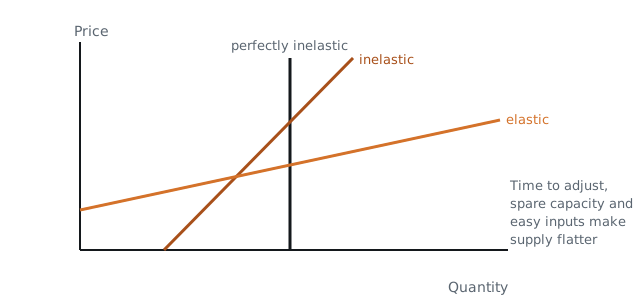
A vertical supply curve is perfectly inelastic: quantity supplied does not change at all when price changes. The tickets to one concert in a hall of fixed size are an example. A horizontal supply curve is perfectly elastic: sellers will supply any quantity at one price, and none at a lower price.
Strawberry supply in Corvale shows how elasticity depends on the time period. On a Saturday morning, the berries are already picked, and a higher price cannot add more. Over a season, growers can hire pickers and plant more rows, so the same price rise brings a larger increase in quantity supplied.
Part 3 of 3 What Makes Supply More Elastic
Price elasticity of supply depends on how easily sellers can get more inputs or switch to other inputs. One factor is the price of alternative inputs. If a grower can hire extra pickers or rent extra land at a low cost, supply is more elastic. If the only extra land is far away and expensive, supply is less elastic.
| Factor | More elastic when | Strawberry example |
|---|---|---|
| Time | Sellers have longer to adjust | A grower can plant more fields for next year |
| Inputs | Extra or alternative inputs are cheap and easy to get | Extra pickers are available at the usual wage |
| Spare capacity | Sellers have unused workers and equipment | Some fields are planted and not yet picked |
Supply grows more elastic when sellers have time and can get more inputs cheaply.
Key Terms
Practice Questions
6 questions. Nothing here is recorded or scored.
- Question 1MKT-3.E.6
Hand-Built Guitars
A small workshop builds acoustic guitars by hand. Each guitar takes a trained builder about three weeks, and the workshop employs four builders. When the price of its guitars rose from $2,000 to $2,400, the workshop raised its output for the year from 100 guitars to 110.
What is the workshop's price elasticity of supply over this price change?
- A.2.0
- B.1.0
- C.0.5
- D.0.025
Check answerHide answer
Answer: C
- A.
- This would need quantity to rise by twice the percentage that price rose. Quantity rose 10% and price 20%.
- B.
- Unit elasticity would need equal percentage changes. Quantity rose 10% and price rose 20%.
- C.
- Correct. Quantity rises 10 out of 100, or 10%. Price rises $400 out of $2,000, or 20%. Elasticity is 10% divided by 20%, or 0.5.
- D.
- This divides the change in quantity, 10, by the change in price, 400. Elasticity uses percentage changes.
- Question 2MKT-3.E.7
Based on the calculation, the workshop's supply over this range is best described as which of the following?
- A.Inelastic, because quantity rose by a smaller percentage than price
- B.Elastic, because quantity supplied rose when price rose
- C.Unit elastic, because both price and quantity rose
- D.Perfectly inelastic, because the workshop has only four builders
Check answerHide answer
Answer: A
- A.
- Correct. An elasticity of supply below 1 means quantity supplied responds less than proportionally to price. That is inelastic supply.
- B.
- Quantity supplied usually rises with price. Supply is elastic only when it rises by a larger percentage.
- C.
- Unit elasticity needs equal percentage changes, and these are 10% and 20%.
- D.
- Perfectly inelastic supply would show no change in quantity. Output rose by 10 guitars.
- Question 3MKT-3.E.8
Which change would most likely make the workshop's supply more elastic?
- A.The time to build each guitar doubles.
- B.Trained builders become easy to hire at the usual wage.
- C.The wood it uses becomes available from only one supplier.
- D.Demand for acoustic guitars rises.
Check answerHide answer
Answer: B
- A.
- Slower production makes it harder to respond to a price rise, so supply becomes less elastic.
- B.
- Correct. Supply is more elastic when sellers can get extra inputs easily and cheaply. If builders are easy to hire, the workshop can expand output quickly when the price rises.
- C.
- A harder-to-get input limits how far output can rise, which makes supply less elastic.
- D.
- A change in demand moves the price. It does not change how responsive sellers are.
- Question 4MKT-3.E.7
A supply curve is vertical. Which of the following is true?
- A.Supply is perfectly elastic: sellers will supply any amount at one price.
- B.Supply is unit elastic at every price.
- C.Quantity supplied rises by a large percentage for a small price rise.
- D.Supply is perfectly inelastic: quantity supplied does not change when price changes.
Check answerHide answer
Answer: D
- A.
- Perfectly elastic supply is horizontal.
- B.
- A vertical curve has elasticity zero at every price.
- C.
- That describes elastic supply, a flat curve.
- D.
- Correct. A vertical supply curve shows the same quantity at every price. Its price elasticity of supply is zero.
- Question 5MKT-3.E.8
Supply of fresh fish at a harbor market is more elastic over a year than over a single morning. Which of the following best explains why?
- A.Over a year, buyers have more substitutes for fish.
- B.Over a single morning, the price of fish cannot change.
- C.Over a year, sellers have time to add boats and crews.
- D.Over a year, the law of supply no longer applies.
Check answerHide answer
Answer: C
- A.
- More substitutes affects the elasticity of demand. The question concerns supply.
- B.
- Prices can change in a morning. The quantity sellers can bring is what is fixed.
- C.
- Correct. Time to adjust is a key factor in supply elasticity. On one morning, sellers can sell only the fish already caught.
- D.
- The law of supply applies in both periods. Sellers simply respond more when they have time.
- Question 6MKT-3.E.6, MKT-3.E.7
When the price of a product rises 8%, quantity supplied rises 12%. What is the price elasticity of supply, and how is supply described?
- A.0.67, inelastic
- B.1.0, unit elastic
- C.4.0, elastic
- D.1.5, elastic
Check answerHide answer
Answer: D
- A.
- This divides 8% by 12%. Elasticity of supply divides the change in quantity by the change in price.
- B.
- Unit elasticity needs equal percentage changes. Twelve percent is larger than 8%.
- C.
- This subtracts the percentages. Elasticity is a ratio.
- D.
- Correct. Elasticity of supply is 12% divided by 8%, or 1.5. A value greater than 1 means supply is elastic.
Practice every topic in Unit 2
CED Codes
MKT-3.E.6 · MKT-3.E.7 · MKT-3.E.8