2.5 Other Elasticities
Other elasticities for AP Microeconomics: income elasticity for normal and inferior goods and cross-price elasticity for substitutes and complements.
Part 1 of 3 Elasticity for Any Determinant
Economists can calculate an elasticity for every determinant of demand or supply. Price is only one of them. Two other measures come up often: income elasticity of demand and cross-price elasticity of demand.
Both measures follow one pattern. Take the percentage change in the quantity buyers want, then divide it by the percentage change in the determinant. For these two measures, the sign matters. A positive or negative result tells you what kind of good you have.
Price elasticity of demand drops the minus sign because demand curves slope down, so the sign is always negative. Income and cross-price elasticity can be positive or negative, and the sign carries the information. A researcher who drops the sign loses the answer.
Part 2 of 3 Income Elasticity of Demand
Income elasticity of demand tells economists whether a good is normal or inferior. Corvale is a fictional city whose farmers markets sell strawberries by the pint. When incomes in Corvale rise 10%, the quantity of strawberries demanded rises 5%. Income elasticity is 5% divided by 10%, or 0.5. The result is positive, so strawberries are a normal good in Corvale.
Over the same change, purchases of discount canned fruit fall 4%. Income elasticity is negative 4% divided by 10%, or negative 0.4, so discount canned fruit is an inferior good. Positive income elasticity means normal; negative means inferior.
Part 3 of 3 Cross-Price Elasticity of Demand
Cross-price elasticity of demand tells economists whether two goods are substitutes, complements or unrelated.
| Change | Effect on strawberries | Cross-price elasticity | Relationship |
|---|---|---|---|
| Blueberry price rises 20% | Quantity demanded rises 10% | +0.5 | Substitutes |
| Whipped cream price rises 10% | Quantity demanded falls 3% | -0.3 | Complements |
| Bus fare rises 10% | No change | 0 | Not related |
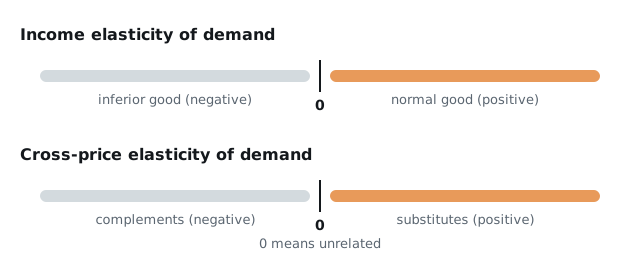
Grocery stores use these numbers when they plan. A store expecting a recession stocks more inferior goods. A store that raises the price of coffee can expect higher sales of tea, a substitute, and lower sales of creamer, a complement.
Key Terms
Practice Questions
6 questions. Nothing here is recorded or scored.
- Question 1MKT-3.E.10
Spending in Larchmont
Researchers studied household purchases in Larchmont, a fictional city. When average household income rose 5%, purchases of restaurant meals rose 10% and purchases of bus passes fell 2%. When the price of coffee rose 10%, purchases of tea rose 4% and purchases of coffee creamer fell 6%.
What is the income elasticity of demand for restaurant meals in Larchmont?
- A.0.5
- B.2.0
- C.-2.0
- D.15
Check answerHide answer
Answer: B
- A.
- This divides the income change by the quantity change. Income elasticity divides the change in quantity by the change in income.
- B.
- Correct. Income elasticity is the percentage change in quantity, 10%, divided by the percentage change in income, 5%, which is 2.0.
- C.
- Purchases rose when income rose, so the sign is positive.
- D.
- This adds the two percentages. Elasticity is a ratio.
- Question 2MKT-3.E.10
Based on the study, bus passes in Larchmont are best described as which kind of good?
- A.An inferior good, because purchases fell when income rose
- B.A normal good, because people still buy bus passes
- C.A complement to restaurant meals, because both changed when income changed
- D.A substitute for coffee, because its elasticity is negative
Check answerHide answer
Answer: A
- A.
- Correct. Income elasticity for bus passes is negative 2% divided by 5%, or negative 0.4. A negative income elasticity means an inferior good.
- B.
- A good is normal when purchases rise with income. Bus pass purchases fell.
- C.
- Complements are identified with cross-price elasticity, the response to another good's price.
- D.
- Substitutes have a positive cross-price elasticity. Bus passes were measured against income.
- Question 3MKT-3.E.11
Based on the study, which of the following correctly describes the relationship between coffee and the other two goods?
- A.Tea is a complement to coffee, and creamer is a substitute for coffee.
- B.Both tea and creamer are substitutes for coffee.
- C.Both tea and creamer are inferior goods.
- D.Tea is a substitute for coffee, and creamer is a complement to coffee.
Check answerHide answer
Answer: D
- A.
- This reverses the signs. Tea purchases rose when coffee got more expensive, so tea is a substitute.
- B.
- Creamer purchases fell when the coffee price rose, which is the sign of a complement.
- C.
- Inferior goods are identified by income elasticity. These measurements respond to the price of coffee.
- D.
- Correct. Tea has a cross-price elasticity of 4% divided by 10%, or +0.4, so it is a substitute. Creamer has negative 6% divided by 10%, or -0.6, so it is a complement.
- Question 4MKT-3.E.11
The cross-price elasticity of demand between two goods is zero. Which of the following is most likely true?
- A.The goods are close substitutes.
- B.The goods are strong complements.
- C.The goods are not related.
- D.Both goods are inferior.
Check answerHide answer
Answer: C
- A.
- Substitutes have a positive cross-price elasticity.
- B.
- Complements have a negative cross-price elasticity.
- C.
- Correct. A cross-price elasticity of zero means a change in one good's price has no effect on the quantity demanded of the other.
- D.
- Whether a good is inferior is shown by income elasticity, which this measure does not report.
- Question 5MKT-3.E.9, MKT-3.E.10
Which of the following measures how strongly quantity demanded responds to a change in buyers' incomes?
- A.Income elasticity of demand
- B.Price elasticity of demand
- C.Cross-price elasticity of demand
- D.Price elasticity of supply
Check answerHide answer
Answer: A
- A.
- Correct. Income elasticity of demand divides the percentage change in quantity demanded by the percentage change in income.
- B.
- Price elasticity measures the response to the good's own price.
- C.
- Cross-price elasticity measures the response to another good's price.
- D.
- Price elasticity of supply measures how sellers respond to price.
- Question 6MKT-3.E.11
A store finds that when the price of printers falls 20%, sales of ink cartridges rise 30%. What is the cross-price elasticity of demand for ink cartridges with respect to printer prices, and what does it show?
- A.+1.5, so printers and ink are substitutes
- B.-0.67, so printers and ink are complements
- C.-1.5, so printers and ink are complements
- D.+0.67, so printers and ink are not related
Check answerHide answer
Answer: C
- A.
- The price of printers fell and ink sales rose, so the percentages have opposite signs and the result is negative.
- B.
- This divides the price change by the quantity change. Divide 30% by negative 20%.
- C.
- Correct. The quantity of ink rises 30% while the printer price falls 20%: 30% divided by negative 20% is -1.5. A negative cross-price elasticity means complements.
- D.
- A nonzero value means the goods are related, and the sign here is negative.
Practice every topic in Unit 2
CED Codes
MKT-3.E.9 · MKT-3.E.10 · MKT-3.E.11