2.6 Market Equilibrium and Consumer and Producer Surplus
Market equilibrium for AP Microeconomics: how supply and demand set price and quantity, and how to calculate consumer, producer and total surplus.
Part 1 of 3 Finding Equilibrium
The supply and demand model explains what influences prices and quantities, and why they differ across markets and change over time. In a perfectly competitive market, equilibrium is the price at which the quantity buyers want to buy equals the quantity sellers want to sell.
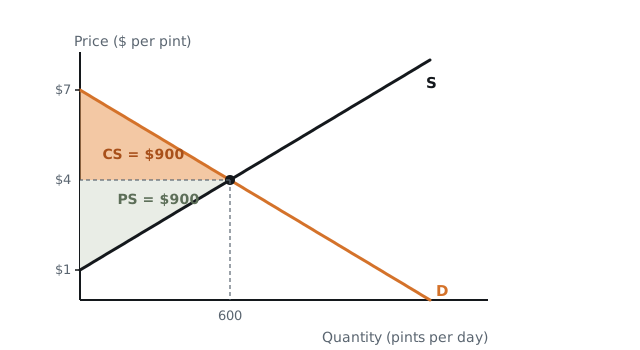
Corvale is a fictional city whose farmers markets sell strawberries by the pint. At $4 a pint, buyers want 600 pints a day and growers offer 600 pints. The market clears: there is no shortage and no surplus. The equilibrium price is $4 and the equilibrium quantity is 600 pints.
The equilibrium price carries information. A high strawberry price tells growers that buyers value strawberries highly, and growers move land and workers toward strawberries. Equilibrium price guides the allocation of resources.
Part 2 of 3 Consumer and Producer Surplus
Economists use consumer and producer surplus to measure the benefits a market creates for buyers and sellers.
| Consumer surplus | Producer surplus | |
|---|---|---|
| Definition | What buyers are willing to pay minus what they actually pay | What sellers receive minus the lowest price they would accept |
| Area on the graph | Below demand, above the price | Above supply, below the price |
| Corvale at $4 | 1/2 x 600 x ($7 - $4) = $900 | 1/2 x 600 x ($4 - $1) = $900 |
Area of a triangle = one half times base times height
Part 3 of 3 Equilibrium and Efficiency
Total economic surplus is consumer surplus plus producer surplus: $1,800 a day in Corvale. When there are no market failures, the market equilibrium makes total surplus as large as possible. Every pint that buyers value at more than its cost gets produced, and no pint gets produced that costs more than buyers value it.
For this reason, perfectly competitive markets are efficient. At 500 pints, buyers would value the next pint at $4.50 and growers could produce it for $3.50, so $1 of surplus would go unused. At 700 pints, the last pint would cost growers $4.50 to produce and be worth only $3.50 to buyers, so producing it would destroy $1 of surplus.
Only at 600 pints does the value of the last pint to buyers equal its cost to growers. Any other quantity leaves total surplus below $1,800.
At equilibrium, quantity supplied equals quantity demanded and total surplus is as large as it can be.
Key Terms
Practice Questions
6 questions. Nothing here is recorded or scored.
- Question 1MKT-4.A.2
The Market for Phone Cases
In the fictional town of Bramwell, the market for phone cases has straight-line demand and supply curves. Demand reaches zero at a price of $20, and supply begins at a price of $4. The table shows weekly quantities at three prices.
Price | Quantity demanded | Quantity supplied $10 | 50 | 30 $12 | 40 | 40 $14 | 30 | 50 What are the equilibrium price and quantity of phone cases in Bramwell?
- A.$10 and 50 cases
- B.$14 and 30 cases
- C.$20 and 0 cases
- D.$12 and 40 cases
Check answerHide answer
Answer: D
- A.
- At $10, buyers want 50 cases and sellers offer only 30. That gap is a shortage.
- B.
- At $14, sellers offer 50 cases and buyers want only 30. That is a surplus.
- C.
- At $20, no one buys. This is the price where demand reaches zero.
- D.
- Correct. At $12, buyers want 40 cases and sellers offer 40, so the market clears.
- Question 2MKT-4.A.4
Price | Quantity demanded | Quantity supplied $10 | 50 | 30 $12 | 40 | 40 $14 | 30 | 50 What is consumer surplus in the phone case market at equilibrium?
- A.$160
- B.$320
- C.$480
- D.$240
Check answerHide answer
Answer: A
- A.
- Correct. Consumer surplus is the triangle below demand and above the price: 1/2 x 40 cases x ($20 - $12) = $160.
- B.
- This leaves out the one half in the triangle formula. 40 x $8 is the rectangle, twice the triangle.
- C.
- This is the total amount buyers spend, $12 x 40. Consumer surplus is what buyers would pay above what they do pay.
- D.
- This uses the price, $12, as the height of the triangle. The height runs from the price, $12, up to $20, where demand reaches zero.
- Question 3MKT-4.A.5
Price | Quantity demanded | Quantity supplied $10 | 50 | 30 $12 | 40 | 40 $14 | 30 | 50 Which of the following is true of the phone case market at its equilibrium, assuming no market failures?
- A.Consumer surplus equals producer surplus, so the market is efficient.
- B.Total economic surplus is as large as possible, so the market is efficient.
- C.Producers could raise total surplus by selling 50 cases.
- D.There is a shortage of 40 cases.
Check answerHide answer
Answer: B
- A.
- Efficiency depends on the size of total surplus. Here producer surplus is 1/2 x 40 x $8 = $160, but the market would be efficient even if the shares differed.
- B.
- Correct. Without market failures, the competitive equilibrium makes the sum of consumer and producer surplus as large as it can be. That is what it means for the market to be efficient.
- C.
- At 50 cases, the last 10 would cost more to make than buyers value them, so total surplus would fall.
- D.
- At equilibrium, quantity demanded equals quantity supplied, so there is no shortage.
- Question 4MKT-4.A.3
Which of the following best describes the role of the equilibrium price in a market?
- A.It guarantees that every buyer can purchase the good.
- B.It is set by the government to protect consumers.
- C.It signals buyers and sellers how to use scarce resources.
- D.It is the highest price any buyer would pay.
Check answerHide answer
Answer: C
- A.
- Buyers who value the good below the price choose not to buy.
- B.
- In a competitive market, supply and demand determine the price.
- C.
- Correct. Equilibrium price carries information. A high price tells producers to move resources toward the good, and buyers to use it sparingly.
- D.
- That is the top of the demand curve. Equilibrium is where quantity supplied equals quantity demanded.
- Question 5MKT-4.A.4
Producer surplus is best measured by which area on a supply and demand graph?
- A.The area below the demand curve and above the price
- B.The area above the supply curve and below the price
- C.The area below the supply curve
- D.The area of the rectangle formed by price and quantity
Check answerHide answer
Answer: B
- A.
- This area is consumer surplus.
- B.
- Correct. Producer surplus is what sellers receive minus the lowest price they would accept, which is the area between the price and the supply curve.
- C.
- The area under the supply curve measures sellers' costs.
- D.
- That rectangle is total revenue, or total spending by buyers.
- Question 6MKT-4.A.1
Which of the following best explains why the supply and demand model is useful?
- A.It predicts the exact price of every good in an economy.
- B.It shows that prices never change once equilibrium is reached.
- C.It applies only to markets with government price controls.
- D.It shows what influences prices and quantities and why they change.
Check answerHide answer
Answer: D
- A.
- The model explains how prices form. It does not give exact prices without data.
- B.
- Equilibrium changes whenever supply or demand shifts.
- C.
- The model applies to competitive markets with or without government action.
- D.
- Correct. The model is a tool for understanding what drives price and quantity in a market and how those outcomes move when conditions change.
Practice every topic in Unit 2
CED Codes
MKT-4.A.1 · MKT-4.A.2 · MKT-4.A.3 · MKT-4.A.4 · MKT-4.A.5