2.7 Market Disequilibrium and Changes in Equilibrium
Market disequilibrium for AP Micro: shortages and surpluses, how shifts in demand and supply change price, quantity and surplus, and double shifts.
Part 1 of 3 Shortages and Surpluses
When the price is away from equilibrium, the market is in disequilibrium. Market forces then push price and quantity back toward equilibrium.
| Shortage | Surplus | |
|---|---|---|
| When it happens | Price is below equilibrium | Price is above equilibrium |
| Corvale example | At $3, buyers want 800 pints and growers offer 400: a shortage of 400 | At $5, growers offer 800 pints and buyers want 400: a surplus of 400 |
| What pushes price back | Buyers compete for scarce pints and bid the price up | Sellers cut prices to sell unsold pints |
In a shortage, the price rises. A higher price lowers quantity demanded and raises quantity supplied, so the gap closes. In a surplus, the price falls, which raises quantity demanded and lowers quantity supplied. Both processes stop at the equilibrium price, $4 in Corvale.
Part 2 of 3 When a Curve Shifts
Corvale is a fictional city whose farmers markets sell strawberries by the pint. A health report praises strawberries, and demand rises by 200 pints at every price. At the old price of $4, buyers now want 800 pints and growers still offer 600, a shortage of 200. The price rises until the market clears at $4.50 and 700 pints.
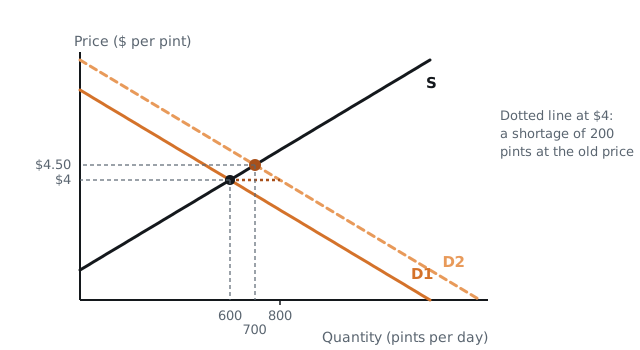
Shifts also change surplus. After the increase in demand, consumer surplus is 1/2 x 700 x ($8 - $4.50) = $1,225, and producer surplus is 1/2 x 700 x ($4.50 - $1) = $1,225. Total surplus in the market rises from $1,800 to $2,450.
| Change | Equilibrium price | Equilibrium quantity |
|---|---|---|
| Demand increases | Rises | Rises |
| Demand decreases | Falls | Falls |
| Supply increases | Falls | Rises |
| Supply decreases | Rises | Falls |
Part 3 of 3 Elasticity and Double Shifts
Elasticity decides how large each change is. When supply is inelastic, an increase in demand raises price a lot and quantity only a little. When supply is elastic, the same increase in demand raises quantity more and price less. Elasticity of demand plays the same role when supply shifts: with inelastic demand, a fall in supply raises price sharply and cuts quantity only a little.
When both curves shift at once, one of the two outcomes is indeterminate: its direction depends on which shift is larger. If demand and supply both increase, quantity rises for certain, and price could rise, fall or stay the same.
| Demand | Supply | Price | Quantity |
|---|---|---|---|
| Increases | Increases | Indeterminate | Rises |
| Decreases | Decreases | Indeterminate | Falls |
| Increases | Decreases | Rises | Indeterminate |
| Decreases | Increases | Falls | Indeterminate |
Key Terms
Practice Questions
6 questions. Nothing here is recorded or scored.
- Question 1MKT-4.B.2
Umbrellas in Halden
Halden is a fictional city. Its market for umbrellas is in equilibrium at $15 and 2,000 umbrellas a month. A weather service then forecasts the wettest season in decades. At the same time, a new factory begins producing umbrellas for Halden's stores.
Consider only the forecast. Which of the following is most likely to happen in the umbrella market?
- A.Demand increases, and the equilibrium price and quantity both rise.
- B.Supply increases, and price falls while quantity rises.
- C.Demand increases, and price rises while quantity falls.
- D.Quantity demanded rises along the demand curve, and price is unchanged.
Check answerHide answer
Answer: A
- A.
- Correct. Expected rain raises the quantity demanded at every price, shifting demand right. With supply unchanged, price and quantity both rise.
- B.
- The forecast changes buyers' wants. It shifts demand.
- C.
- With an increase in demand and fixed supply, quantity rises along the supply curve.
- D.
- The forecast is a determinant, so it shifts the whole demand curve.
- Question 2MKT-4.B.2
Considering both the forecast and the new factory, which of the following is certain?
- A.Equilibrium price rises, and the change in quantity is indeterminate.
- B.Equilibrium price and quantity both rise.
- C.Equilibrium quantity rises, and the change in price is indeterminate.
- D.Equilibrium price falls, and quantity rises.
Check answerHide answer
Answer: C
- A.
- Both shifts raise quantity, so quantity is not the uncertain one.
- B.
- Price rises only if the demand shift is larger than the supply shift, which the passage does not say.
- C.
- Correct. Demand and supply both increase. Both shifts raise quantity, so quantity rises for certain. Demand pushes price up and supply pushes it down, so the price change depends on which shift is larger.
- D.
- Price falls only if the supply shift is larger, which is not known.
- Question 3MKT-4.B.1
Suppose that, before any curves shift, a store chain holds the price at $12, below the $15 equilibrium. Which of the following will occur?
- A.A surplus, as quantity supplied exceeds quantity demanded, and pressure pushes the price down
- B.An increase in demand until the market clears at $12
- C.No change, as the market is still in equilibrium
- D.A shortage, as quantity demanded exceeds quantity supplied, and pressure pushes the price up
Check answerHide answer
Answer: D
- A.
- A surplus happens when price is above equilibrium.
- B.
- A price below equilibrium does not shift demand. It creates a shortage.
- C.
- At $12, quantity demanded and quantity supplied are no longer equal.
- D.
- Correct. Below equilibrium, buyers want more umbrellas than sellers offer. Buyers compete for the limited stock, which pushes the price back toward $15.
- Question 4MKT-4.B.1
In a market, buyers want 20 units and sellers offer 20 units at $30. At $35, buyers want 15 units and sellers offer 25. If the price is set at $35, what is the result?
- A.A shortage of 10 units
- B.A surplus of 10 units
- C.A surplus of 20 units
- D.No shortage or surplus
Check answerHide answer
Answer: B
- A.
- At $35, quantity supplied is 25 and quantity demanded is 15. Sellers offer more than buyers want, which is a surplus.
- B.
- Correct. At $35, quantity supplied is 25 and quantity demanded is 15. The surplus is 25 - 15 = 10 units.
- C.
- The surplus is the difference between 25 and 15, which is 10.
- D.
- Equilibrium is at $30, where both quantities are 20. At $35, they differ.
- Question 5MKT-4.B.2
An increase in demand raises the equilibrium price of a good a lot and its equilibrium quantity only a little. Which of the following best explains this outcome?
- A.Supply of the good is inelastic.
- B.Supply of the good is perfectly elastic.
- C.Demand for the good is inelastic.
- D.Supply of the good increased at the same time.
Check answerHide answer
Answer: A
- A.
- Correct. When supply is inelastic, sellers cannot raise output much, so most of the effect of higher demand shows up in price.
- B.
- With perfectly elastic supply, an increase in demand raises quantity and leaves price unchanged.
- C.
- When demand shifts, the split between the price change and the quantity change depends on the supply curve. The elasticity of demand plays that role when supply shifts.
- D.
- A simultaneous increase in supply would push price down, which works against a large price rise.
- Question 6MKT-4.B.2
A drought sharply reduces the supply of wheat. Which of the following describes the effect on the wheat market?
- A.Price falls, quantity rises, and consumer surplus rises.
- B.Price rises, quantity falls, and consumer surplus falls.
- C.Price rises, quantity rises, and consumer surplus rises.
- D.Price and quantity are unchanged, because demand did not change.
Check answerHide answer
Answer: B
- A.
- Those are the effects of an increase in supply.
- B.
- Correct. A decrease in supply shifts the supply curve left. Price rises and quantity falls, and buyers pay more for fewer units, so consumer surplus falls.
- C.
- Quantity falls when supply decreases, because buyers move up the demand curve.
- D.
- A shift in supply alone changes equilibrium price and quantity.
Practice every topic in Unit 2
CED Codes
MKT-4.B.1 · MKT-4.B.2