2.8 The Effects of Government Intervention in Markets
Government intervention for AP Microeconomics: price ceilings and floors, quotas, per-unit taxes and subsidies, deadweight loss, and who bears a tax.
Part 1 of 3 Price Ceilings and Price Floors
Governments sometimes regulate prices or quantities. Price and quantity rules change incentives and outcomes in every market structure.
Corvale is a fictional city whose farmers markets sell strawberries by the pint. The market clears at $4 and 600 pints, with total surplus of $1,800 a day.
| Policy | What it is | Result | Deadweight loss |
|---|---|---|---|
| Price ceiling at $3 | A legal maximum price, binding when set below equilibrium | Buyers want 800, growers offer 400: a shortage of 400 | $200 |
| Price floor at $5 | A legal minimum price, binding when set above equilibrium | Growers offer 800, buyers want 400: a surplus of 400 | $200 |
| Quota of 400 pints | A legal limit on the quantity sold | Price rises to $5, the price buyers will pay for the 400th pint | $200 |
Under each policy, only 400 pints change hands. Deadweight loss is the surplus lost on the 200 pints that buyers value at more than they cost to grow. The lost area is a triangle: 1/2 x 200 x ($5 - $3) = $200.
Part 2 of 3 Per-Unit Taxes and Subsidies
Governments use taxes and subsidies to change incentives. Suppose Corvale charges growers a $1 tax on each pint. The tax raises sellers' cost of each pint, so the supply curve shifts up by $1.
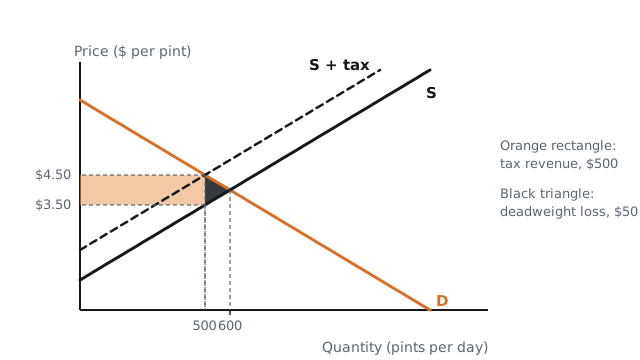
| Measure | Before the tax | After the tax |
|---|---|---|
| Quantity | 600 pints | 500 pints |
| Price buyers pay | $4.00 | $4.50 |
| Price sellers keep | $4.00 | $3.50 |
| Consumer surplus | $900 | $625 |
| Producer surplus | $900 | $625 |
| Tax revenue | None | $500 |
| Deadweight loss | None | $50 |
Taxes raise government revenue and subsidies cost the government money. A $1 subsidy per pint would shift supply down by $1. Quantity would rise to 700 pints. Buyers would pay $3.50, growers would receive $4.50, and the subsidy would cost the city $700 a day. The subsidy also creates a $50 deadweight loss, because it pays for pints that cost more to grow than buyers value them.
Part 3 of 3 Efficiency and Who Pays
When a market already produces the efficient quantity, a tax, subsidy, price control or quantity control can only reduce allocative efficiency. Deadweight loss is the surplus that buyers and sellers lose when the government intervenes in an efficient market.
Tax incidence describes who actually bears the tax. In Corvale, buyers pay $0.50 more and sellers keep $0.50 less, so they split the $1 tax evenly. The split is even because demand and supply respond equally to price in this example. In general, the side of the market that is more inelastic bears more of a tax or receives more of a subsidy.
Intervention in an efficient market creates deadweight loss. The more inelastic side bears more of a tax.
Key Terms
Practice Questions
6 questions. Nothing here is recorded or scored.
- Question 1POL-1.A.3
Taxing Sports Drinks
In the fictional country of Marisport, the market for sports drinks is perfectly competitive and in equilibrium at $2.00 a bottle and 10,000 bottles a day. The government places a tax of $0.60 on each bottle, paid by sellers. After the tax, buyers pay $2.40 a bottle and 8,000 bottles are sold each day.
How much tax revenue does the government collect each day?
- A.$6,000
- B.$3,200
- C.$4,800
- D.$19,200
Check answerHide answer
Answer: C
- A.
- This multiplies the tax by the original quantity, 10,000. Revenue uses the quantity sold after the tax.
- B.
- This multiplies $0.40, the part of the tax buyers bear, by 8,000. The government collects the whole $0.60 on each bottle.
- C.
- Correct. Tax revenue is the tax per unit times the quantity sold after the tax: $0.60 x 8,000 = $4,800.
- D.
- This is buyers' total spending, $2.40 x 8,000.
- Question 2POL-1.A.6
How is the burden of the tax divided, and what does the division suggest?
- A.Buyers bear $0.20 and sellers $0.40 per bottle, suggesting supply is more inelastic than demand.
- B.Sellers bear the full $0.60, because the law requires them to pay it.
- C.Buyers and sellers each bear $0.30, because the tax is split evenly.
- D.Buyers bear $0.40 and sellers $0.20 per bottle, suggesting demand is more inelastic than supply.
Check answerHide answer
Answer: D
- A.
- Buyers pay $2.40 instead of $2.00, an increase of $0.40, so buyers bear the larger share.
- B.
- Who writes the check does not decide who bears the tax. The price buyers pay rose by $0.40.
- C.
- An even split would put the buyers' price at $2.30. It rose to $2.40.
- D.
- Correct. Buyers pay $0.40 more than before, and sellers keep $1.80, which is $0.20 less. The more inelastic side of the market bears more of a tax, so demand is more inelastic here.
- Question 3POL-1.A.4, POL-1.A.5
Which of the following best describes the effect of the tax on efficiency in this market?
- A.It raises total surplus, because the government collects revenue.
- B.It creates a deadweight loss on the 2,000 bottles no longer sold.
- C.It has no effect on efficiency, because buyers still buy 8,000 bottles.
- D.It creates a shortage of 2,000 bottles at the new price.
Check answerHide answer
Answer: B
- A.
- Tax revenue is a transfer from buyers and sellers. The surplus on the lost bottles goes to no one.
- B.
- Correct. The market was producing the efficient quantity. The tax cuts output to 8,000, so surplus on the lost 2,000 bottles disappears. That lost surplus is deadweight loss: 1/2 x 2,000 x $0.60 = $600.
- C.
- Efficiency depends on whether the efficient quantity is produced. Output fell from 10,000.
- D.
- A tax shifts supply. The market clears at the new price, so there is no shortage.
- Question 4POL-1.A.1
A government sets a maximum price for apartment rent below the market equilibrium. Which of the following is most likely?
- A.A shortage of apartments develops.
- B.A surplus of apartments develops.
- C.The number of apartments rented rises above the equilibrium quantity.
- D.Nothing changes, because the ceiling is below equilibrium.
Check answerHide answer
Answer: A
- A.
- Correct. A binding price ceiling holds the price below equilibrium. Renters want more apartments than landlords offer, so a shortage develops.
- B.
- A surplus results from a binding price floor, set above equilibrium.
- C.
- Landlords offer fewer apartments at the lower price, so fewer are rented.
- D.
- A ceiling below equilibrium is binding, so it does change the outcome.
- Question 5POL-1.A.2, POL-1.A.3, POL-1.A.4
A government pays producers a subsidy for each unit of a good sold in a perfectly competitive market that was producing the efficient quantity. Which of the following results?
- A.Output falls, and the government collects revenue from producers.
- B.Output rises, and total surplus rises because buyers pay less.
- C.Output rises above the efficient level, and a deadweight loss results.
- D.Output is unchanged, because the subsidy only transfers money.
Check answerHide answer
Answer: C
- A.
- A subsidy encourages more output and is paid by the government.
- B.
- Buyers and sellers gain, and the government's cost is larger than their gain. Total surplus falls.
- C.
- Correct. The subsidy shifts supply to the right, so more is produced. Some extra units cost more to make than buyers value them, creating deadweight loss, and the subsidy is a cost to the government.
- D.
- The subsidy changes the incentive to produce, which shifts supply and changes output.
- Question 6POL-1.A.1, POL-1.A.5
In a market with straight-line demand and supply curves, the market clears at 500 units and $10. The government sets a price floor of $14. At $14, buyers want 300 units and sellers offer 700. At 300 units, the supply curve shows a price of $6. What is the deadweight loss?
- A.$800
- B.$1,600
- C.$400
- D.$5,600
Check answerHide answer
Answer: A
- A.
- Correct. Only 300 units trade instead of 500. At 300 units, buyers would pay $14 and sellers would accept $6. Deadweight loss is 1/2 x 200 x ($14 - $6) = $800.
- B.
- This is 200 x $8 without the one half. Deadweight loss is a triangle.
- C.
- This uses $14 - $10 as the height. The triangle runs from the demand price, $14, down to the supply price, $6, at 300 units.
- D.
- This is the 400-unit surplus times $14, the value of unsold output. Deadweight loss is the surplus lost on the units not traded.
Practice every topic in Unit 2
CED Codes
POL-1.A.1 · POL-1.A.2 · POL-1.A.3 · POL-1.A.4 · POL-1.A.5 · POL-1.A.6