2.9 International Trade and Public Policy
International trade for AP Microeconomics: how opening to trade changes price and surplus, and how tariffs and quotas affect a domestic market.
Part 1 of 3 Opening a Market to Trade
Opening an economy to trade can change equilibrium price, quantity and surplus. Without trade, called autarky, the domestic market sets its own price. With trade, the domestic price moves to the world price, and trade fills the gap between domestic supply and demand.
Ardavia is a fictional country. Its market for wool blankets clears at $40 and 60 thousand blankets a year without trade. Consumer surplus and producer surplus are each $900 thousand. The world price of a blanket is $25.
| Measure | No trade, $40 | Free trade, $25 | With a $5 tariff, $30 |
|---|---|---|---|
| Quantity demanded | 60 | 90 | 80 |
| Quantity produced in Ardavia | 60 | 30 | 40 |
| Imports | 0 | 60 | 40 |
| Consumer surplus | $900 | $2,025 | $1,600 |
| Producer surplus | $900 | $225 | $400 |
| Tariff revenue | None | None | $200 |
| Total surplus | $1,800 | $2,250 | $2,200 |
Free trade lowers Ardavia's price, so consumers gain and domestic producers lose. Consumers gain more than producers lose: total surplus rises from $1,800 thousand to $2,250 thousand. If the world price were above $40, Ardavia would export blankets instead. Domestic producers would gain, consumers would lose, and total surplus would again rise.
Part 2 of 3 Tariffs
A tariff is a tax on imported goods. Suppose Ardavia charges $5 on each imported blanket. The domestic price rises from $25 to $30. Ardavians buy 80 thousand blankets, domestic producers make 40 thousand, and imports fall to 40 thousand.
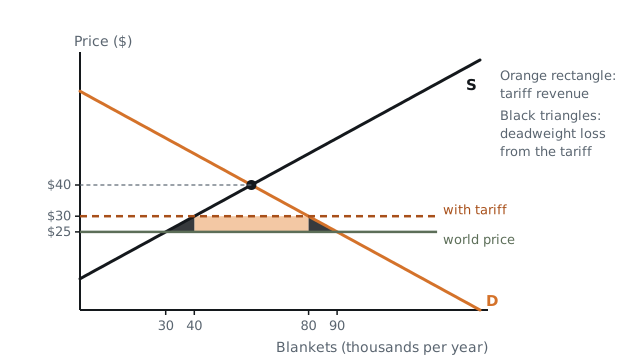
The government collects $5 on each of the 40 thousand imports, which is $200 thousand. Consumer surplus falls by $425 thousand. Producer surplus rises by $175 thousand. Total surplus falls by $50 thousand. The loss is the two deadweight loss triangles on the graph. One triangle is blankets that Ardavian producers make at a higher cost than the world price. The other is blankets that buyers no longer buy.
Part 3 of 3 Quotas
An import quota is a limit on the quantity of a good that may be imported. A quota of 40 thousand blankets has the same effect on price and quantity as the $5 tariff: the price rises to $30 and Ardavians buy 80 thousand. Like the tariff, the quota raises the domestic price and lowers consumer surplus and total surplus compared with free trade.
| Tariff | Quota | |
|---|---|---|
| What it acts on | The price of imports, through a tax | The quantity of imports |
| Effect on domestic price | Rises | Rises |
Trade raises total surplus. Tariffs and quotas raise domestic prices and turn part of that gain into deadweight loss.
Key Terms
Practice Questions
5 questions. Nothing here is recorded or scored.
- Question 1POL-1.B.1
Sugar in Kelvara
Kelvara is a small fictional country that can trade freely at the world price. Without trade, Kelvara's sugar market would clear at $0.80 a pound. The world price of sugar is $0.50 a pound. At $0.50, Kelvarans buy 900 tons a month and domestic farms produce 300 tons.
With free trade at the world price, how much sugar does Kelvara import each month?
- A.300 tons
- B.900 tons
- C.1,200 tons
- D.600 tons
Check answerHide answer
Answer: D
- A.
- Three hundred tons is domestic production. Imports fill the gap between what Kelvarans buy and what they produce.
- B.
- Nine hundred tons is total domestic consumption, part of which domestic farms supply.
- C.
- This adds consumption and production. Imports are the difference.
- D.
- Correct. Imports equal domestic quantity demanded minus domestic quantity supplied at the world price: 900 - 300 = 600 tons.
- Question 2POL-1.B.1
Compared with no trade, how does free trade at $0.50 affect Kelvara's sugar market?
- A.Consumer surplus falls, producer surplus rises, and total surplus rises.
- B.Consumer surplus rises, producer surplus falls, and total surplus rises.
- C.Consumer surplus rises, producer surplus falls, and total surplus falls.
- D.Consumer and producer surplus both rise.
Check answerHide answer
Answer: B
- A.
- That pattern happens when the world price is above the domestic price and the country exports.
- B.
- Correct. The price falls from $0.80 to $0.50. Buyers gain and domestic farms lose, and buyers' gain is larger than farms' loss, so total surplus rises.
- C.
- Opening to trade raises total surplus, because buyers gain more than domestic producers lose.
- D.
- A lower price hurts domestic producers.
- Question 3POL-1.B.2
Kelvara places a tariff of $0.10 a pound on imported sugar. Which of the following will occur?
- A.The domestic price falls to $0.40, and imports rise.
- B.The domestic price rises to $0.80, and imports stop.
- C.The domestic price rises to $0.60, and imports fall.
- D.The domestic price rises to $0.60, and total surplus rises.
Check answerHide answer
Answer: C
- A.
- A tariff is a tax on imports, so it raises the domestic price.
- B.
- A $0.10 tariff raises the price to $0.60, which is still below the no-trade price, so some imports continue.
- C.
- Correct. The tariff raises the price Kelvarans pay to the world price plus the tariff. Domestic farms produce more, buyers buy less, imports shrink, and the government collects $0.10 on each imported pound.
- D.
- The tariff creates deadweight loss, so total surplus falls compared with free trade.
- Question 4POL-1.B.1
A country opens to trade, and the world price of its wheat is above the price that would clear its domestic market without trade. Which of the following is most likely?
- A.The country imports wheat, and domestic consumers gain.
- B.The country exports wheat, and domestic consumers gain.
- C.Neither imports nor exports occur, because the world price is higher.
- D.The country exports wheat, and domestic producers gain.
Check answerHide answer
Answer: D
- A.
- Imports happen when the world price is below the domestic price.
- B.
- Domestic consumers pay the higher world price, so their surplus falls.
- C.
- A gap between domestic supply and demand at the world price is filled by trade, here by exports.
- D.
- Correct. At the higher world price, domestic producers supply more than domestic buyers want, and the extra is exported. The higher price raises producer surplus.
- Question 5POL-1.B.2
A tariff on imported steel raises the domestic price of steel. Which of the following is a deadweight loss from the tariff?
- A.The revenue the government collects from the tariff
- B.The lost surplus on steel that buyers no longer buy
- C.The gain in producer surplus for domestic steel makers
- D.The full amount buyers spend on imported steel
Check answerHide answer
Answer: B
- A.
- Tariff revenue is a transfer from buyers to the government, so it is not lost.
- B.
- Correct. Some buyers who valued steel above the world price stop buying. Their lost surplus goes to no one, which is part of the deadweight loss. The other part is the extra cost of steel produced at home above the world price.
- C.
- Producers' gain is a transfer from buyers.
- D.
- Spending on imports is not a loss of surplus by itself.
Practice every topic in Unit 2
CED Codes
POL-1.B.1 · POL-1.B.2 · POL-1.B.3