3.1 The Production Function
The production function for AP Microeconomics: short run and long run, total, marginal and average product, and diminishing marginal returns.
Part 1 of 3 Inputs and Output
A production function describes how much output a firm gets from different amounts of inputs. Economists separate two time frames.
Hollin Farm is a fictional potato farm that sells into a market with hundreds of farms selling identical potatoes. In the short run, the farm's sorting shed and its one conveyor belt are fixed. The farm changes output by hiring more or fewer workers.
Part 2 of 3 Total, Marginal and Average Product
| Workers | Total product (sacks per hour) | Marginal product | Average product |
|---|---|---|---|
| 0 | 0 | ||
| 1 | 10 | 10 | 10 |
| 2 | 30 | 20 | 15 |
| 3 | 45 | 15 | 15 |
| 4 | 55 | 10 | 13.75 |
| 5 | 60 | 5 | 12 |
| 6 | 62 | 2 | 10.33 |
- Total product is all the output the workers produce together.
- Marginal product is the extra output from one more worker: the change in total product divided by the change in workers.
- Average product is output per worker: total product divided by the number of workers.
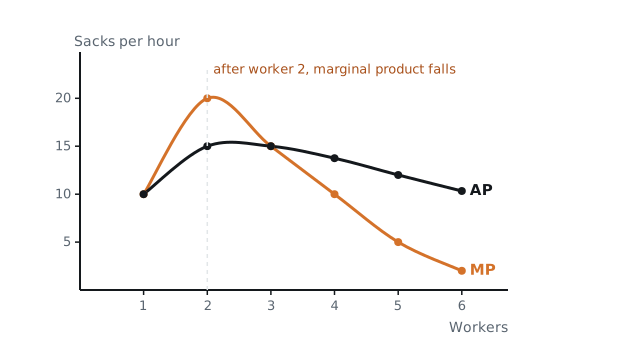
Marginal product and average product change as the farm hires more workers, and so total product changes too. When marginal product is above average product, average product rises. When marginal product is below average product, average product falls.
Part 3 of 3 Diminishing Marginal Returns
The second worker adds 20 sacks, more than the first, because two workers can split the jobs of loading and sorting. From the third worker on, each new worker adds less: 15, 10, 5, then 2 sacks. The shed and the belt stay the same size, so each extra worker has less equipment and space to work with.
Diminishing marginal returns occur when each added unit of one input adds less output than the unit before. The other inputs stay fixed while this happens. Diminishing marginal returns are a short-run idea, because they need a fixed input.
Key Terms
Practice Questions
6 questions. Nothing here is recorded or scored.
- Question 1PRD-1.A.2
Dumpling Kitchen
A dumpling shop has one kitchen with two stoves, which it cannot change this month. The table shows how many dumplings per hour the shop produces with different numbers of cooks.
Cooks | Dumplings per hour 1 | 40 2 | 100 3 | 140 4 | 160 5 | 170 What is the marginal product of the third cook?
- A.140 dumplings
- B.46.7 dumplings
- C.40 dumplings
- D.60 dumplings
Check answerHide answer
Answer: C
- A.
- One hundred forty is total product with three cooks. Marginal product is the change from two cooks to three.
- B.
- This is average product with three cooks, 140 divided by 3.
- C.
- Correct. Marginal product is the change in total product: 140 - 100 = 40 dumplings per hour.
- D.
- Sixty is the marginal product of the second cook, 100 - 40.
- Question 2PRD-1.A.3
Cooks | Dumplings per hour 1 | 40 2 | 100 3 | 140 4 | 160 5 | 170 Diminishing marginal returns begin with which cook?
- A.The third cook
- B.The second cook
- C.The fifth cook
- D.No cook, because total product rises with every cook
Check answerHide answer
Answer: A
- A.
- Correct. Marginal product is 40, 60, 40, 20 and 10. It rises with the second cook and first falls with the third, so diminishing marginal returns begin there.
- B.
- The second cook adds 60 dumplings, more than the first cook's 40, so returns are still increasing.
- C.
- Marginal product is already falling by the third cook. The fifth cook continues the pattern.
- D.
- Total product can rise while marginal product falls. Falling marginal product is what diminishing marginal returns means.
- Question 3PRD-1.A.3
Cooks | Dumplings per hour 1 | 40 2 | 100 3 | 140 4 | 160 5 | 170 Which of the following best explains why the shop experiences diminishing marginal returns?
- A.The shop can change all of its inputs this month.
- B.The stoves are fixed, so each new cook has less to work with.
- C.The later cooks are less skilled than the earlier cooks.
- D.Total product falls after the third cook.
Check answerHide answer
Answer: B
- A.
- If all inputs could change, the shop would be in the long run, where diminishing marginal returns do not apply in this way.
- B.
- Correct. Diminishing marginal returns occur when one input rises while another is held constant. With two stoves, extra cooks crowd the kitchen and add less output.
- C.
- The model assumes identical workers. Falling marginal product comes from the fixed input.
- D.
- Total product keeps rising, from 140 to 170. Only marginal product falls.
- Question 4PRD-1.A.1
Which of the following describes the long run in production?
- A.A period of more than one year
- B.A period in which at least one input is fixed
- C.A period in which output cannot change
- D.A period in which every input can change
Check answerHide answer
Answer: D
- A.
- The long run is defined by whether every input can change. No fixed number of months marks it.
- B.
- This describes the short run.
- C.
- Output can change in both the short run and the long run.
- D.
- Correct. In the long run, no input is fixed. A firm can change its plant size as well as its workers.
- Question 5PRD-1.A.2
When the marginal product of labor is greater than the average product of labor, which of the following is true?
- A.Average product is rising.
- B.Average product is falling.
- C.Total product is falling.
- D.The firm is experiencing diminishing marginal returns for certain.
Check answerHide answer
Answer: A
- A.
- Correct. A worker who adds more than the current average pulls the average up, the same way a high quiz score raises your average.
- B.
- Average product falls when marginal product is below it.
- C.
- Total product falls only if marginal product is negative.
- D.
- Marginal product can be above average and still be rising or falling. The comparison with the average tells you about the average.
- Question 6PRD-1.A.2
A bakery hires a fourth baker, and total output rises from 300 to 330 loaves a day. Average product with three bakers was 100 loaves. What happens to average product?
- A.It rises to 110 loaves, because total output rose.
- B.It falls to 82.5 loaves, because the fourth baker adds only 30 loaves.
- C.It stays at 100 loaves, because each baker is equally skilled.
- D.It falls to 30 loaves, the output of the fourth baker.
Check answerHide answer
Answer: B
- A.
- Average product is total output divided by workers: 330 divided by 4 is 82.5.
- B.
- Correct. Average product with four bakers is 330 divided by 4, or 82.5. The fourth baker's marginal product, 30, is below the old average of 100, so the average falls.
- C.
- Average product depends on total output and workers, and it changed to 82.5.
- D.
- Thirty is the marginal product of the fourth baker. Average product is 82.5.
Practice every topic in Unit 3
CED Codes
PRD-1.A.1 · PRD-1.A.2 · PRD-1.A.3